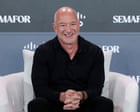
Hollywood’s favorite pastime is clutching its pearls whenever a tech billionaire touches a legacy property.
The moment reports surfaced that Jeff Bezos was "heavily involved" in selecting the next James Bond following Amazon’s $8.5 billion acquisition of MGM, the entertainment press went into predictable meltdown mode. Hand-wringing op-eds immediately framed the news as a hostile takeover of British cinema by an algorithm-obsessed Seattle oligarch. Critics painted a dystopian picture of 007 drinking Prime-branded martinis, selected by a focus-grouped spreadsheet rather than creative instinct.
That consensus is lazy, historically illiterate, and completely backwards.
The purists mourning the death of "pure" Bond curation are defending a romanticized myth that never existed. Worse, they are ignoring the glaring reality that Eon Productions—the Broccoli family stewardship everyone suddenly treats as infallible—had painted the franchise into a creative and commercial corner. If you want James Bond to survive the next two decades without becoming a museum piece, having an obsessive, founder-mode operator like Bezos in the room isn't a bug. It’s the exact shock to the system the franchise needs.
The Myth of the Purist Steward
Let’s dismantle the central delusion driving the backlash: the idea that James Bond casting has historically been an elevated, artistic exercise insulated from cold, hard commercial calculation.
It never was.
Albert "Cubby" Broccoli and Harry Saltzman didn't cast Sean Connery in Dr. No because they were running an arthouse collective. They cast him because Cary Grant wanted too much money and wouldn't commit to a multi-picture deal, and Connery had the raw physical presence they calculated would sell tickets to post-war audiences. When Connery walked, they didn't hold a sacred creative retreat; they cast George Lazenby, a male model with zero acting credits, because he looked the part in a suit and resembled Connery from behind.
Every single Bond transition in history has been a high-stakes commercial gamble dressed up in tuxedo glamour:
- Roger Moore was brought in to pivot the brand toward lighter, self-aware camp to compete with the shifting comedic sensibilities of the 1970s.
- Timothy Dalton was an overcorrection toward Fleming’s literary grit when Moore aged out of believability.
- Pierce Brosnan was hired in the 1990s specifically because his Remington Steele persona offered a safe, globally bankable, handsome-leading-man reset after a six-year legal hiatus nearly killed the studio.
- Daniel Craig—the casting choice fans now hold up as proof of Eon’s genius—was ruthlessly mocked by the exact same media class in 2005 as "James Blond," too short, too rugged, and completely wrong for the role.
Barbara Broccoli and Michael G. Wilson deserve immense credit for the Daniel Craig era. Casino Royale and Skyfall revitalized the character for the post-Bourne generation. Yet by the time No Time to Die limped across the finish line after pandemic delays, inflated budgets, and reported creative clashes—including Danny Boyle walking off the project—the limits of the traditional Eon model were painfully obvious.
A five-to-six-year gap between installments is fatal in modern entertainment. You cannot maintain cultural mindshare with two movies a decade while competing against cinematic universes, prestige television, and interactive media. Eon protected the brand so tightly they nearly suffocated its momentum.
Why Founder-Mode Obsession Beats Studio Committee
When critics hear "Jeff Bezos is involved in casting," they imagine a corporate drone reading A/B test results off a tablet. That is a fundamental misunderstanding of how Bezos actually operates when he cares about a vertical.
Look at how Amazon built The Boys, Fallout, and Reacher. Those weren't sanitized, committee-approved corporate slops. They were sharp, distinct adaptations that understood the core engine of their source material better than traditional Hollywood studios did. Compare that to the catastrophe at Warner Bros. Discovery with DC over the last decade, or Disney’s endless, risk-averse cannibalization of Star Wars. Traditional studio executives are terrified of losing their jobs; their primary KPI is avoiding blame. Consequently, they default to safe, bland consensus picks that offend nobody and excite nobody.
Bezos does not answer to a nervous studio board worried about next quarter’s theatrical slate. He operates on a multi-decade horizon with a well-documented obsession for customer fixation—or, in entertainment terms, audience obsession.
I have sat in enough development rooms and packaging meetings to watch legacy executives blow tens of millions of dollars chasing "prestige" casting that looks brilliant on a trade announcement and dies on opening weekend. Legacy Hollywood casts for peers, awards voters, and agency relationships. A ruthless operator casts for the person buying the ticket.
Think about what a high-conviction founder actually looks for when evaluating an actor to carry an $8.5 billion asset:
- Global Asymmetric Appeal: Not just who plays well in London and Los Angeles, but who commands screens in Mumbai, Seoul, São Paulo, and Mexico City without needing a translator for their charisma.
- Durability and Velocity: An actor who isn't going to treat Bond as an artistic burden after two films, allowing Amazon MGM to actually execute a sustainable release cadence.
- Physical and Psychological Credibility: Someone who can sell the espionage fantasy in an era where audiences are hyper-literate about intelligence, technology, and global power.
Imagine a scenario where the casting decision was left entirely to traditional British theatre instincts versus a room where Bezos demands proof of global screen magnetism. The former gives you a brilliant stage actor who looks miserable doing press tours and wants out by film three. The latter forces the creative team to justify why millions of people around the world will cancel their Friday night plans to watch this specific human being walk across a casino floor.
Answering the Wrong Question About 007
The internet is currently flooded with variations of the same tired questions: Who is going to play James Bond next? Is Aaron Taylor-Johnson too old? Will Bezos ruin Bond by turning it into a streaming spin-off factory?
Everyone is asking who will wear the tuxedo. That is the wrong question entirely.
The actor is the hood ornament. The engine is the tonal architecture of the franchise itself.
If you drop the greatest actor alive into a script that doesn't know what a British spy is supposed to do in the late 2020s, the movie fails. Look at Quantum of Solace or Spectre. Daniel Craig didn't suddenly forget how to act in those films; the franchise lost its narrative compass.
Let’s look brutally at the real anxieties surrounding Amazon’s involvement:
"Will Amazon dilute Bond with cheap streaming spin-offs?"
They already tested the waters with 007: Road to a Million, a reality competition show that barely registered a cultural pulse. That failure actually works in the franchise's favor. It proved early that slapping the 007 logo onto secondary content doesn't automatically print attention. Bezos didn't spend $8.5 billion on MGM just to run a reality show; he bought it for theatrical tentpoles that anchor Prime Video’s global value proposition. You don't protect a crown jewel by turning it into costume jewelry, and nobody understands brand equity preservation better than the guy who turned an online bookstore into global infrastructure.
"Does a tech billionaire understand British cultural nuance?"
He doesn't have to write the dialogue. Being "heavily involved" in a final casting decision is not the same thing as rewriting the third act of a screenplay. In high-stakes franchising, the ultimate check-signer always weighs in on the face of the asset. Bob Iger weighed in on Marvel and Star Wars casting. David Zaslav weighs in on Superman. Pretending Bezos is uniquely overstepping by having an opinion on the single most important hire of an $8.5 billion acquisition is pure industry hypocrisy.
"Won't data-driven casting kill the magic of discovery?"
This is the most persistent fallacy in entertainment. Data doesn't pick an actor; data eliminates blind spots. Legacy casting directors rely heavily on intuition, which is often just a polite word for recency bias and personal social circles. Pairing creative producers who understand screen presence with leadership that understands global audience behavior doesn't kill magic—it prevents multi-hundred-million-dollar unforced errors.
The Real Risk Nobody Is Talking About
To be clear, Bezos having a heavy hand in the Bond reboot is not a guaranteed home run. There is a massive, legitimate downside to founder-level intervention in Hollywood, and pretending otherwise would be dishonest.
Tech founders are addicted to optimization and scale. Cinema thrives on friction, ambiguity, and edge.
James Bond works because he is fundamentally problematic. He is a blunt instrument of a fading empire, a man who solves geopolitical crises with a Walther PPK, tailored suits, and lethal detachment. Every time a studio tries to over-optimize Bond to satisfy every demographic quadrant simultaneously, the character turns into mush. If Bezos’s involvement translates into sanding down Bond’s sharp edges to make him a universally palatable, brand-safe corporate mascot, the franchise will die a slow, profitable death.
There is also the danger of the "smartest guy in the room" trap. Building AWS and revolutionizing logistics does not automatically confer an eye for screen chemistry. If Bezos overrules seasoned creative instincts based on personal preference rather than collaborating with the producers who actually know how to build a shoot, the resulting mismatch between star and director will show up immediately on screen.
How to Actually Reboot a Legacy Franchise
If you are running an intellectual property, a media brand, or a legacy business facing a generational reset, the Bond saga offers a masterclass in what not to do—and what actually works.
First, stop worshipping your own history. The fastest way to kill an iconic brand is to treat it like a fragile antique. Eon spent the last decade treating Bond’s continuity like sacred scripture, culminating in killing off the character at the end of No Time to Die—a melodramatic stunt that forced a total hard reset before they even had a succession plan in place. Respect the core DNA of your product, then ruthlessly discard the baggage.
Second, separate creative execution from commercial accountability. Creative teams need freedom to build texture, style, and tension. Ownership needs to enforce commercial reality: release schedules, global relevance, and audience appetite. When ownership abdicates completely, projects bloat and stall for six years. When ownership micromanages the daily craft, the work becomes sterile. Bezos stepping in on the foundational casting choice and then letting a killer director execute is the exact right division of labor.
Third, cast for the next ten years, not the last five. By the time an actor is the consensus internet favorite for a major role, their window is already closing. If you hire the guy everyone already expects, you are buying at the top of the market. The next Bond shouldn't be a safe validation of online fan-casting; it should be an asymmetric bet on someone who makes the audience lean forward because they aren't entirely sure what he’s going to do next.
Hollywood pundits can keep writing elegies for the old way of doing business, praying that the Broccoli family keeps the gates locked against the barbarians from Seattle. Meanwhile, audiences are starved for a Bond movie that actually feels dangerous, modern, and alive again.
If it takes a ruthless tech billionaire to break a six-year creative deadlock and put a lethal, magnetic new 007 back on the big screen before the decade is half over, hand Jeff Bezos the martini shaker.



