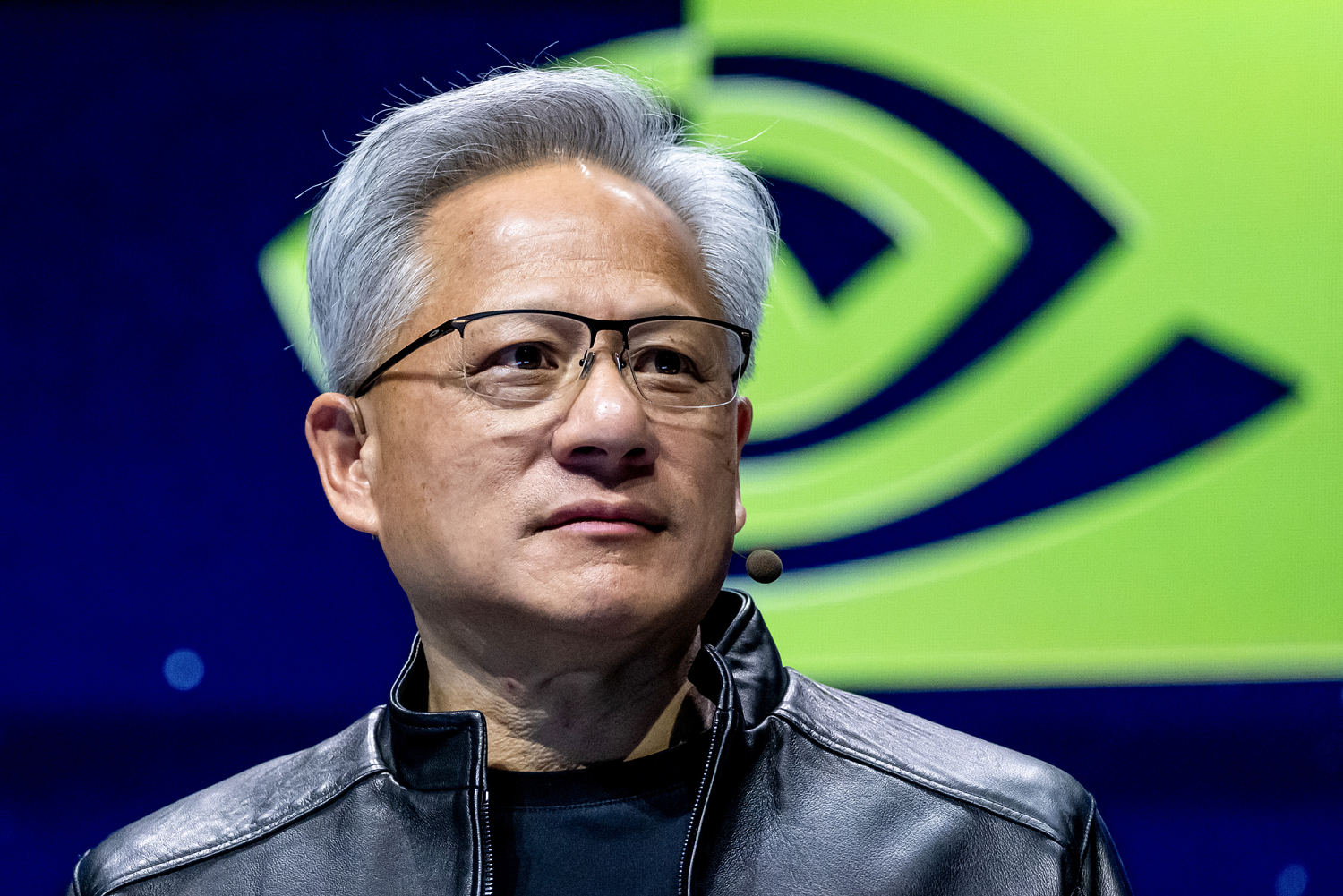
Wall Street analysts love a fairy tale. They need a single protagonist to explain why a three-trillion-dollar ticker symbol goes up or down, which is why the mere whisper of Jensen Huang stepping down from Nvidia triggers immediate panic across financial media.
The lazy consensus is predictable. Pundits frame Nvidia as a fragile empire held together exclusively by one man in a leather jacket. They argue that without Huang’s founder-led intensity, the company’s roadmap would fracture, hyperscalers would revolt, and the entire artificial intelligence boom would stall out.
This is corporate astrology. It confuses the architect with the building, and it completely misunderstands how modern semiconductor monopolies actually function.
I have spent twenty years watching enterprise tech executives blow hundreds of millions of dollars chasing "visionary" founders while ignoring structural realities. The truth is uncomfortable for hero-worshippers: Nvidia’s dominance is no longer sustained by Jensen Huang’s daily management. In fact, his continued presence at the helm is rapidly becoming the single greatest existential threat to the broader AI ecosystem.
To understand why, you have to stop looking at keynote speeches and start looking at silicon physics, compiler lock-in, and the brutal economics of supply chains.
The Myth of the Irreplaceable Founder
Tech journalism suffers from Steve Jobs syndrome. Every time a founder builds a generational company, commentators assume the business will instantly rot the second that founder walks out the door.
They point to Apple in 1985. They ignore Apple in 2011.
When Tim Cook took over from Steve Jobs, the prevailing wisdom was that Apple’s innovation engine would die within twenty-four months. Instead, Cook turned Apple into an operational juggernaut, scaling market capitalization from roughly $350 billion to over $3 trillion by mastering supply chain logistics, custom silicon development, and recurring services revenue.
Nvidia is currently sitting in that exact same transition window, except its structural moat is significantly deeper than Apple’s ever was.
Apple had to convince consumers to buy a new phone every two years. Nvidia has already convinced the largest technology companies on earth—Microsoft, Meta, Alphabet, and Amazon—to build their entire multi-decade compute infrastructure around a proprietary software stack.
CUDA Is the Real CEO
If Jensen Huang vanished tomorrow, not a single line of CUDA code would stop executing.
Compute Unified Device Architecture (CUDA) is Nvidia’s true monopoly. Launched in 2006, it is a parallel computing platform and application programming interface that allows software developers to use a graphics processing unit for general-purpose processing. Over nearly two decades, Nvidia quietly embedded CUDA into university computer science programs, research labs, and enterprise production pipelines.
Here is the reality of the current hardware stack:
- The Hardware Layer: Hopper, Blackwell, and Rubin architectures. These are extraordinary feats of engineering, yes, but competitors like AMD (with its Instinct MI300 series) and custom ASICs (like Google’s TPUs) can match or occasionally beat Nvidia on raw theoretical FLOPS (floating-point operations per second) per dollar.
- The Interconnect Layer: NVLink and InfiniBand. Acquired via the $6.9 billion Mellanox deal in 2020, this networking hardware allows tens of thousands of GPUs to act as a single massive processor without suffering catastrophic latency bottlenecks.
- The Software Layer: CUDA, cuDNN, TensorRT, and thousands of domain-specific libraries.
I have sat in boardrooms where CTOs desperately wanted to migrate away from Nvidia to save 30% on hardware capital expenditures. Every single one of those migrations stalled. Why? Because rewriting millions of lines of heavily optimized PyTorch and C++ code to run cleanly on AMD’s ROCm or custom silicon introduces months of engineering delays, subtle precision bugs, and massive opportunity costs.
You do not need a charismatic founder on stage to enforce a software monopoly. The switching costs enforce themselves. Once an enterprise builds its foundation models on CUDA, leaving is like trying to swap out the foundation of a skyscraper while people are still working on the eightieth floor.
What Everyone Gets Wrong About Post-Huang Nvidia
Whenever the topic of Nvidia succession comes up, investors ask the same flawed questions. They are looking for risk in all the wrong places. Let’s dismantle the most common anxieties circulating on trading floors right now.
"Won't Nvidia's innovation speed collapse without Huang's flat organizational structure?"
Huang famously manages over fifty direct reports, rejecting traditional corporate hierarchy to force rapid information flow. Critics claim removing him will turn Nvidia into a slow, bureaucratic dinosaur like Intel in the 2010s.
This assumes Nvidia’s engineering culture exists solely in Huang’s head. It does not. Leaders like Ian Buck (VP of Hyperscale and HPC, the father of CUDA), Jonah Alben (SVP of GPU Engineering), and Bill Dally (Chief Scientist) are the actual architects executing the annual cadence of chip releases. Furthermore, an ultra-flat organization with sixty direct reports works brilliantly when you are fighting for survival or scaling a $100 billion company. At a $3 trillion valuation with tens of thousands of employees, extreme centralization becomes a bottleneck. A traditional operational executive could actually streamline decision-making across Nvidia's sprawling software and enterprise divisions.
"Will hyperscalers immediately abandon Nvidia if Huang leaves?"
Hyperscalers are already trying to abandon Nvidia! They have been trying for five years.
Amazon has Trainium and Inferentia. Google has TPUs. Microsoft has Maia. Meta has MTIA. Every single cloud giant is pouring billions of dollars into custom silicon because they despise paying Nvidia’s 75%+ gross margins. They are not buying H100s and Blackwell racks out of personal affection for Jensen Huang. They are buying them because if they don't, their competitors will train better models faster, rendering their cloud platforms obsolete. The prisoner's dilemma driving GPU demand has nothing to do with who sits in the CEO chair in Santa Clara.
"Does an exit signal that the AI bubble has peaked?"
Founders leave at the top all the time, and it rarely signals the end of the underlying technology. Jeff Bezos stepped down as Amazon CEO in 2021; cloud computing and e-commerce did not suddenly evaporate. Bill Gates transitioned out of day-to-day operations at Microsoft in 2000; enterprise software continued to conquer the globe. If Huang steps back, it simply means the existential risk phase of Nvidia’s journey is over. The company has transitioned from an insurgent disruptor into an entrenched utility.
How Huang’s Departure Would Unclog the AI Ecosystem
Here is the counter-intuitive truth that Wall Street refuses to print: Jensen Huang is too good at his job, and his ruthless execution is actively suffocating the broader AI market.
Under Huang’s leadership, Nvidia has shifted from being a component supplier to a full-stack competitor against its own largest customers. Through DGX Cloud, Nvidia is renting out AI supercomputers directly to enterprises—competing head-to-head with AWS, Microsoft Azure, and Google Cloud, the very companies buying 40% to 50% of Nvidia’s chips.
Simultaneously, Huang has accelerated Nvidia’s architecture release cycle from two years to one year. Moving from Hopper to Blackwell to Rubin in rapid succession forces customers into a brutal capital expenditure treadmill. If you spend $2 billion building a data center cluster today, Nvidia announces a chip twelve months later that makes your brand-new hardware look like a calculator.
This relentless compression creates three massive distortions across the technology sector:
- Capital Starvation for Software Startups: Venture capital and enterprise IT budgets are finite. Because Nvidia captures the vast majority of the economic value in the AI stack through hardware margins, application-layer startups are starving for oxygen. The infrastructure layer is eating the entire pie before the software layer can even build a sustainable business model.
- Artificial Scarcity and Supply Chain Distortion: Huang’s aggressive allocation strategies and ecosystem investments (like funding CoreWeave and other specialized neoclouds) keep demand perpetually overheated, preventing the market from finding natural price equilibrium.
- Regulatory Crosshairs: A founder-led monopoly that aggressively bullies partners and captures 80% to 90% of the AI accelerator market is an irresistible target for the Department of Justice and European antitrust regulators.
Imagine a scenario where Huang steps aside and hands the reins to an operational pragmatist.
The cadence of chip releases would likely stabilize to a predictable eighteen-to-twenty-four-month cycle, giving data center operators breathing room to actually amortize their hardware investments. Nvidia would likely dial back its direct competition with cloud service providers, repairing strained relationships with Microsoft and Amazon. Gross margins might compress slightly from a stratospheric 75% down to a still-obscene 65%, allowing hardware competitors like AMD and Broadcom to capture a healthy 20% to 25% market share.
That scenario is a nightmare for short-term momentum traders, and an absolute dream for everyone else building artificial intelligence. Healthy ecosystems require competition, predictable capital cycles, and room for the application layer to generate real return on investment.
The Real Threat Nobody Is Talking About
Of course, arguing that Nvidia would survive—and that the industry would benefit—from Huang’s exit does not mean the transition would be painless. Ignoring the real risks is just as foolish as inventing fake ones.
The genuine danger of a post-Huang Nvidia is not technological collapse. It is strategic drift.
Semiconductor companies operate on five-year R&D horizons. The chips shipping in 2026 were conceived in 2021. Huang’s greatest superpower has never been engineering; it has been his willingness to bet the entire company on markets that did not yet exist. He bet on programmable shaders in 1999. He bet on CUDA in 2006 when Wall Street punished Nvidia’s stock for years over wasted R&D expenses. He bet on deep learning in 2012 after seeing AlexNet run on two GTX 580s.
A professional, non-founder CEO brought in to optimize margins and appease institutional investors will almost never make a decade-long bet that depresses quarterly earnings. They will milk the CUDA cash cow, buy back stock, acquire mid-sized software companies, and slowly lose the instinct for paradigm shifts.
If physical AI, humanoid robotics, or biological simulation turns out to be the next trillion-dollar compute wave after large language models, a caretaker CEO might miss the turn while busy optimizing data center margins. That is the exact trap Intel fell into after Andy Grove stepped down, and it took twenty years for the rot to fully show up on the balance sheet.
How to Play the Succession Trade Without Losing Your Shirt
If you are an executive, investor, or builder trying to navigate a world where Nvidia transitions out of its founder era, stop trading headlines and start positioning around structural realities.
For Enterprise CTOs and Engineering Leaders
Stop waiting for a magical hardware savior to break Nvidia’s pricing power, and stop burning engineering cycles trying to rewrite your entire codebase for alternative silicon just to save a few percentage points on compute.
- Abstract your orchestration layer now. Use open-source frameworks like vLLM, Ray, or Triton Inference Server to decouple your model weights from the underlying hardware execution.
- Focus on inference optimization, not training hardware. Training is a concentrated, capital-intensive battleground where Nvidia will remain king for years. Inference is fragmented, latency-sensitive, and price-elastic. That is where custom ASICs, Groq-style LPUs, and quantized open-weights models will actually eat into Nvidia’s dominance, regardless of who runs the company.
For Tech Investors
If rumors of Huang’s retirement ever trigger a 15% to 20% sell-off in Nvidia stock, recognize it for what it is: a massive mispricing of software lock-in by emotional retail traders and short-term algorithms.
- Look at the ecosystem beneficiaries. A slightly less aggressive, post-Huang Nvidia opens up massive upside for custom silicon designers like Broadcom and Marvell, as well as networking infrastructure players like Arista Networks.
- Watch the R&D-to-revenue ratio. The day a new Nvidia CEO cuts R&D spending to juice earnings per share is the exact day you should sell the stock. Until then, the machine runs itself.
For AI Founders
Quit building thin wrappers around foundation models that rely on cheap compute to survive. Build proprietary data loops and deep workflow integrations. Whether Jensen Huang wears a leather jacket on stage next year or retires to a beach in Taiwan, compute costs will eventually commoditize, and only companies that own the customer relationship will survive.
The tech industry loves worshipping gods, right up until the moment those gods become bottlenecks. Nvidia does not need Jensen Huang to survive, and the AI revolution desperately needs him to step back so the rest of the ecosystem can finally breathe.