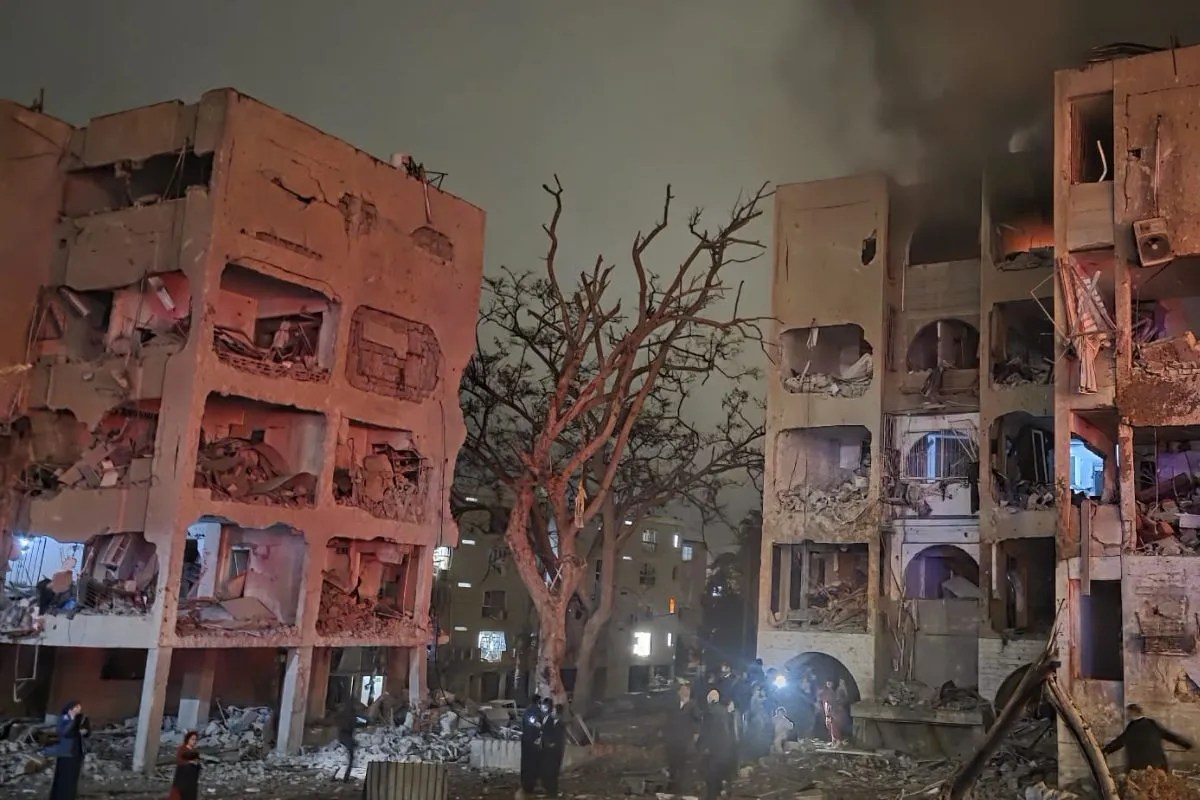
The failure of an integrated air defense system (IADS) is rarely a result of technological inferiority; it is a mathematical certainty when the arrival rate of incoming threats exceeds the interceptor launch rate or the sensor tracking capacity. Reports of injuries in the Dimona and Arad regions, following Iranian kinetic operations against Israel, suggest a breach in the layered defense architecture. Analyzing this event requires moving past surface-level reporting of "missile strikes" toward an understanding of Saturation Theory and the Cost-Exchange Ratio of modern aerial warfare.
The Tri-Layer Deficit and Probability of Leakage
Israel’s defense is predicated on a tiered response: Arrow-3 for exo-atmospheric intercepts, David’s Sling for medium-range ballistic threats, and Iron Dome for short-range rockets and cruise missiles. In any high-intensity engagement, the system functions through a series of probability gates. If a single battery has a 90% kill probability ($P_k$), and 100 projectiles are fired, 10 will theoretically bypass that layer. For a different view, read: this related article.
When Iranian forces coordinated a multi-vector launch involving UAVs, cruise missiles, and medium-range ballistic missiles (MRBMs), they forced the Israeli IADS to manage different "time-of-flight" windows. This tactic, known as Temporal Saturation, ensures that sensors are occupied with low-speed targets (drones) while high-velocity threats (MRBMs) enter the terminal phase. The reported damage near sensitive sites like Dimona indicates that the defense perimeter faced a "leaker" problem—where the sheer volume of targets forced the system to prioritize assets, potentially allowing lower-priority or high-clutter targets to impact near civilian or secondary military infrastructure.
The Mechanics of Interceptor Exhaustion
A critical bottleneck in defense operations is the Magazine Depth. Every interceptor fired from an Iron Dome or Arrow battery represents a finite resource that cannot be instantly replenished during a raid. Iran’s strategy relies on the asymmetric cost of engagement: Similar insight on the subject has been shared by Associated Press.
- Manufacturing Delta: A Shahed-type loitering munition may cost $20,000 to $50,000, whereas a Tamir interceptor costs roughly $40,000 to $50,000. When scaling to the Arrow-3, each interceptor costs approximately $2 million to $3.5 million.
- Tracking Thresholds: Radar systems have a maximum number of concurrent tracks they can maintain. Beyond this limit, the system experiences "sensor ghosting" or prioritization lag.
- Kinetic Overlap: By launching from multiple geographic locations, the attacker forces the defender to spread their radar aperture, reducing the dwell time on any single incoming object.
The injuries in Arad and the proximity to Dimona suggest a specific focus on the Negev desert's strategic corridor. If the air defense "failed," it likely did so because the Fire Control Centers (FCCs) were forced to make sub-second decisions on which targets posed a lethal threat to hardened structures versus those falling in open areas. The human cost—over 100 injured—stems from the fragmentation of intercepted debris and the psychological shock of impacts in areas previously considered "iron-clad."
Structural Vulnerabilities in Geopolitical Signal-Firing
Military analysts distinguish between "damage-optimized strikes" and "saturation-optimized strikes." Iran's movement toward Dimona—a site of extreme strategic sensitivity—signals a shift from symbolic posturing to a demonstration of kinetic reach. The logic here is not necessarily to destroy a hardened facility, which would require bunker-busting capabilities and a direct hit, but to prove that the Circular Error Probable (CEP) of Iranian missiles has tightened enough to threaten high-value targets despite a sophisticated defense.
The "failure" reported in initial accounts is often a misunderstanding of Operational Availability. If a battery is reloading or undergoing maintenance, a gap in the "dome" appears. Iranian intelligence likely timed the launches to coincide with perceived gaps in regional sensor coverage or to overwhelm the specific data-link frequencies used by the IDF.
The Economic Attrition of Long-Term Defense
The sustainability of Israel’s defense posture depends on the US-funded interceptor pipeline. From a strategic consulting perspective, the "victory" in such an exchange is not measured by whose missile hit which building, but by the Depletion Rate.
- Stockpile Erosion: If Iran can force Israel to expend 20% of its national interceptor stockpile in a single 48-hour window, the strategic advantage shifts to the attacker for the subsequent month.
- Civilian Displacement: The physical injuries in Dimona and Arad create a secondary economic burden through healthcare strain and the cessation of local industrial activity.
- Infrastructure Stress: Continuous high-alert status degrades the hardware life of radar components and exhausts the human operators in the Command and Control (C2) cells.
The intelligence failure leading to the impact near Arad may also involve Electronic Countermeasures (ECM). If Iranian missiles were equipped with even rudimentary jamming or chaff dispensers, the $P_k$ of Israeli interceptors would drop significantly, necessitating the launch of two or three interceptors per incoming threat to ensure destruction. This creates a 3:1 exhaustion ratio that is financially and logistically unsustainable over a protracted conflict.
Re-evaluating Regional Security Baselines
The breach of the Negev’s airspace forces a recalibration of the "invincibility" narrative surrounding the Iron Dome and its sister systems. The primary takeaway for strategic planners is that Mass Beats Precision. No matter how advanced the interceptor is, a sufficiently large "swarm" of mixed-velocity munitions will produce hits.
Future escalations will likely see an increase in Hypersonic Claims or the use of Decoy-Heavy Payloads. If the attacker can populate the defender's radar screen with 500 "false" targets that mimic the heat signature of a real missile, the IADS will bankrupt itself or lock up entirely. The events in Dimona are a proof-of-concept for this mass-attrition strategy.
The strategic play for regional actors now moves toward Hardened Redundancy. Relying on active interception (shooting things down) must be balanced with passive defense (reinforced concrete, underground facilities, and distributed command nodes). For Israel, the next phase involves not just buying more interceptors, but upgrading the AI-driven prioritization engines to ensure that "leakers" are stopped before they reach population centers like Arad.
The immediate tactical requirement is a shift toward Directed Energy Weapons (DEW), such as the Iron Beam laser system. Unlike kinetic interceptors, a laser-based defense offers a near-zero cost-per-shot and an infinite "magazine," provided the power supply remains intact. Until DEW is fully integrated, the math of the Middle East will continue to favor the side that can produce the cheapest mass of projectiles to overwhelm the most expensive wall of defense.