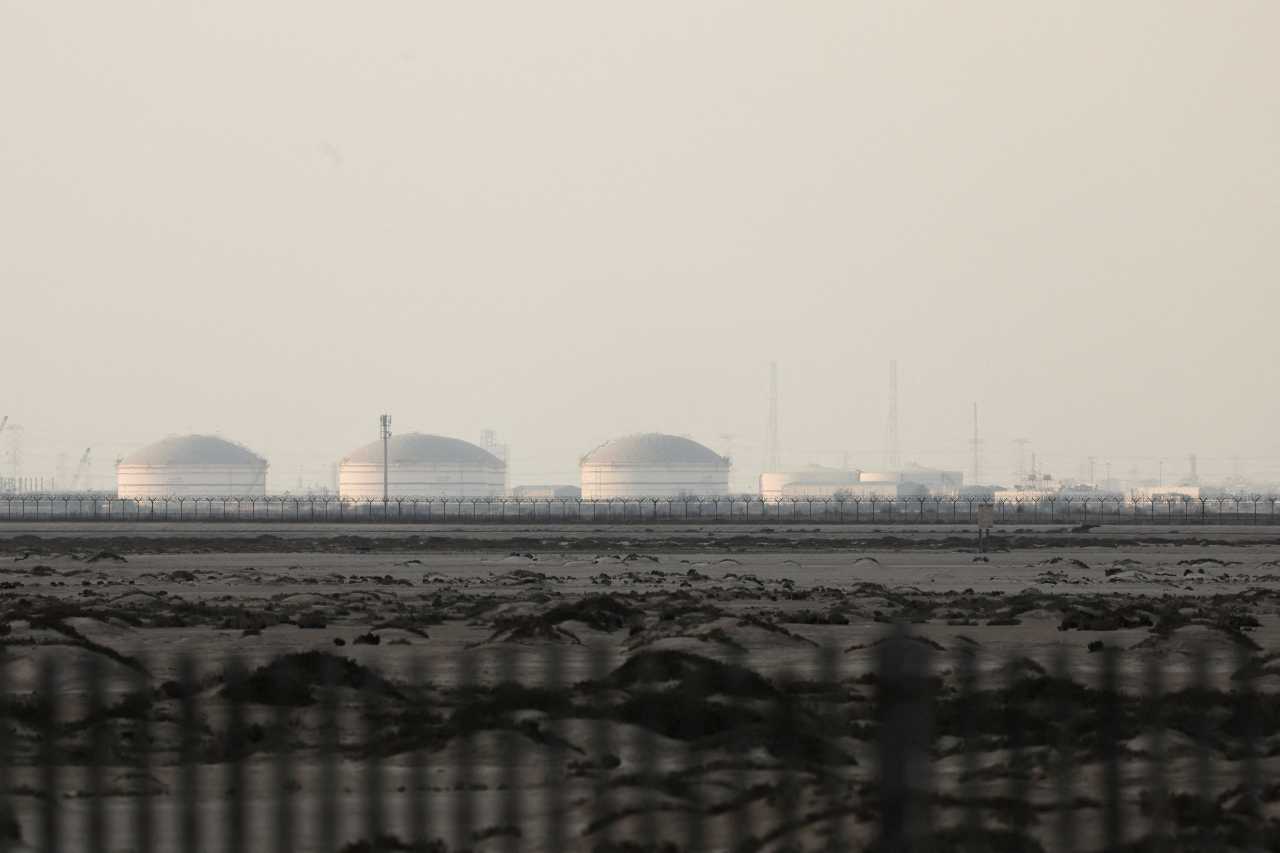
The targeted kinetic interference with Qatari Liquified Natural Gas (LNG) infrastructure marks a fundamental shift from asymmetric gray-zone friction to a direct assault on the global energy architecture. Qatar’s expulsion of Iranian security and military attaches is not a diplomatic formality; it is a defensive decoupling necessitated by a breach of the unwritten maritime security pact that has historically governed the Persian Gulf’s shared gas reserves. When a state actor targets a hub of this systemic importance, the primary concern is not just the immediate fire or structural damage, but the permanent recalibration of the "Risk Premium" applied to 20% of the world’s LNG supply.
The Architecture of Vulnerability: Why the North Field is the Global Single Point of Failure
The North Field/South Pars complex is the world’s largest non-associated natural gas field. Its geography creates a paradoxical dependency: while Qatar and Iran share the reservoir, their extraction philosophies and geopolitical alignments are diametrically opposed. The reported attack on a Qatari LNG hub targets the specific point of "liquefaction density." Unlike oil, which can be rerouted through various pipelines or trucked in emergencies, LNG requires massive, stationary, and highly complex cooling trains to convert gas to liquid at $-162$°C.
The mechanics of this disruption follow a three-tier failure cascade:
- Thermal Shock and Cryogenic Integrity: An attack on a liquefaction train does not just cause an explosion; it compromises the specialized metallurgical integrity of the cooling units. Repairing these systems requires bespoke components with lead times exceeding 18 months, effectively removing millions of tonnes per annum (mtpa) from the global balance sheet instantly.
- Maritime Bottlenecking: The Strait of Hormuz serves as the only exit for Qatari vessels. By provoking a security crisis that leads to the expulsion of attaches, the "Safe Passage" protocols are voided. Insurers move from standard hull and machinery coverage to "War Risk" premiums, which can increase the cost of a single voyage by $200,000 to $500,000.
- The Contractual Domino Effect: Most Qatari LNG is tied to long-term Sales and Purchase Agreements (SPAs). A force majeure event at the hub triggers "take-or-pay" disputes and forces Asian and European utilities to scramble for spot-market cargoes, driving a vertical price spike in the JKM (Japan-Korea Marker) and TTF (Title Transfer Facility) indices.
The Diplomatic Decoupling: Quantifying the Intelligence Breach
Qatar’s decision to remove Iranian military attaches signals a high-confidence attribution of "Inside-Out" sabotage. In high-security energy zones, attaches often serve as the liaison for joint-field management. Their expulsion suggests that the intelligence used to facilitate the attack was gathered through these official channels.
This move dismantles the "Dual-Track" strategy Qatar has maintained for decades—acting as a mediator for Iran while remaining a primary host for U.S. Central Command (CENTCOM) at Al-Udeid Air Base. The friction coefficient between these two roles has reached its limit. From a strategic consulting perspective, this is a transition from a "Hedging Strategy" to a "Hard Alignment."
The Cost Function of Sabotage in the Energy Transition
The global energy transition has made natural gas the "bridge fuel," meaning any disruption in Qatari supply is an attack on the stability of the European power grid and Asian industrial baseload. The impact of the Tehran-attributed strike can be measured through a specific cost function:
$$C_{total} = (P_{spot} - P_{contract}) \times V_{disrupted} + I_{premium} + S_{cap}$$
Where:
- $P_{spot}$ is the current market price.
- $P_{contract}$ is the indexed price Qatar usually provides.
- $V_{disrupted}$ is the volume lost during the downtime.
- $I_{premium}$ represents the spike in maritime insurance.
- $S_{cap}$ is the capital expenditure required for hardened security and infrastructure repair.
This equation demonstrates that the "actual" cost of the attack is several orders of magnitude higher than the physical damage to the pipes. The volatility introduced into the market forces high-volume importers like Germany and Japan to reconsider their "Just-in-Time" energy procurement models, shifting instead to "Just-in-Case" stockpiling, which permanently ties up billions in liquid capital.
Technical Analysis of the Threat Vector
Military attaches typically possess deep knowledge of "critical node mapping." If the Iranian attaches were involved, the attack likely focused on:
- SCADA System Penetration: Modern LNG hubs rely on Supervisory Control and Data Acquisition systems. A kinetic attack paired with a cyber-intrusion can prevent emergency shut-off valves from activating, turning a localized fire into a catastrophic site loss.
- Logistics Interdiction: Targeting the loading berths rather than the storage tanks. A damaged berth prevents the docking of Q-Max and Q-Flex vessels, the largest LNG carriers in the world. Since these ships are specialized, any damage to the docking interface renders the entire hub's output inaccessible, even if the gas is successfully liquefied.
The expulsion of military personnel is a counter-intelligence "flush." It removes the eyes on the ground, but it also removes the backchannel communication that prevents accidental escalation. We are now in a "Blind Friction" environment where miscalculation is the highest risk factor.
The Strategic Realignment of the GCC
The Gulf Cooperation Council (GCC) has spent the last three years attempting a "de-escalation cycle" with Iran. This attack shatters that trajectory. For Saudi Arabia and the UAE, the Qatari situation is a proof-of-concept for their own vulnerabilities.
We are seeing the emergence of a "Hardened Energy Corridor" policy. This involves:
- Redundancy at Scale: Accelerating projects like the North Field East expansion to ensure that a hit on one hub does not paralyze the entire export capacity.
- Autonomous Security Layers: Integration of AI-driven maritime surveillance and automated counter-drone swarms around the liquefaction trains.
- The End of the Neutrality Premium: Qatar can no longer market itself as the "Switzerland of the Middle East" if its primary economic asset is being targeted by its neighbor.
The Operational Playbook for Energy Stakeholders
The immediate strategic requirement for global energy firms and state actors is a pivot to "Resilience Engineering."
- Diversification of Liquefaction Geography: There will be a renewed rush for U.S. Gulf Coast and East African LNG projects. Even if they are more expensive per unit, they offer a "Geopolitical Alpha"—a return on investment measured in security of supply rather than just margin.
- Arbitrage as a Defense: Global majors (Shell, Exxon, TotalEnergies) must utilize their "portfolio" flexibility to swap cargoes. If a Qatari cargo destined for Europe is lost, a U.S. cargo originally slated for Asia must be diverted, necessitating a complex web of "backfill" agreements.
- The Intelligence-Infrastructure Link: Private security for energy hubs must now incorporate "State-Actor Defense" protocols. Standard industrial security is insufficient against the specialized sabotage techniques used in this instance.
The expulsion of the attaches is the final warning shot in the "Energy Cold War." The focus moves now to whether Iran will respond to the diplomatic snub with further kinetic escalations in the maritime lanes. If the Strait of Hormuz becomes a "contested zone" for energy transport, the global economy faces a supply-side shock equivalent to the 1973 oil crisis, but with the added complexity of modern, highly-integrated power grids that cannot simply switch back to coal or oil overnight.
The era of "Quiet Gas" is over. Every cubic meter of LNG now carries a geopolitical weight that must be factored into every sovereign balance sheet and corporate strategy moving forward.