The air at the corner of Liberty and Greenwich Streets carries a specific weight. It is not just the humidity of a New York morning or the exhaust of the idling taxis. It is the weight of absence. Here, the ground does not simply hold up buildings; it holds memories that are still, decades later, jagged and raw.
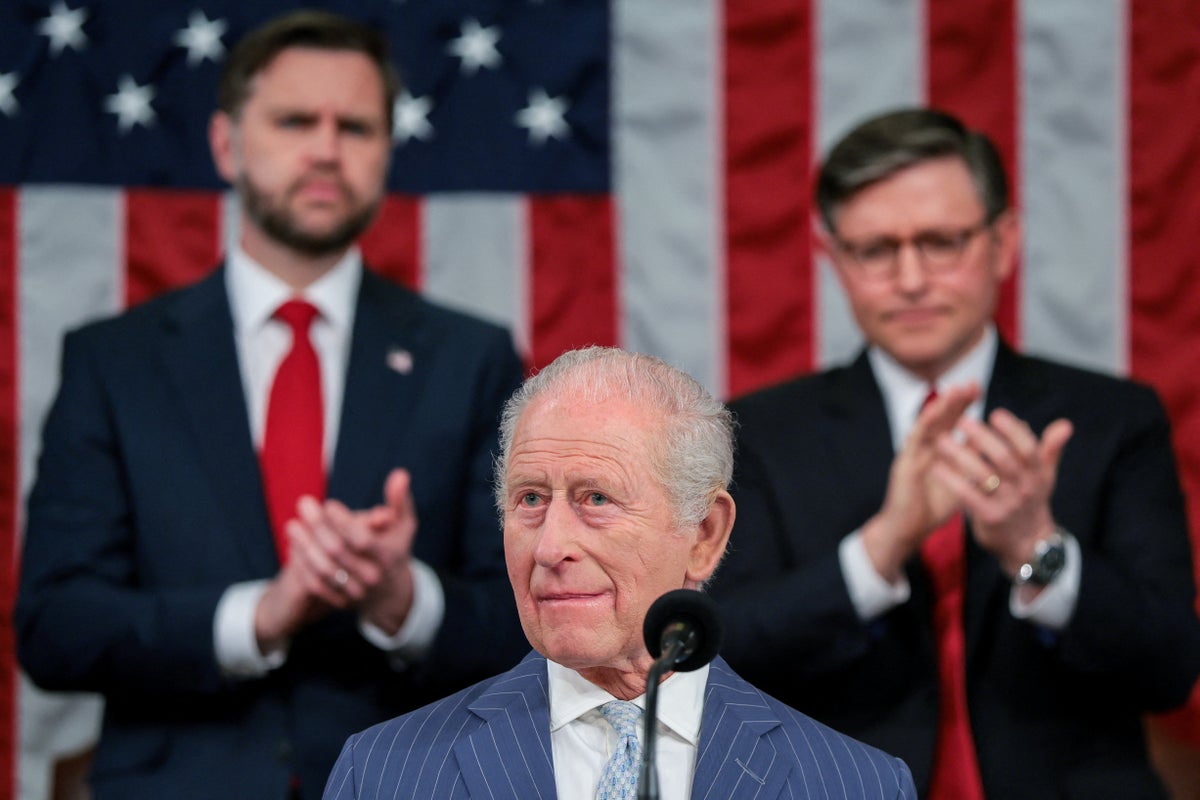
When the motorcade pulls up, there is a momentary hush that cuts through the city’s perpetual roar. A door opens. A man steps out. To the world, he is a sovereign, the physical manifestation of a thousand years of British history. But as King Charles III stands before the North Pool, his shoulders possess a slight, human stoop. Beside him, Queen Camilla adjusts her coat against a breeze that feels far colder than the thermometer suggests.
They are not here for a photo opportunity. They are here because some griefs are so vast they require the presence of those who understand the heavy, often lonely burden of duty.
The Braille of Loss
There is a particular way people interact with the 9/11 Memorial. They don't just look. They touch. They run their fingers over the bronze parapets, tracing the names of the 2,983 victims. It is a form of communal Braille.
As the King moves along the edge of the void, he sees more than just names. He sees the British citizens among them—sixty-seven souls who left for work on a bright Tuesday in September and never came home. For Charles, this isn't abstract. He represents a nation that felt the shockwaves of that day across the Atlantic, a country that saw its own sons and daughters vanished in a cloud of grey dust.
The water falls. It doesn’t splash so much as disappear into the center of the earth. It is a relentless, cascading curtain of white noise that drowns out the chatter of the sidewalk. Standing there, the King is just another man confronted by the scale of the unthinkable. He knows about the long game of history, but history is made of individuals. It is made of the father who liked his tea too strong and the daughter who had just moved to the Big Apple with a suitcase full of dreams.
A Different Kind of Crown
We often think of royalty as something gold and distant. We see the pageantry, the crowns resting on velvet cushions, and the stiff-upper-lip resolve. But the true function of a modern monarch is to be a professional mourner.
It is a strange, taxing job.
Consider the stamina required to look into the eyes of a grieving mother and offer a comfort that doesn't feel like a platitude. Charles has spent seventy years practicing this. He has mastered the art of the meaningful silence. In New York, far from the gothic arches of Westminster, that silence is his greatest gift.
Camilla walks a half-step behind, her presence a quiet anchor. She is often the one who catches the smaller details—the way a family member’s hand trembles as they present a flower, or the specific glint of a badge on a first responder’s uniform. Together, they form a bridge between two nations that have spent the last quarter-century learning how to heal without forgetting.
The stakes are invisible but massive. In a world that feels increasingly fractured, where alliances are questioned and borders are hardened, this visit is a reminder of the "Special Relationship" in its most skeletal, honest form. It isn’t about trade deals or military strategy. It’s about the fact that when one of us bleeds, the other feels the sting.
The Garden of the Unforgotten
The King’s journey takes him from the roar of the waterfall to the relative peace of the British Memorial Garden in Hanover Square. If the 9/11 Memorial is a monument to what was lost, this garden is a testament to what persists.
It is a small pocket of London tucked into the grid of Manhattan. The bollards are shaped like the tops of the pillars in the House of Commons. The stones are Portland stone, the same material used to build St. Paul’s Cathedral. It smells of damp earth and boxwood.
Here, the King meets with the families. This is where the narrative shifts from the global to the granular.
One might assume these meetings are formal, dictated by rigid protocol. In reality, they are often surprisingly messy and emotional. There are hugs that last a second too long. There are stories shared about mischievous brothers and stubborn fathers. Charles listens. He doesn't check his watch. He doesn't look for the cameras. He stands in the dirt of the garden and lets the stories wash over him.
He is a man who loves gardens. He understands that growth requires patience and that the most beautiful things often rise from the most broken soil. By placing a wreath here, he isn't just performing a ritual; he is tending to a relationship that was forged in fire.
The Geometry of Grief
Why does it matter that a King visits a hole in the ground three thousand miles from his palace?
Because symbols are the only tools we have to measure things that are immeasurable. You cannot put a ruler against heartbreak. You cannot weigh the impact of a lost generation of leaders, artists, and parents. But you can mark the spot. You can show up.
The geometry of the memorial is deliberate. The squares are perfect. The lines are sharp. It is an attempt to impose order on a day that was defined by chaos. For a monarch—the ultimate symbol of order and continuity—standing in this space is an act of defiance. It says that even when the towers fall, the values they stood for remain upright.
The King's hands, weathered and familiar to the public eye, place the wreath with a precision that comes from decades of practice. But the look in his eyes is not practiced. It is the look of a man who knows that he, too, is a leaf on a very large, very old tree. He knows that his time is finite, but the office he holds is a relay race. He is carrying the torch of memory for those who can no longer hold it.
Beyond the Bronze
As the afternoon light begins to stretch across the plaza, reflecting off the glass of the One World Trade Center, the royal party prepares to depart. The crowds have thinned. The tourists are beginning to head toward Broadway or the subway.
The impact of such a visit doesn't vanish when the motorcade rounds the corner. It lingers in the minds of the survivors who felt, for a moment, that their private pain was recognized by the highest level of human authority. It lives in the "Survivor Tree," a callery pear tree that was pulled from the rubble, charred and broken, only to bloom again.
Charles spent a moment at that tree. He touched its bark, which is gnarled and scarred, much like the city itself.
We live in an age of digital noise, where news cycles are measured in minutes and empathy is often reduced to a heart icon on a screen. A royal visit is an analog response to a digital world. It is slow. It is expensive. It is deeply inconvenient. And that is exactly why it is necessary. It is a physical manifestation of "I see you."
The King and Queen leave behind a trail of white flowers and a sense of stilled time. They leave behind the North Pool, where the water continues its eternal descent, naming the names into the dark.
New York returns to its frenetic pace. The taxis honk. The jackhammers resume their rhythmic assault on the pavement. But for those few hours, the city and the Crown shared a single heartbeat. In the shadow of the towers that aren't there, a man who wears a crown of gold stood in solidarity with those who wear a crown of sorrows, proving that the most powerful thing a King can do is simply stand still and remember.
The names on the bronze remain cool to the touch, but for today, they feel a little less like ghosts.