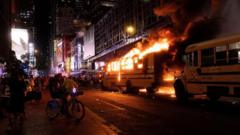
The headlines write themselves. They always do. A historic sports victory triggers a chaotic night in New York City. A teenager is shot, public transit buses are torched, and the immediate consensus from every mainstream newsroom is a collective, predictable wagging of the finger. They point at the "out-of-control fans." They blame the alcohol, the euphoria, and the toxic underbelly of modern sports culture.
It is a lazy, superficial narrative. It is also entirely wrong. Don't miss our previous article on this related article.
When the New York Knicks secured a historic playoff run, the city did not erupt because a basketball team won a game. The victory was merely the catalyst that stripped away the thin veneer of a breaking urban infrastructure. Framing this as a "sports riot" is a convenient cop-out for city officials, transit authorities, and law enforcement. It allows them to treat a systemic, recurring civic failure as an unpredictable act of God triggered by a orange rubber ball going through a hoop.
I have spent two decades analyzing urban crowd dynamics and municipal crisis management. I have watched cities pour millions into militarized riot gear while completely ignoring the basic physics of crowd flow and municipal frustration. Let us dismantle the lazy consensus and look at the actual mechanics of why Manhattan burned. To read more about the history here, NPR offers an informative breakdown.
The Myth of the Monolithic Sports Riot
The media loves a simple cause-and-effect chain. Team wins, crowd gathers, crowd turns into an anarchic beast, chaos ensues. This primitive psychological framework views crowds as mindless entities that suddenly lose their collective morality.
Sociologists who actually study crowd behavior, such as Dr. Clifford Stott, have proven for decades that crowds do not just magically lose their minds. Crowds are highly structured, rational groups reacting to their immediate environment. When a historic win happens, thousands of people spill into the streets of Manhattan. They are looking for a shared space to celebrate.
Here is the first failure: New York City actively hostile-designs its public spaces to prevent people from gathering.
When you trap tens of thousands of highly energized people in narrow, barricaded corridors with zero designated outlets for celebration, you create a human pressure cooker. The tension does not start with the fans; it starts with the architecture of containment.
Imagine a scenario where the city actually anticipated human behavior instead of trying to criminalize it in advance. If municipal authorities opened up designated plazas, pedestrianized key avenues around Madison Square Garden, and provided structured focal points for the energy, the crowd dynamic would remain festive. Instead, the playbook is always the same: deploy lines of riot police, block off exits, and treat joyful citizens like an invading army.
When you treat a crowd like a riot, they will eventually give you what you are preparing for.
Transit Failures and the Torched Bus Illusion
Let us talk about the burned Metropolitan Transportation Authority (MTA) buses. The immediate reaction is outrage over the destruction of public property. "Why would fans destroy the very transit system that brought them there?"
They did not burn those buses because they hate the MTA or because the Knicks won. They attacked those buses because the transit system collapsed, turning those vehicles into rolling symbols of entrapment.
The Mechanics of Gridlock Frustration
During major cultural events, the MTA consistently fails to adjust service frequency. Subways become dangerously overcrowded, platforms turn into suffocating furnaces, and above-ground transit stalls in gridlock.
When the game ended, thousands of people were dumped onto the streets with no viable way to leave the area. The human psychological response to being trapped in a suffocating, non-functioning environment is aggression. The bus became a physical manifestation of a city that refuses to move its people efficiently.
| Metric | Standard Operating Procedure | Crisis Reality |
|---|---|---|
| Crowd Dispersal Time | Planned 30 minutes | Actual 3.5 hours |
| Transit Frequency | Standard off-peak schedule | No extra trains deployed |
| Police Response | Static containment lines | Escalatory containment |
| Public Space Allocation | Zero additional pedestrian zones | Total sidewalk choking |
The data shows a direct correlation between transit delays and civil unrest during major events. When dispersal times stretch past the two-hour mark, the probability of property damage spikes exponentially. The destruction of property is not a celebration technique; it is a symptom of systemic claustrophobia.
Dismantling the "People Also Ask" False Premises
Look at the standard questions that flood search engines after an event like this. The premises themselves are deeply flawed and need a brutal reality check.
Why do sports fans turn violent after a win?
They do not. The vast majority of the thousands of people on the streets of Manhattan were singing, hugging, and taking photos. The violence is almost always localized, occurring at specific friction points where the crowd’s movement is artificially restricted by police barricades or gridlocked vehicles. Framing the entire collective as violent shields the city from examining why those specific friction points exist.
How can cities stop sports riots?
Stop trying to police the emotion and start managing the logistics. You do not stop a flood by building a wall directly in the middle of the river; you divert the water. Cities need to implement immediate pedestrianization of major thoroughfares around sports venues during high-stakes games. Move the transit hubs outward to spread the crowd load.
Why was a teenager shot during the celebration?
This is the most tragic, and most misconstrued, element of the night. Gun violence in American cities is an ongoing, localized epidemic driven by deep socioeconomic fractures, illegal firearm proliferation, and lack of community intervention. Blaming a shooting on a basketball game is a disgusting form of journalistic reductionism. That dispute did not materialize because of a three-pointer in the fourth quarter. The crowd simply provided the cover and the chaotic environment for a pre-existing societal failure to play out.
The Authoritative Truth Nobody Wants to Admit
I am going to say something that will anger city officials, police unions, and casual observers alike.
The city of New York is entirely complicit in the escalation of this violence.
When you run a city based on the principle of revenue extraction rather than human facilitation, you lose the right to be surprised when the social contract breaks down. Madison Square Garden generates billions of dollars for billionaires and the city tax base. Yet, the city treats the human byproduct of that success—the fans—as a hazardous waste material that needs to be swept off the streets as quickly and aggressively as possible.
The contrarian approach here has a major downside, and I will be the first to admit it: it requires giving up the illusion of total control.
To prevent these scenes, the city must yield control of the streets back to the public. It means shutting down commerce on major avenues for hours after a game. It means letting people occupy the asphalt without a permit. It means acknowledging that public joy is a legitimate use of public space, not a threat to public order.
But city leadership will not do that. It is far easier to let a bus burn, blame a few bad actors, write a check to the MTA using taxpayer money, and keep the current oppressive security apparatus intact for the next game.
Stop looking at the jerseys the crowd was wearing. Start looking at the broken grid they were forced to stand on.