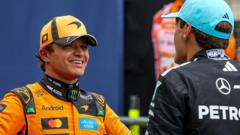
Lando Norris expects a brutal fight to convert his recent Saturday dominance into Sunday victory, knowing full well that consecutive pole positions offer zero protection once the lights go out.
Qualifying speed in Formula 1 is an illusion of absolute control. You extract every milligram of grip from a chassis, thread the needles between painted white lines at three hundred kilometers per hour, and step out of the cockpit to the satisfying flash of camera strobes. It feels like ownership. Then Sunday arrives, the air temperature shifts by five degrees, thirty kilograms of fuel slosh through the carbon-fiber fuel cell, and the physics of a Grand Prix tear that ownership to shreds.
Having secured back-to-back pole positions, Norris finds himself trapped in the most uncomfortable position in motorsport: the hunted. The McLaren driver understands the anatomy of his own vulnerabilities better than anyone. He knows that securing the optimal grid slot is merely purchasing a ticket to a knife fight.
The Saturday Trap
To understand why pole position frequently turns into a tactical liability, you have to look past the telemetry and examine the psychological weight of leading a pack into the first apex. At tracks where the run down to turn one is agonizingly long, the pole-sitter acts as a plow for the entire field. They punch a hole in the dense wall of air, gifting a catastrophic aerodynamic advantage to the cars tucked eagerly into their slipstream.
McLaren built a phenomenal machine for single-lap pace. The MCL38 and its evolutionary successors possess an uncanny ability to rotate sharply through medium-speed entries, allowing drivers to attack apexes with a ferocity that leaves rivals helpless on Saturday afternoons. Yet that exact setup philosophy often exacts a punishing toll over a full race distance. When you tune a car to maximize peak rotation on fresh soft tires, you frequently introduce thermal degradation nightmares for the race stints.
Norris has spent years refining his racecraft, shedding the friendly-challenger persona for the hard-edged realism required of a world championship contender. He knows the media will fixate on his starts. Every slow getaway gets dissected by pundits who have never stared down the barrel of twenty roaring internal combustion engines at terminal velocity. But the start is only the opening salvo of a long war of attrition.
The Tire Management Equation
Modern Formula 1 racing is fundamentally a race engineer's exercise in thermal management disguised as a driver's championship. Pirelli brings rubber compounds designed to degrade at specific rates, creating mandatory strategic variables. When you lead from the front, you cannot hide in dirty air to preserve your tires the way a chasing driver can, nor can you easily dictate the pace without inviting an undercut from a rival who pits a lap early.
Norris faces a distinct tactical squeeze. If he pushes hard in the opening stint to build a safety margin, he risks graining his front tires and destroying his rubber before the first round of pit stops. If he manages his pace to protect the tires, he opens the door for the cars behind to DRS-train him or launch an opportunistic lunge under braking.
The competition refuses to blink. Max Verstappen and the chasing pack do not care about your pole position trophies. They wait for hesitation. They hunt for the single millimeter where a driver misses their apex by a hairsbreadth, sliding the rear tires just enough to spike the surface temperature. Once that thermal threshold is breached, the tire loses its chemical grip, and the lap times drop off a cliff.
The Weight of Expectation
We have watched this movie before. Drivers who master the art of the Saturday afternoon time attack often find themselves wrestling with the brutal reality of Sunday race management. It requires a completely different cognitive framework. Qualifying is an act of pure, unadulterated aggression. Racing is an act of supreme calculation and ruthless preservation.
Norris speaks candidly about the challenge because he has lived through the painful lessons of converted poles gone wrong. He has felt the sinking realization halfway through a stint that his tires are expiring while a rival's car looks glued to the asphalt. That kind of frustration burns away naivety.
The championship math does not care about hard-earned qualifying achievements if they do not translate into maximum points on Sunday afternoon. Every dropped position off the line is a self-inflicted wound that requires twice the energy to repair later in the race.
As the lights prepare to go out for his next title defense from the front row, Norris is not celebrating his qualifying supremacy. He is calculating the exact trajectory of the cars behind him, knowing that the real race begins the moment the visor goes down and the telemetry engineers stop talking in his ear


