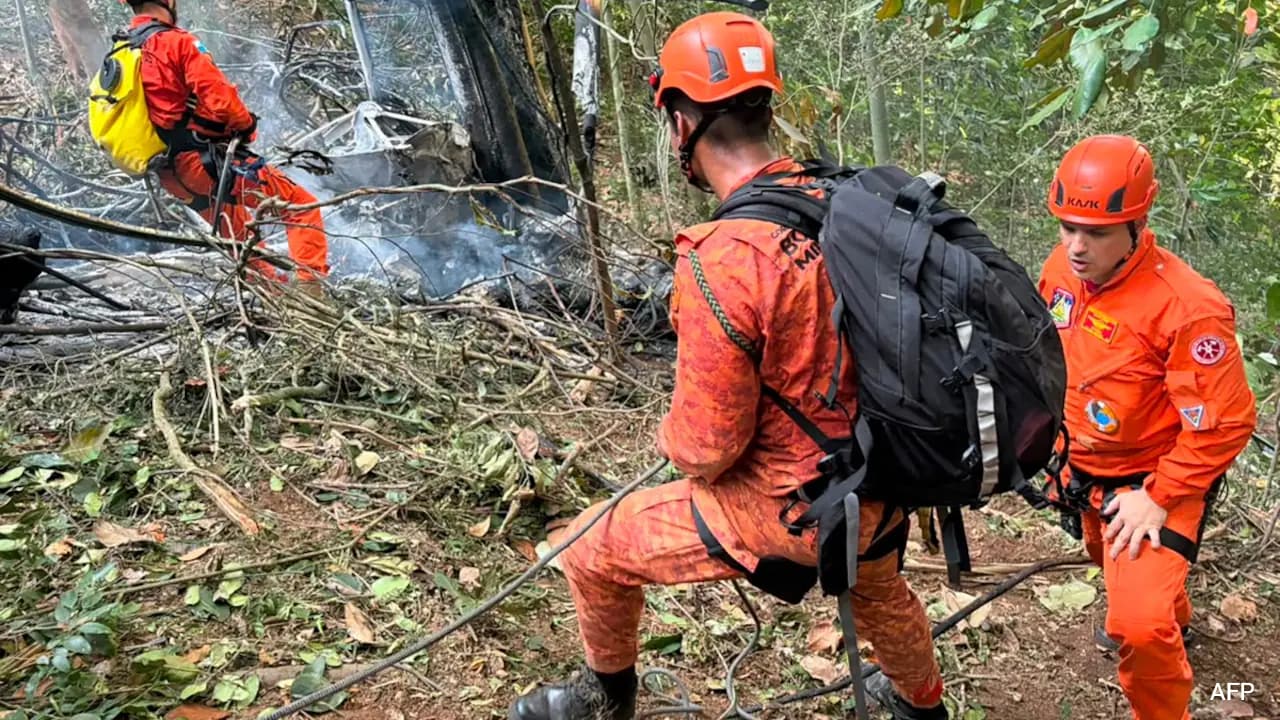
The air over Rio de Janeiro on that Tuesday smelled of salt and burning fuel. It was one of those afternoons where the Atlantic humidity clings to the skin like a wet wool blanket, and the jagged peaks of the mountains seem to scrape a low, bruised sky. Down below, the city churned with its usual chaotic symphony: traffic horns blaring along the coastline, the distant murmur of waves crashing against Copacabana, and the rhythmic pulse of daily life moving at breakneck speed.
Up high, away from the concrete, the world looks different. It is quiet. Orderly. Beautiful.
Until it isn't.
Heavy clouds hung low over the Jacarepaguá zone, a western district known for its sprawl, its industry, and its bustling aviation hub. A Robinson R44 helicopter, a machine with a slender frame and a notorious reputation for demanding absolute precision, lifted off. Inside the cabin sat four souls. There was the pilot, a man whose hands knew every switch and dial by muscle memory alone, and a family of three—a mother, a father, and their child—seeking a bird’s-eye view of a landscape that poets have spent centuries trying to capture in ink.
They did not know that gravity was about to reclaim them.
Sudden silence. That is what witnesses later described. Not an explosion that tore the sky apart, but a sickening stutter of the rotor blades, a sudden tilt of the nose, and a desperate, plummeting descent. The aircraft dropped out of the grey haze and slammed into an open area near a local street, erupting into a fierce ball of flame that devoured the delicate metal frame in seconds.
Emergency crews arrived with sirens wailing, cutting through the gridlock, but they arrived only to witness the aftermath of catastrophe. Four bodies pulled from the wreckage. Four lives extinguished in the span of a heartbeat.
We read headlines like this every day. We scroll past them on our phones while waiting for a train or sipping morning coffee. A number appears on a screen: four dead. A location is logged: Rio de Janeiro. We register the tragedy for a fraction of a second, feel a cold flicker of sympathy in the pit of our stomachs, and then we swipe to the next story.
We treat statistics like armor. As long as the names are unfamiliar, we remain safe.
(Note: The following reconstruction of the final moments inside the cabin is a hypothetical scenario grounded in the verified physics of sudden aviation failures, designed to illuminate the human weight behind the casualty report.)
Imagine the sudden shift from awe to terror. The child points out the window at the sprawling roofs below, perhaps laughing at a stray dog or a bright red umbrella. The parents smile. Then, the pitch of the engine changes. The collective control lever shakes violently in the pilot’s grip. There is no time for panic, only action. The pilot fights the cyclic, muscles straining, calculating wind shear and altitude in milliseconds, trying to find an open patch of earth away from the dense residential grid. In those final seconds, the world narrows down to a single imperative: protect the family in the back.
Physics offers no mercy. It cares nothing for love, or potential, or tomorrow.
Why do these crashes happen with such terrifying regularity? Why does the romantic dream of soaring above the world so often end in jagged metal and smoke?
To understand, we have to look past the charred remains and examine the invisible machinery of modern aviation. Helicopters are not like airplanes. An airplane is an obedient beast; if the engine dies, it becomes a glider, buying the pilot precious minutes to find a flat field. A helicopter is different. It is a machine that flies purely by defiance. It beats the air into submission using spinning blades that must maintain a delicate, synchronized equilibrium. If that rhythm breaks—if the engine fails, if the tail rotor jams, if a sudden downdraft pins the craft against an unyielding mountain wall—the margin for error vanishes.
Rio de Janeiro is particularly unforgiving. The city is a masterpiece of geographical contradictions, where towering granite monoliths rise straight out of dense urban jungles, creating unpredictable wind tunnels and microclimates. A pilot flying over the Zona Oeste is fighting not just mechanical parts, but nature itself. The sea breezes crash against the Tijuca Massif, creating invisible vortices that can toss a light aircraft around like a dry leaf.
And yet, thousands of people take to the skies every week. Tourists want the cinematic experience of Christ the Redeemer from above. Business executives want to bypass the crawling nightmare of the Avenida Brasil. Families celebrate milestones with a scenic tour, trading the mundane ground for the clouds.
We assume safety is a baseline. We pay our fare, buckle our seatbelts, and place our lives into the hands of a stranger up front. We trust the badge, the license, the gleaming paint job of the aircraft.
We forget that we are mortal.
When the news broke of the pilot and the family of three, the local aviation authorities launched their mandatory investigations. Black boxes were recovered. Flight paths were reconstructed from radar telemetry. Maintenance logs were hauled into sterile rooms and examined under fluorescent lights by inspectors looking for rust, fatigue, or human error.
Was it a mechanical failure? A sudden gust of wind that overloaded the rotor system? A momentary lapse in visibility as the fog rolled in from the Atlantic?
The answers will eventually fill a PDF report, buried in an online database read only by insurance adjusters and safety regulators. The report will feature technical jargon, diagrams of stress fractures, and dry recommendations for future oversight.
That paperwork will do nothing for the family waiting at home for a phone call that will never come. It will not resurrect the child whose laughter filled the living room just hours before takeoff.
This is the hidden cost of our eternal desire to conquer distance and gravity. Every technological leap we make carries a tax, paid in blood and sorrow by those who happen to be on the wrong flight at the wrong time. We build marvels of engineering, yet we remain remarkably fragile creatures, easily broken by a sudden drop from the sky.
Consider what happens next. The wreckage is cleared from the street. The burned asphalt is scrubbed clean by municipal workers. Traffic returns to its frantic rhythm. The helicopters continue to buzz over the beaches of Ipanema, carrying the next load of wide-eyed passengers looking for a thrill.
Life is relentless that way. It refuses to pause for grief.
But for those who stop to look closer at the headlines, the wreckage leaves a deeper imprint. It reminds us of the profound fragility of our daily routines. We step out the door in the morning, kissing our loved ones goodbye, assuming a predictable return. We make plans for the weekend, oblivious to the invisible threads holding our lives together.
The pilot in Rio de Janeiro woke up that morning, checked his aircraft, and prepared for another routine day at the controls. The parents dressed their child, perhaps arguing about whether to pack a light jacket or sunscreen. They were ordinary people living ordinary lives, right up until the moment the sky gave way.
There is no neat moral to be drawn from a tragedy like this. There is no comforting platitude that makes sense of a child's life cut short or a pilot's futile struggle against a dying engine. The universe is indifferent to our desire for closure.
All we are left with is the weight of the silence that follows the crash. The quiet grief of survivors. And the haunting realization that the distance between a normal Tuesday afternoon and eternity is often no wider than the blade of a helicopter spinning against the wind.


