The pre-dawn air in Mammoth Lakes doesn't just bite; it chews. You stand in a gondola line that snakes around the village like a concrete serpent, shoulder-to-shoulder with thousands of others who paid three hundred dollars for the privilege of elbowing you. By 10:00 AM, the "wide-open spaces" promised in the brochure have been carved into a chaotic grid of crisscrossing skis and frantic energy. You spend forty minutes ascending and four minutes descending. It is a factory of recreation. Efficient, yes. Beautiful, certainly. But it lacks a soul.
Three hours north, past the volcanic scars and the shimmering expanse of Mono Lake, the rhythm of the mountains changes. The traffic thins until it is just you and the wind. You turn off Highway 395, heading toward a notch in the peaks where the sky seems a deeper shade of indigo. This is June Mountain.
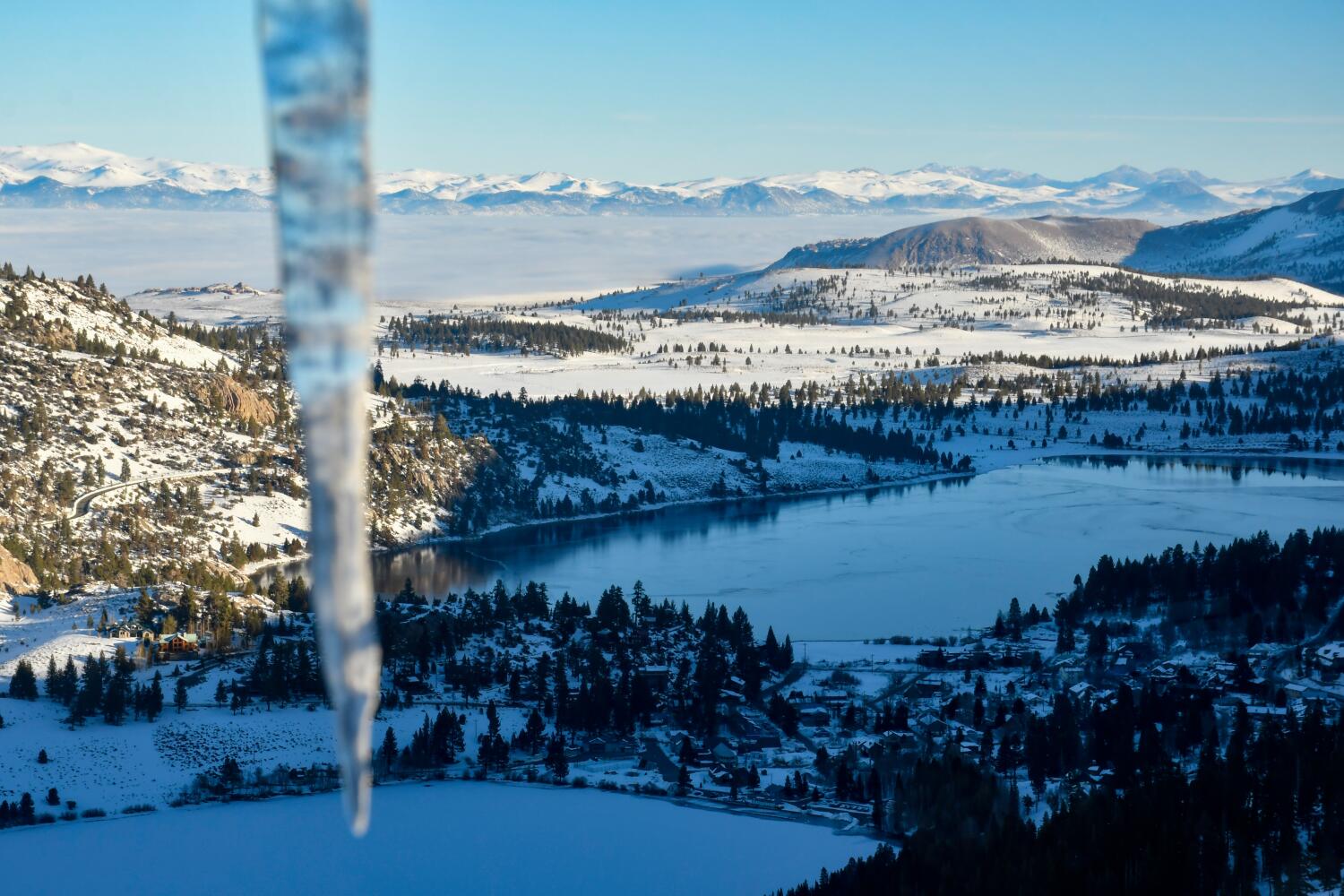
For decades, this place has lived in the shadow of its gargantuan sibling to the south. While Mammoth grew into a world-class behemoth of luxury condos and high-speed quads, June Lake stayed frozen in a more honest era. It is the "Swiss Alps of California," a title earned not by marketing departments, but by the sheer, vertical drama of the Carson Peak skyline reflecting in the glass-bottomed clarity of the loop’s four lakes.
The Ghost of the Lift Line
Consider a hypothetical skier named Elias. Elias has spent twenty years chasing powder. He has the high-end shells, the carbon-fiber poles, and a mounting sense of burnout. At the major resorts, Elias is a metric. He is a scanned pass, a unit of throughput, a body to be moved.
When Elias pulls into the parking lot at June, he keeps waiting for the catch. He looks for the orange-vested attendants waving him into a spot three miles from the base. They aren't there. He looks for the swarm at the ticket window. It’s a ghost town. He walks fifty feet, clicks into his bindings, and boards the J1 lift.
The silence is the first thing that hits you. It isn't the empty silence of a deserted mall; it’s the heavy, expectant silence of a cathedral. As the chair rises out of the base area, the face of the mountain opens up. June is upside down. Most mountains have their steepest terrain at the top and mellow out at the bottom. June starts with a sheer, intimidating face and then unfolds into a high-alpine plateau of rolling meadows and wide-open glades.
Elias reaches the top of the Rainbow Chair. He looks left. Nobody. He looks right. A single patroller is adjusting a sign in the distance. He drops in. The snow here stays cold longer because the crowds aren't there to chew it into a mogul-field by noon. He carves a turn that feels a mile wide. There is no fear of a weekend warrior taking out his knees from the blind side. There is only the friction of metal on frozen water and the sight of the jagged Minarets piercing the horizon.
The Economics of Intimacy
The "Big Ski" industry is built on the logic of the cattle drive. Success is measured in "skier visits"—a cold term for how many souls can be crammed onto a hill before the experience curdles. June Mountain operates on a different, almost defiant logic.
It is owned by the same company as Mammoth, yet it remains fundamentally un-Mammoth. It is the pressure valve. Because it lacks the sprawling village and the high-end shopping, the "scenester" crowd stays south. This leaves June to the families, the locals, and the purists who realize that a mountain’s value isn't measured in the number of sushi bars at the base, but in the acreage-to-human ratio.
Statistically, June offers 1,500 acres of skiiable terrain. In a vacuum, that’s a mid-sized resort. But when you factor in the density, those 1,500 acres feel like 10,000. On a Tuesday after a storm, you can find "stashes"—pockets of untouched powder—at 2:00 PM that would have been tracked out at a larger resort within twenty minutes of the opening bell.
This isn't just about convenience. It’s about the psychological shift that happens when you aren't competing for resources. Aggression vanishes. On the lifts, strangers actually talk to one another. They don’t check their stocks or their Instagram feeds; they point out where the snow is holding up under the trees.
A Town That Refused to Grow Up
The village of June Lake sits at the base of the mountain, a horseshoe-shaped canyon that feels like a secret guarded by granite giants. There is one main road. There are no stoplights. If you want a gourmet, deconstructed avocado toast, you are in the wrong place. If you want a beer at the Tiger Bar where the wooden counters are smoothed by a century of leaning elbows, you’ve found home.
The stakes here are invisible but high. Every small mountain town in the West is currently fighting a war for its identity. They are being hollowed out by short-term rentals and billionaire flight. June Lake is vulnerable, yet it feels protected by its own topography. The canyon walls are steep, and the land is mostly National Forest. It can’t sprawl. It can only deepen.
Walking through the loop in the evening, the smell of woodsmoke hangs heavy in the sub-zero air. You see the same faces at the General Store that you saw on the mountain. There is a communal understanding that everyone here is a co-conspirator in a great heist. You are stealing time back from a world that wants to hurry you.
The Burden of the Secret
There is a guilt that comes with discovering a place like this. You want to tell your friends, but you also want to bury the map. You realize that the very act of praising the "lack of crowds" is the first step toward creating them.
But June Mountain has a built-in filter. It requires a bit more effort. It requires you to pass the glitz of the big resorts and keep driving. It requires you to be okay with a slower lift and a humbler lodge. It attracts a specific breed of human—one who values the sound of their own breathing over the thumping bass of a base-area DJ.
I remember standing at the top of the "The Face" late one afternoon. The sun was dipping behind the peaks, casting long, bruised-purple shadows across the frozen surface of Grant Lake far below. My legs were heavy, that good kind of exhaustion that feels like a physical accomplishment. I realized I hadn't looked at my watch once all day. I hadn't felt that low-level anxiety of "getting my money's worth" by rushing to the next lift.
I was just a person on a mountain.
The Fine Art of Doing Less
We are taught that more is always better. More vertical feet, more high-speed lifts, more dining options, more prestige. June Mountain is a quiet argument for the power of "less."
It is a place where kids can ski for free—a genuine rarity in an industry that increasingly feels like a luxury gated community. It is a place where the "backcountry" is accessible right off the lift, offering the kind of high-alpine touring that usually requires a helicopter or a grueling five-hour skin.
The magic isn't just in the snow. It’s in the realization that the world hasn't been entirely paved over yet. There are still pockets where the old California—the rugged, unpretentious, wild California—is breathing.
As the sun finally disappears, leaving the sky a haunting shade of electric lime and orange, you realize the true cost of the crowded resorts isn't the lift ticket. It’s the spirit. You trade your peace for the spectacle.
At June, you make the opposite trade. You give up the spectacle, and in return, the mountain gives you yourself back.
You click out of your skis. The metal clinks against the frozen ground. The silence returns, absolute and welcoming. You walk toward your car, and for the first time in a long time, you aren't thinking about the traffic on the way home or the emails waiting in your inbox. You are just thinking about the curve of the last turn, and how the snow felt like silk, and how, for a few hours, the entire world belonged to no one but you.
The mountains are still there. They are just waiting for you to stop looking for the crowd and start looking for the light.