At 4:30 in the morning, before the streetlights in New Hartford, Iowa, have even thought about flickering off, the gravel crunches under a familiar pair of running shoes.
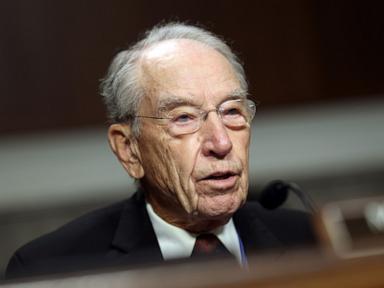
Chuck Grassley is awake. He has been awake for decades, moving through the dark in the steady, rhythmic cadence of a man who treats time not as an enemy, but as a crop to be tended. Born in 1933—when Franklin D. Roosevelt was in the White House and the Dust Bowl was choking the American heartland—Grassley is now the oldest sitting member of the United States Senate. He has cast more than 15,000 roll-call votes. He has outlasted colleagues, presidents, and entire political eras.
Yet, in a candid moment that rippled far beyond the cornfields of Butler County, the nonagenarian senator voiced a quiet, chilling dread. It wasn't the fear of death itself. For a man of deep Baptist faith and pragmatic Midwestern stock, mortality is merely a transition. What troubled him—what made him pause and reflect aloud—was the political arithmetic of his own hypothetical demise. Specifically, the prospect of dying in office while a Democrat sits in the governor's mansion in Des Moines.
Pause.
Think about what that actually means.
On the surface, it sounds like standard partisan gamesmanship, the kind of tactical calculation that makes ordinary voters roll their eyes and change the channel. We are used to politicians treating public office like a family heirloom or a chess piece. When a news headline reduces a human life to a Senate majority margin, it feels cold. Cynical. Distant.
But look closer at the machinery behind that fear. When an aging statesman admits he worries about who will hold the pen the day his heart stops beating, he isn't just talking about party loyalty. He is exposing the fragile, unseen architecture of American power—a system where a single biological event in a hospital room can instantly rewrite the laws governing 330 million people.
The Architecture of a Vacant Chair
To understand why a ninety-something senator lies awake thinking about gubernatorial succession, you have to strip away the marble columns of Capitol Hill and imagine a much simpler scene.
Picture a small-town hardware store in Iowa—let’s call it Miller’s Supply, run by a hypothetical third-generation owner named Sarah. Sarah doesn't spend her afternoons reading the Congressional Record. She worries about interest rates on her inventory loans, the cost of diesel for her delivery truck, and whether the federal farm bill will pass before spring planting. For forty years, whenever Sarah had a gripe about Washington, she knew exactly who sat behind the desk in Washington representing her zip code. There was a predictability to it, like the changing of the seasons.
Now, consider what happens in the quiet hours after a senator dies in office.
Under the Seventeenth Amendment to the U.S. Constitution, which moved Senate elections from state legislatures to the popular vote in 1913, states were given a crucial mechanism to prevent prolonged vacancies. If a senator dies, resigns, or is removed, the state's governor typically holds the unilateral authority to appoint a temporary replacement until a special election can be held.
It is an extraordinary concentration of power. Millions of ballots cast over a six-year cycle—millions of individual hopes, compromises, and arguments—suddenly evaporate into a single signature on a piece of parchment in the state capital.
In Iowa, where Grassley has won eight consecutive terms since 1980, the governor’s office has long been a Republican stronghold under Kim Reynolds. Under that alignment, the succession chain is unbroken; a Republican senator would be replaced by a Republican appointee, preserving the ideological mandate voters delivered at the ballot box.
But politics is never static. Governorships flip. Midterms surge and recede like tides. And when Grassley lamented the possibility of passing away under a Democratic governor, he was staring directly at the ultimate political inversion: a lifetime of conservative jurisprudence, judicial confirmations, and legislative battles undone in an afternoon by an executive appointment from the opposite party.
It is a bizarre psychological burden to carry. Imagine working at your craft for half a century, knowing that your final act—the very moment you can no longer speak for yourself—might immediately empower the exact policies you spent your career trying to stop.
The Invisible Stakes of the Senate Margin
Why does one seat carry so much weight? Because the modern United States Senate operates on a razor's edge.
In decades past, the Senate was a sprawling, unpredictable body where conservative Democrats from the South and liberal Republicans from New England regularly crossed the aisle. A single seat shifting from red to blue, or vice versa, rarely altered the fundamental gravity of the chamber. Bills still moved. Committees still functioned.
That world is gone.
Today, the Senate is an institution defined by razor-thin majorities—50-50 splits broken by the Vice President, or 51-49 margins where a single absentee vote due to illness can grind the entire federal government to a halt. In this hyper-calibrated environment, one senator is not merely one percent of the chamber. One senator is the difference between who chairs the Judiciary Committee, which federal judges receive lifetime appointments to the bench, which cabinet nominees get confirmed, and which bills ever see the light of day on the Senate floor.
Consider the numbers. Between 2021 and 2024, the Senate confirmed over two hundred federal judges by margins so narrow that a single absence would have derailed the calendar. When Senator Dianne Feinstein of California fell ill in 2023 at age eighty-nine, her months-long absence temporarily paralyzed the Senate Judiciary Committee, stalling judicial confirmations across the country. When she passed away later that year, California’s Democratic governor, Gavin Newsom, appointed Laphonza Butler within days, immediately restoring the party’s majority control.
The system worked seamlessly because the senator and the governor shared a political party.
Now flip the script. What happens when they don't?
History offers stark reminders of how jarring that collision can be. When Republican Senator John McCain died in Arizona in 2018, Republican Governor Doug Ducey appointed Martha McSally, keeping the seat in GOP hands until a special election. Conversely, when Democratic Senator Paul Wellstone died in a tragic plane crash in Minnesota just eleven days before the 2002 election, the state's independent governor, Jesse Ventura, appointed Dean Barkley—an Independence Party member who refused to caucus with either major party, temporarily scrambling the Senate's balance of power.
In states like Massachusetts, the rules themselves have been rewritten in real time to prevent such flips. In 2004, when Democratic Senator John Kerry ran for president, the Democratic-controlled Massachusetts legislature stripped Republican Governor Mitt Romney of his appointment power, mandating a special election instead—lest a victorious Kerry give Romney the chance to appoint a Republican to Ted Kennedy's side. Five years later, after Kennedy’s death, that same legislature reversed course and restored temporary appointment power to Democratic Governor Deval Patrick so the seat wouldn't sit empty during the crucial months of the Affordable Care Act debate.
Power, it turns out, rarely leaves succession to chance.
The Gerontocracy Question We Avoid
There is another layer to Grassley’s remark, one that makes both voters and politicians deeply uncomfortable. It forces us to confront the quiet reality of aging in American leadership.
I remember sitting in the press gallery of the Capitol a few years ago, watching an afternoon quorum call drag into the evening. Down on the floor, senators shuffled between desks, leaning heavily on mahogany lecterns, whispering into aides' ears to confirm what amendment was being voted on. The air in the chamber felt thick, reverent, and slightly suspended in time. You could feel the immense institutional memory in the room—men and women who had negotiated arms treaties during the Cold War and written the tax codes of the Reagan era.
You could also feel the weight of the years.
The average age of the U.S. Senate has hovered around sixty-four in recent sessions, making it one of the oldest governing bodies in the democratic world. Americans routinely tell pollsters they favor age limits or term limits for Congress. Yet, when election day arrives, those same voters overwhelmingly re-elect incumbents.
Why? Because seniority is currency in Washington.
To understand this paradox, think of the Senate like a massive, centuries-old law firm where corner offices and billion-dollar client accounts are distributed strictly by hire date. If a state replaces a forty-year veteran with a bright, energetic thirty-five-year-old newcomer, that state doesn't just get fresh ideas—it immediately drops to the bottom of the seniority ladder. It loses committee gavels. It loses federal grant leverage. It loses the institutional muscle required to protect local industries, military bases, and agricultural subsidies.
For a state like Iowa, with just four electoral votes and a population smaller than the city of Los Angeles, Grassley’s seniority is a massive shield. As a former chairman of the Finance Committee and the Judiciary Committee, and as President Pro Tempore—third in the presidential line of succession—he commands attention that no freshman senator could ever dream of wielding.
Voters know this. Grassley knows this.
And therein lies the trap. The very seniority that makes an aging senator indispensable to their state is the exact thing that makes stepping down feel like unilateral disarmament. You hold on because letting go costs your constituents their seat at the head of the table. You run one more time, and then one more time after that, until the calendar catches up and your mortality becomes a matter of partisan risk assessment.
The Human Weight of a Public Exit
It is easy to mock politicians from afar. It is harder to imagine the sheer existential vulnerability of having your lifespan debated as a political liability.
When Grassley spoke about not wanting to die in office under a Democratic governor, he wasn't delivering a polished talking point drafted by a twenty-six-year-old communications director. It was an unvarnished admission from a man who still visits all ninety-nine Iowa counties every single year—a grueling annual ritual known as the "Full Grassley"—sitting in town halls, taking unscripted questions from farmers, teachers, and high school students.
There is an undeniable grit to that kind of public service. You don't keep that schedule in your nineties unless you genuinely love the work and the people you represent.
Yet, human biology does not negotiate with legislative calendars. Every heartbeat is borrowed time. And in a polarized nation where the margin between triumph and defeat is measured in single votes, even a devout public servant is forced to view his own final breath through the prism of partisan survival.
What happens to our hypothetical hardware store owner, Sarah, in New Hartford if the unthinkable happens?
If a governor from the opposing party holds the appointment pen, Sarah wakes up on a Tuesday morning to find that the political voice she voted for has been replaced overnight by someone who champions the exact opposite economic philosophy. No campaign was run. No debates were held. No ballots were cast. Just a press conference in the state capitol, a raised right hand in Washington, and a sudden shift in the laws governing her livelihood.
Alternatively, if a governor from the same party makes the appointment, the ideological continuity holds—yet voters are still represented by someone they never chose, often for months or even years until the next general election cycle arrives.
Either way, democracy holds its breath.
The Unfinished Ledger
Look at the clock on the wall of the Senate chamber. It has ticked through civil wars, economic depressions, moon landings, and pandemics. Men and women have walked through those heavy swinging doors in the prime of their youth and been carried out decades later draped in flags.
The institution endures, vast and indifferent to the ambitions of any single occupant.
Grassley knows this better than anyone alive today. He has seen the brass nameplates unscrewed from mahogany desks countless times, watching new arrivals claim the seats of giants who once seemed permanent. He has attended the funerals, delivered the eulogies, and watched the Senate move on to the next roll call before the flowers have even wilted.
That is the quiet tragedy hidden inside his remark. Every leader eventually faces the moment when their legacy leaves their hands and enters the custody of history—or, in the merciless arithmetic of American politics, the custody of whoever happens to hold the governor's mansion on a Tuesday morning.
At 4:30 a.m. in Butler County, the road is empty, the air is cold, and the miles stretch out ahead in the dark. You keep running because stopping means letting someone else decide where the path leads.