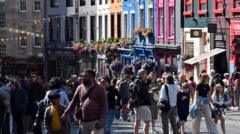
The morning air in Edinburgh carries a familiar chill, tasting faintly of coal smoke and wet granite. Down on Princes Street, shop shutters rattle upward against the dawn. A bus rumbles past, half-empty, hauling sleepy nurses and bakers toward their shifts. To anyone standing at the curb, it looks like just another Tuesday. Ordinary. Unremarkable.
Yet underneath the asphalt, deep inside the ledger books of the nation, something remarkable has shifted.
We talk about public spending deficits with the glazed-over eyes of people watching a weather report for a distant continent. Billions. Percentages. Gross domestic product. They sound like words invented by accountants to keep the rest of us from asking questions. But numbers are just frozen history. Behind every decimal point sits a nurse waiting for a bus, a stretch of crumbling road in the Highlands, a classroom roof leaking during a November gale, and the quiet, heavy anxiety of a family kitchen table after the bills arrive.
Consider Callum.
Callum is a hypothetical butcher in Perth who has spent thirty years waking up at three in the morning to carve ribs of beef and tie strings around pork loins. He does not read macroeconomic journals. He does not care about the Government Expenditure and Revenue Scotland report when it drops into the news cycle like a heavy anchor.
What Callum cares about is whether his customers have enough coin in their pockets to buy a decent roast on a Saturday. He cares about whether the local clinic has an open appointment slot when his knees flare up. He cares about whether the streetlights outside his shop stay lit so he does not have to stumble through the dark.
For years, Callum and millions like him lived under the shadow of a widening gap. A fiscal chasm. The money coming into the public treasury from taxes—PAYE, council rates, corporation levies, fuel duties—was not enough to cover the money flowing out to keep the hospitals heated, the police cars fueled, and the teachers paid. The deficit yawned wide. It felt permanent. Like a leak in the roof that nobody had the ladder to fix.
Then the numbers turned.
Recently, the public spending deficit for Scotland narrowed. Not by a whisper, but by billions.
Let us look at the mechanics, stripped of the dry jargon. Imagine a household budget. For a long time, the household was spending significantly more than it earned, relying on credit cards and overdrafts to make ends meet. That is what a deficit is. It is the shortfall. When that shortfall shrinks, it means two things could have happened: spending went down, or income went up.
In this case, the primary driver was a surge in the tax take.
Why did the tax take rise? Because wages nudged upward in certain sectors. Because employment held a steady line. Because inflation, for all its cruelty in driving up the cost of a pint of milk, temporarily inflated the nominal values of transactions and earnings, fattening the receipts flowing back to the tax office.
Suddenly, the ledger looked a little less bruised.
But numbers do not bleed, and they do not celebrate. People do.
When the deficit narrows, what does it actually buy us? Does it mean the potholes on the A9 vanish overnight? Does it mean the waiting lists for orthopedic surgery melt away like morning frost?
No.
That is the trap of fiscal reporting. We treat a shrinking deficit like a trophy won at the end of a long season. We want to wave it in the air and declare victory. But a deficit is not a disease cured; it is merely a fever that has broken. The body is still weak. The underlying infections of an aging population, a sluggish productivity rate, and volatile global energy markets remain entirely intact.
Think about Margaret.
Margaret lives in a stone cottage outside of Inverness. She is seventy-four, fiercely independent, and stubborn enough to argue with the wind. When the winter gales howl off the North Sea, her heating bills climb to terrifying heights. She remembers a time when public services felt omnipresent, like the air you breathed. You needed a doctor, you saw one. You needed a home care visit, someone knocked on the door.
Over the past decade, Margaret has watched the edges fray. The local library hours were cut. The bus that took her into town was reduced from hourly to twice a week. She heard the politicians on the television talk about fiscal consolidation and balanced budgets, but all she felt was the cold draft coming through her floorboards.
When she hears that the public spending deficit has fallen, she does not feel richer. She feels skeptical.
And her skepticism is entirely earned.
A falling deficit tells us that revenue caught up slightly with expenditure, largely powered by a stronger-than-expected revenue stream from onshore economic activity and a recalibration of oil and gas revenues during periods of high global commodity prices. But energy markets are notoriously fickle beasts. They roar like lions one year and whimper like whipped dogs the next. Relying on volatile sectors to fund permanent public commitments is like building a house on a shifting sand dune.
The real story of Scotland's public finances is not found in the headline figure of a shrinking deficit. It is found in the tension between what we demand from our public realm and what we are willing to contribute to sustain it.
We want world-class healthcare. We want smooth roads, green energy grids, well-paid teachers, modern public transport, and a robust safety net for the vulnerable. These are noble desires. They are the scaffolding of a civilized society.
Yet, every single one of those desires has a price tag attached to it.
When the tax take rises, it means extraction. It means more of Callum the butcher's hard-earned margin is being redirected from his cash register to the public purse. It means workers across Glasgow, Aberdeen, Dundee, and the Borders are handing over a larger slice of their monthly paychecks to keep the machinery turning.
There is an unspoken compact in this arrangement. We surrender a portion of our individual autonomy—our money—in exchange for collective security. We buy insurance against misfortune. We pool our resources so that no single person has to bankrupt themselves to pay for an ambulance ride or a cancer treatment.
When the deficit falls because tax receipts are up, it means the insurance pool is currently collecting more premiums. That is good news for solvency. It means less borrowing, lower debt-servicing costs down the road, and greater fiscal breathing room for the administration in Holyrood.
Yet, breathing room is not the same thing as running forward.
Consider what happens next.
The demographic tide is relentless. Scotland's population is aging faster than many parts of Western Europe. Every year, more people cross the threshold into retirement, transitioning from net contributors to the tax base to net consumers of public services, particularly health and social care. At the same time, the working-age population is growing more slowly.
This is the demographic scissors. One blade is the rising cost of caring for an older population. The other blade is the stagnant growth in the number of people paying income tax.
So when we look at a single snapshot in time where the deficit falls, we are looking at a momentary truce in a long war. We are looking at a snapshot of a moving train. The fact that the engine is currently burning fuel efficiently does not change the fact that the tracks ahead run up a very steep mountain.
How do we reconcile this?
By dropping the illusion that economics is a science conducted by disembodied brains in glass towers. Economics is anthropology. It is the study of human choices, fears, and hopes translated into currency.
When tax receipts rise, it reflects human labor. It reflects the exhausted baristas pulling espresso shots at six in the morning, the software developers squinting at lines of code in Edinburgh tech hubs, the fishermen hauling creels off the coast of Shetland, and the teachers marking essays late into the night. Every pound in the public treasury started as someone's sweat.
When politicians and analysts debate the narrowing deficit, they are really debating how fairly that sweat was valued and how wisely it is being spent.
If the deficit falls because the tax take rises, but the quality of public services continues to degrade in the eyes of citizens like Margaret, then the numbers are lying to us. A balanced ledger means nothing if the bridge is falling down. A shrinking deficit is a hollow victory if the people paying the taxes feel like strangers in their own economy.
The challenge ahead is not simply balancing the books. Balancing a set of books is easy if you cut enough services or tax enough earnings; you just keep cutting and taking until the columns match. The true artistry—the human challenge—is to foster a productive economy that generates wealth naturally, so that the tax take rises not out of economic strain or inflation, but out of genuine, sustainable prosperity.
We are not there yet.
The recent dip in the deficit is a welcome reprieve. It provides breathing space. It lowers the immediate fever. But the patient is still in the room, watching the door, wondering what next winter will bring.
Callum locks his shop door at five o'clock. He counts the day's takings, sweeps the sawdust from the floor, and turns off the neon sign in the window. Outside, the dusk settles over Perth, turning the stone buildings the color of old pewter. He doesn't know the exact percentage by which the national deficit fell this quarter. He doesn't need to. He can feel it in his bones, in the rhythm of his community, in the quiet spaces between the worries.
The numbers have moved. Now, the harder work begins.