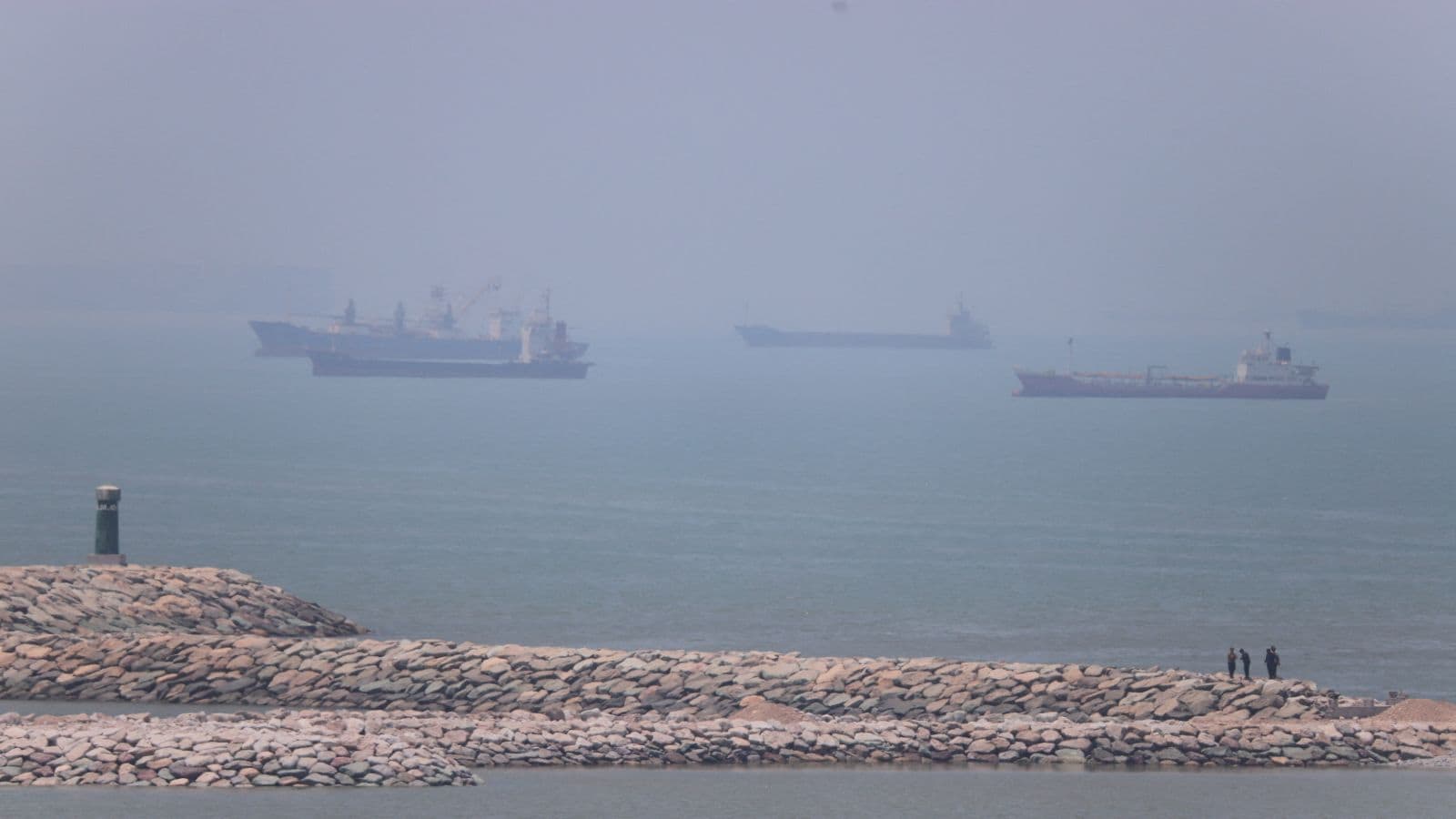
Darkness on the open ocean is not the darkness of a bedroom with the curtains drawn. It is thick, wet, and absolute, swallowing the horizon until the sea and the sky become a single black wall.
On a standard Tuesday night in the Persian Gulf, that wall is pierced by a steady, reassuring rhythm. Red flashes. Green flashes. Amber strobes. For decades, mariners steering supertankers loaded with two million barrels of crude oil have relied on those floating beacons—buoys, lighthouses, and radar transponders—like breadcrumbs leading out of a narrow alley.
Then the breadcrumbs vanished.
When Iranian authorities recently announced that zero unauthorized vessels had transited the Strait of Hormuz overnight following the destruction of critical navigation aids, the news wires spat out the update in dry, clinical prose. Maritime security. Transit protocols. Infrastructure damage. To anyone scrolling past the headline over morning coffee in Chicago or Frankfurt, it sounded like a minor technical hiccup in a distant corner of the map.
It wasn't. It was the quiet tightening of a tourniquet around the global economy.
The Ghost Ship on the Bridge
To understand what happens when those lights go dark, step onto the bridge of a hypothetical Very Large Crude Carrier—let's call her the M/T Pacific Horizon—and meet her captain, a fictional composite of the seasoned mariners who run this gauntlet every week, whom we'll call Captain Henrik Lindqvist.
Picture Henrik at 03:00 hours. The air on the bridge smells of stale espresso, ozone from the radar consoles, and the faint, metallic tang of warm electronics. Beneath his boots, a 330-meter steel hull carrying $150 million worth of liquefied natural gas or heavy crude hums at a cautious twelve knots.
Outside the angled glass windows, the Strait of Hormuz narrows to just twenty-one nautical miles at its tightest choke point. Within that narrow ribbon of water, the actual shipping lanes—the Traffic Separation Scheme—are only two miles wide in each direction, separated by a two-mile buffer zone. There is no room for guesswork. Shallow shoals, jagged rocky outcrops, and bustling fishing dhows sit just yards outside the invisible lines.
Normally, Henrik checks his satellite GPS against the physical reality outside his window. He looks for the reassuring blink of the channel buoys. They are the sanity check against electronic spoofing, the analog truth in a digital age.
Now, imagine looking out into the pitch black and seeing nothing where a green starboard buoy is supposed to flash every four seconds.
Worse, imagine your GPS screen suddenly claiming you are parked on a runway in Tehran, or steaming thirty knots inland across the Omani desert. Electronic warfare and GPS jamming have become routine background noise in the Gulf. When digital signals lie, sailors fall back on physical navigation aids—lighted buoys, racons, and coastal beacons—and visual bearings. Destroy those aids, and you haven't just broken a few solar-powered lights. You have blinded the ship.
Silence.
That is what settles over a bridge when the physical markers disappear and the digital screens start hallucinating. Suddenly, steering a floating skyscraper through a rocky funnel becomes a high-stakes game of blindfolded chicken.
Why "Zero Unauthorized Vessels" Is a Chilling Number
On an average day, roughly twenty-one million barrels of petroleum liquids flow through the Strait of Hormuz. That is roughly one-fifth of the entire world's daily oil consumption, alongside a massive share of global liquefied natural gas exports from Qatar. Every single day, dozens of massive hulls thread that needle, carrying the raw energy that heats homes in Tokyo, powers factories in Seoul, and fuels delivery trucks in Ohio.
When Tehran declares that no unauthorized vessels passed through overnight after navigation markers were wiped out, read between the lines.
In maritime law, the Strait of Hormuz is governed by the transit passage regime under the United Nations Convention on the Law of the Sea. Ships do not legally need permission from coastal states to pass through an international strait connecting two parts of the high seas, provided they proceed continuously and expeditiously. Calling vessels "unauthorized" reframes an international highway as a private driveway with a locked gate.
And the destruction of navigation aids acts as the physical lock.
Think of the Strait of Hormuz like a single-lane mountain tunnel during a blizzard. You don't need to park a tank across the entrance to stop traffic. You just need to smash the tunnel lights, knock down the reflective lane markers, and stand at the mouth with a megaphone telling drivers that anyone entering without your explicit permission is on their own.
Most drivers will slam on the brakes.
Shipping companies are fiercely pragmatic, and maritime insurers are even more so. The moment navigation aids go dark and an armed state starts demanding authorization, risk algorithms in London's Lloyd's insurance market go haywire. War risk premiums—the extra insurance fees charged simply for entering dangerous waters—can spike from a fraction of a percent of a ship's value to millions of dollars for a single seven-day voyage.
I remember talking to a veteran maritime risk analyst during a previous Gulf flare-up a few years back. He pulled up a live AIS ship-tracking map on his laptop, his fingers drumming nervously against the desk. "People think a blockade looks like battleships firing broadsides," he told me, pointing at clusters of red and green dots freezing in place outside the Gulf of Oman. "It doesn't. A blockade looks like a bunch of accountants in London refusing to underwrite a policy, and a captain dropping anchor because he doesn't want to run his ship onto a reef in the dark."
He was right. Fear and darkness are cheaper than missiles, and just as effective.
The Invisible Dominoes in Your Kitchen
It is easy to feel detached from a dark stretch of water six thousand miles away. You don't own an oil tanker. You don't negotiate LNG contracts in Doha. Why should a missing buoy off the coast of Iran keep you awake at night?
Because the global supply chain does not care about your zip code. It is a single, taut wire stretched across the planet, and plucking it in the Persian Gulf makes the whole thing vibrate.
Consider what happens next when ships hesitate at the mouth of the Strait.
First, the spot price of Brent crude twitches upward. Even if not a single barrel is spilled, traders price in the terror of scarcity. Within forty-eight hours, wholesale gasoline and diesel futures climb. By the end of the week, the digital numbers on the illuminated sign at your neighborhood gas station tick up ten, twenty, thirty cents a gallon.
But gasoline is just the obvious pain. Look deeper into your daily routine.
Diesel powers the freight trains, container ships, and eighteen-wheelers that move everything you buy. When marine fuel spikes because tankers are idling burn-off fuel waiting for daylight or naval escorts, the cost of shipping a container of sneakers from Vietnam or coffee beans from Brazil jumps.
Then there is the hidden petrochemical web. Natural gas and crude oil derivatives are the building blocks of modern life. They become the nitrogen fertilizer that grows the wheat in your bread, the medical-grade plastics in hospital IV bags, the packaging around your groceries, and the synthetic fibers in your jacket. Qatar alone sends nearly all of its liquefied natural gas—roughly twenty percent of global LNG trade—directly through that twenty-one-mile choke point. When those carriers stall, European and Asian utilities scramble for alternative cargoes, driving up electricity bills from Berlin to Taipei.
We live in a world built on the assumption that the lights in the Strait of Hormuz stay on. Every just-in-time factory inventory, every grocery store restock schedule, every airline ticket price quietly rests on the back of those floating metal buoys bobbing in warm, salty water.
The Anatomy of Asymmetric Leverage
History shows us that the Strait of Hormuz has always been the ultimate pressure valve in Middle Eastern geopolitics. During the "Tanker War" of the 1980s, mines, speedboats, and anti-ship missiles turned the waterway into a shooting gallery, forcing the United States Navy into Operation Earnest Will to escort reflagged Kuwaiti tankers. In 2019, limpet mines tore holes in commercial hulls near Fujairah, and British-flagged vessels were seized in broad daylight.
Yet destroying navigation aids represents a subtler, sneakier evolution in asymmetric pressure.
If you fire a missile at a tanker, the world sees smoke on satellite imagery. You trigger automatic naval retaliation, international condemnation, and an unmistakable act of war.
If navigation aids are destroyed—whether through covert sabotage, kinetic strikes, or coastal skirmishes—plausible deniability clouds the water. Was it a deliberate tactic to blind commercial shipping? Collateral damage from nearby military operations? A sudden, mysterious failure of infrastructure?
While diplomats argue over attribution and maritime agencies issue urgent NAVAREA warnings—the emergency radio broadcasts alerting ships to missing buoys and hazards—the strategic objective is already achieved. Traffic slows. Hesitation sets in. The coastal power demonstrates, without firing a shot at a merchant hull, that it holds its hand over the light switch of global commerce.
I'll be honest: watching this play out from the outside feels unsettling because there is no clean, cinematic fix. You cannot simply send in a repair crew with a wrench and a new lightbulb when coastal batteries and drone swarms watch every square meter of water. Replacing a destroyed buoy in contested waters requires minesweepers, air cover, and political nerve. Until then, mariners are left navigating by dead reckoning, radar echoes off distant cliffs, and sheer nerve.
Navigating the Blind Spot
So how do ships keep moving when the street signs have been torn down?
They adapt, at tremendous cost and agonizing slowness.
Without lighted buoys and reliable transponders, commercial vessels lose the luxury of twenty-four-hour, all-weather transit. Captains wait for dawn. Instead of gliding smoothly through the night, convoys bunch up at the entrances to the Strait, waiting for the sun to rise so lookouts with binoculars can visually spot rocky coastlines, sandbars, and approaching vessels.
Daylight-only transits immediately slash the effective capacity of the Strait in half.
Naval coalitions step in to bridge the gap. Destroyers and frigates station themselves along the shipping lanes, using military-grade radar and inertial navigation systems—gyroscopes and accelerometers that calculate position without needing external satellites or buoys—to act as human guardrails for merchant vessels. A warship steams ahead, broadcasting verified coordinates over secure VHF channels, essentially holding the tanker's hand through the dark.
At the same time, radar reflectors on surviving coastal headlands become priceless. Deck officers spend hours hunched over paper nautical charts—the old-fashioned, ink-on-paper maps that no hacker can spoof and no explosion can turn off—plotting manual fixes with pencils and parallel rulers. It is nineteenth-century seamanship keeping twenty-first-century capitalism alive.
Even with those workarounds, the margin for error shrinks to razor thinness. One engine failure in a narrow channel without buoys, one sudden squall blinding the bridge windows, one misread radar echo in the dark—and a hull carrying millions of barrels of oil can ground on a reef, triggering an environmental catastrophe that makes the Exxon Valdez look like a puddle.
The Heavy Silence of a Dark Sea
Back on the bridge of our hypothetical tanker, the Pacific Horizon, Captain Henrik doesn't care about the geopolitical chess match playing out in press releases and diplomatic cables. He cares about the depth sounder ticking steadily downward under his keel. He cares about the twenty-four crew members sleeping in the berths below him, trusting that the man on the bridge knows where the rocks are.
He stares into the black void ahead, waiting for the first pale gray streak of dawn to touch the eastern horizon, praying that the radar blip two miles off his port bow is a friendly frigate and not a drifting, unlit hull.
Somewhere thousands of miles away, a factory line hums smoothly, a commuter fills a gas tank without thinking twice, and a cargo plane lifts off into a clear morning sky—all of them running on borrowed time, waiting for a handful of small, battered lights in a narrow stretch of sea to start blinking again.


