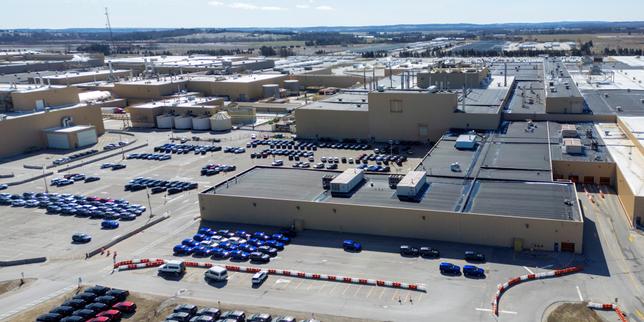
The coffee in Windsor is usually lukewarm by the time the shift changes at seven in the morning. Across the Detroit River, the skyline of Michigan rises like a gray tooth against the frost, familiar and close enough to touch. For decades, that border has been less of a wall and more of a zipper, pulling two economies together so tightly that thousands of people cross it before breakfast just to build transmissions, assemble doors, and wire harnesses that will soon roll out on four wheels.
To understand what happens when a government speaks in percentages and tariffs, you cannot look at macroeconomic charts alone. You have to look at the grease on a mechanic's thumb, the hum of a conveyor belt in Oshawa, and the quiet kitchen table anxiety of a family whose mortgage depends entirely on a customs seal. Learn more on a similar topic: this related article.
Consider a hypothetical worker named Marc. He has spent fourteen years on the line at an assembly plant in Ontario. Every morning, he tightens bolts on vehicles destined for dealerships in Ohio, Texas, and Florida. To Marc, the border is invisible. The parts flow south; the paychecks flow north. It is a rhythm older than his career, a delicate, humming machinery built on the promise of free trade and shared ambition.
Then the vocabulary shifts. More journalism by Associated Press explores related views on this issue.
When political figures start throwing around numbers like a fifty percent tax on manufactured goods crossing an international line, the rhythm stutters. People stop talking about weekend hockey games in the breakroom. They start talking about margins. They start talking about survival.
The core issue here is not merely administrative. It is about geography and momentum. The North American automotive supply chain was never engineered to live behind national barricades. A single vehicle crosses the border multiple times before it ever hits a showroom floor. Steel is smelted in one province, stamped in one state, wired in another, and assembled where the logistics make the most economic sense. Introduce a massive, punitive levy into that equation, and the math breaks instantly.
Imagine trying to build a jigsaw puzzle where someone changes the shape of the edge pieces every few hours.
Economists in Toronto and Washington spend their days parsing the logic of protectionism, arguing whether heavy tariffs act as a shield for domestic manufacturing or a slow-acting poison for consumer purchasing power. But the human reality is far simpler and far more urgent. When the cost of production spikes overnight by half, factories do not simply absorb the blow. They contract. They pause shifts. They look for alternatives where the friction is lower.
And that friction is what terrifies communities whose entire municipal identity is tied to the manufacturing sector. Walk down the main street of any auto town in southern Ontario, and you will see the physical manifestation of this anxiety. The diners, the tool-and-die shops, the local credit unions—they all breathe when the assembly plants breathe.
We have seen this script before. Whenever nations retreat behind economic armor, the immediate casualty is predictability. Investors hate uncertainty more than they hate high taxes. When a sweeping policy shift is floated with a hard deadline—such as the threat of heavy border taxes looming on the horizon—boardrooms freeze. Projects that require billions in capital investment and decades of planning suddenly look like dangerous gambles.
Marc does not care about trade theory. He cares about whether his oldest daughter will be able to start college in the autumn. He cares about whether the credit union will still be friendly if the plant cuts its second shift.
The irony of modern industrial policy is that it often attempts to resurrect a past that no longer exists by using tools that no longer fit. You cannot legislate a twenty-first-century supply chain back into a nineteenth-century fortress without breaking the very engine that made it wealthy in the first place. Every vehicle built across that northern border carries the labor of both nations. To tax one half of that creation is to tax the entire ecosystem.
As the calendar pages turn and the shadows lengthen across the frost-covered parking lots of the borderland, the tension remains palpable. The air in the breakroom is different now. It is quieter, sharper, waiting for the other shoe to drop.
The river keeps flowing beneath the Ambassador Bridge, indifferent to politics, carrying ice chunks toward Lake Erie. But the people standing on its banks know that the invisible line running down the middle of the water is about to get a lot heavier.