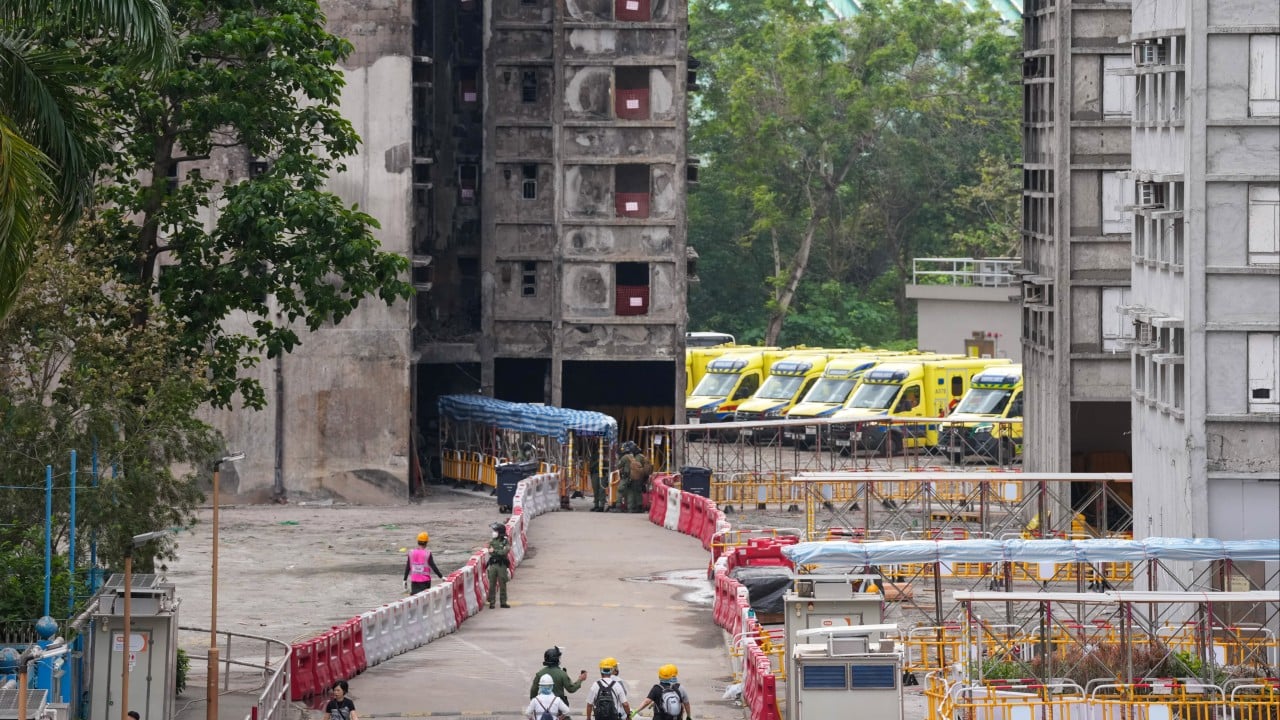
The return of residents to Wang Fuk Court following significant structural or environmental disruption is not a simple homecoming; it is a forced audit of material necessity and spatial efficiency. While traditional reporting focuses on the emotional weight of "leaving things behind," an analytical lens reveals a complex optimization problem. Residents are currently operating under a forced scarcity constraint, where the volume of their previous lives exceeds the current capacity of their reorganized or damaged living environments. This creates a bottleneck in the recovery process, where the speed of reintegration is inversely proportional to the volume of accumulated physical assets.
The Tri-Factor Constraint Model of Post-Disaster Re-entry
Re-entering a residential space after a prolonged absence and subsequent damage assessment requires navigating three distinct, competing pressures. When these factors misalign, the result is the "stuck" state observed in the Wang Fuk Court population.
- Spatial Volumetric Capacity: The physical square footage available is often reduced by structural repairs, the presence of restoration equipment, or the need for increased clearance for safety inspections.
- Economic Utility Threshold: Residents must calculate the cost of cleaning, repairing, or transporting an item against its current replacement value. In post-disaster scenarios, the "sunk cost fallacy" often prevents residents from discarding items that have reached a zero-utility state.
- Hygienic Viability: The presence of mold, soot, or structural contaminants introduces a binary filter. An item is either salvageable within a specific safety margin or it is a liability.
The friction at Wang Fuk Court stems from a failure to synchronize these three factors. Residents are attempting to apply pre-disaster spatial logic to a post-disaster environment, creating a backlog of "undecided" assets that clog the logistics of the move-in.
The Mechanics of Material Attachment and Decision Paralysis
The difficulty in "deciding what to leave behind" is often categorized as sentimentality, but from a strategic standpoint, it is a failure of categorization. Decision paralysis occurs when the criteria for retention are undefined. Residents face a massive data-processing task: evaluating thousands of individual items under high-stress conditions.
The Cognitive Load of Sorting
In a standard relocation, an individual might process 10–20 high-value decisions per day. Returning Wang Fuk Court residents are forced to make hundreds of binary "keep/discard" decisions in a matter of hours. This leads to decision fatigue, where the quality of choices degrades over time. Later in the day, residents are more likely to either discard essential items or—more commonly—attempt to keep everything, thereby failing the spatial constraint.
The Storage Paradox
Residents often seek temporary storage solutions to bypass the immediate need for disposal. However, external storage functions as a high-interest "logic debt." By moving items to a secondary location, the resident pays a monthly premium to delay a decision that will eventually be forced by the same three constraints mentioned above. The cost of storage frequently exceeds the replacement value of the goods within three to six months, yet the lack of immediate liquid capital for replacements makes this a common, if inefficient, choice.
Structural Bottlenecks in the Wang Fuk Recovery Pipeline
The delay in residents' return is not merely a personal choice but a symptom of systemic logistical failures. The "stuck" resident is the visible result of an invisible supply chain disruption.
- Vertical Logistics Congestion: In high-rise structures like Wang Fuk Court, the elevator is the primary throttle. If 20% of the residents are attempting to move large volumes of debris out while others move furniture in, the wait times create a hard cap on the number of successful transitions per day.
- Waste Stream Saturation: Municipal waste systems are designed for steady-state output. A sudden surge of bulk furniture and contaminated materials from a single housing estate creates a localized failure in waste management. When the bins are full, the sorting stops.
- The Labor Gap: Professional restoration services are finite. The "tough decisions" are often made tougher by the absence of expert assessment. Without a professional to verify if a sofa is mold-free, the resident defaults to an uninformed (and often incorrect) risk assessment.
Quantifying the Value of Discarded Assets
To understand the scale of the "tough decisions" at Wang Fuk Court, we must look at the Displacement Depreciation Curve. Household items lose value over time, but in a disaster context, that value drops off a cliff.
Items can be categorized by their Recovery ROI:
- High ROI (Hard Surfaces): Metal, glass, and certain high-grade plastics. These require low-energy input (cleaning) to return to 100% utility.
- Medium ROI (Electronics): Dependent on the nature of the disruption (e.g., smoke vs. water). The cost of diagnostic testing often nears the cost of a new unit.
- Zero/Negative ROI (Porous Materials): Mattresses, upholstered furniture, and low-grade particle board. The energy required to sanitize these often exceeds their market value, and they pose a secondary risk of re-contaminating the restored environment.
The residents "stuck" in their decision-making are frequently over-valuing the Zero ROI category. They see the original purchase price rather than the current negative utility.
The Risk of Re-contamination and Secondary Loss
A critical oversight in the current Wang Fuk Court situation is the risk of "asset-driven re-contamination." Residents who struggle to leave items behind may inadvertently bring environmental hazards back into a remediated space.
If a resident brings a smoke-damaged or mold-spore-heavy wardrobe back into a clean apartment to avoid the "tough decision" of disposal, they trigger a feedback loop. The HVAC system distributes the contaminants, potentially leading to respiratory issues or the need for a second round of professional cleaning. In this scenario, the "kept" item becomes a pathogen that destroys the value of the primary asset: the home itself.
Tactical Framework for Post-Disaster Re-entry
For residents and management at Wang Fuk Court to break the current cycle of indecision, the process must move from an emotional evaluation to a structured protocol. This requires a shift in how the recovery is managed at both the individual and estate levels.
Implement a Tiered Disposal Protocol
Instead of asking "What do I want to keep?", residents should be coached to ask "Does this item meet the 24-hour utility test?" If an item cannot be cleaned, moved, and utilized within 24 hours of re-entry, it moves to a secondary evaluation tier. This forces the most critical decisions to the front of the queue.
Centralized Logistics Management
The estate management must act as a logistics coordinator rather than just a facility provider. This includes:
- Scheduled Disposal Windows: Segmenting the day by "Outbound Waste" and "Inbound Assets" to reduce elevator and hallway friction.
- On-site Appraisal and Sanitization: Providing residents with immediate, expert "Keep/Toss" advice to reduce cognitive load and decision fatigue.
- Bulk Replacement Procurement: Organizing group buys for high-frequency replacement items (mattresses, basic furniture) to lower the economic barrier to discarding damaged goods.
The primary hurdle at Wang Fuk Court is the transition from a state of emergency to a state of optimization. The residents are not just stuck with tough decisions; they are stuck in a system that lacks the data and the logistical support to make those decisions efficiently. The resolution depends on transforming the move-in process from a chaotic, individual struggle into a synchronized, data-driven operation. By prioritizing spatial capacity and hygienic safety over the preservation of low-utility assets, the residents can mitigate the long-term economic and psychological impact of their displacement.
The final strategic move for Wang Fuk Court is the immediate establishment of a "Zero-Friction Disposal Zone" where residents can surrender items with zero financial or logistical penalty, paired with a temporary suspension of bulk-waste fees. This lowers the barrier to disposal and clears the physical path for the estate’s functional recovery.