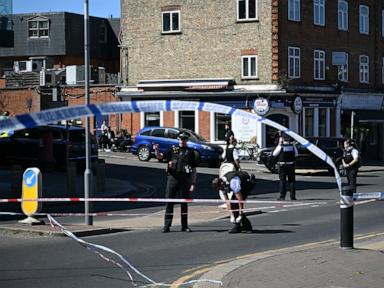
A 28-year-old man faces attempted murder charges following a series of violent stabbings targeting Jewish men in North London, an incident that has once again ignited a fierce debate over how the British legal system categorizes targeted violence. While the Metropolitan Police have not yet formally designated the spree as a terrorist act, the precision of the targets—specifically members of the Charedi community in Stamford Hill—has left local residents and security analysts questioning the gap between public perception and judicial definitions.
The attacks occurred in quick succession. Witnesses described a suspect moving with a chilling sense of purpose, bypassing dozens of potential victims to strike individuals clearly identifiable by their religious attire. This wasn't a random outburst of street violence. It was a surgical strike against a specific demographic, occurring at a time when global tensions frequently spill over into the streets of the capital.
The Legal Tightrope of Intent
Determining whether a crime is "attempted murder" or "terrorism" isn't just about the severity of the wounds. It is about the burden of proof regarding political, religious, or ideological motivation. In the United Kingdom, the Terrorism Act 2000 sets a high bar. Prosecutors must prove that the violence was designed to influence the government or intimidate the public for the purpose of advancing a specific cause.
Often, the police opt for "attempted murder" charges because they are easier to secure in court. A conviction for attempted murder carries a potential life sentence, giving the justice system the teeth it needs without requiring the complex, often fragile evidence needed to prove a broader ideological conspiracy. However, this pragmatic approach often feels like a betrayal to the victims. When a community is targeted for who they are, the "simple" criminal charge can feel like it ignores the soul of the crime.
Security Failures in the Capital
The Stamford Hill attacks didn't happen in a vacuum. For years, the Shomrim—a voluntary Jewish community safety patrol—has been sounding the alarm on the rising frequency of low-level harassment that eventually escalates into physical assault. They are often the first on the scene, sometimes arriving before the blue lights of the Met Police are even visible on the horizon.
This reliance on private, community-funded security highlights a uncomfortable truth about modern policing in London. The Met is stretched thin, dealing with a recruitment crisis and a mandate that forces them to prioritize reactive measures over neighborhood visibility. When a community has to police its own streets to feel safe, the social contract is already frayed. The suspect in this case was apprehended, but the fear remains that the next assailant is already watching from the shadows, emboldened by the perceived gaps in the city's security net.
The Psychology of the Lone Actor
Police investigators are currently digging into the suspect’s digital footprint and mental health history. This is the standard playbook for the "lone actor" phenomenon. We see a recurring pattern in these cases. An individual, often socially isolated, consumes a diet of polarized content online. They don't need a handler or a cell. They only need a grievance and a blade.
The difficulty for intelligence services is that these individuals are nearly impossible to track. They don't communicate with known extremist groups. They don't buy chemicals or firearms that trigger red flags. They use common household items to commit atrocities. This "low-tech" approach to violence is the biggest challenge facing the Counter Terrorism Command (SO15) today. It turns the entire urban environment into a potential crime scene.
Radicalization Beyond the Usual Suspects
We often talk about radicalization in terms of foreign influence or organized hate groups. But there is a growing trend of "eclectic" ideologies—a mix of personal resentment, mental instability, and a surface-level adoption of extremist tropes. This makes the "why" much harder to pin down.
In the North London case, the choice of victims suggests a specific animus, but the legal system must determine if that animus is a coherent ideology or the byproduct of a fractured mind. For the victims, the distinction is academic. The trauma of a knife in the dark is the same regardless of the attacker's manifesto.
The Impact on the Charedi Community
Stamford Hill is home to one of the largest Orthodox Jewish populations in Europe. It is a tight-knit, visible, and deeply traditional area. This visibility makes it a target. Following the stabbings, the atmosphere in the neighborhood changed overnight. Parents are hesitant to let children walk to cheder alone. Shopkeepers keep one eye on the door.
This is the hidden cost of targeted violence. It isn't just the physical recovery of those stabbed; it is the collective psychological withdrawal of an entire neighborhood. When the state fails to provide a convincing deterrent, the community begins to insulate itself, further deepening the divides in an already fragmented city.
Breaking the Cycle of Reactive Justice
The government’s response to these incidents is usually a flurry of press releases promising "zero tolerance." Yet, we see the same patterns repeat. The real work of prevention happens long before a knife is drawn. It involves aggressive monitoring of hate speech, better mental health intervention for those drifting toward violence, and a police presence that doesn't just appear after the blood is spilled.
If the UK continues to treat these attacks as isolated criminal acts rather than symptoms of a deeper social rot, the frequency of these "isolated" events will only increase. We are reaching a tipping point where the standard legal framework is no longer sufficient to address the reality of the streets.
Security isn't a luxury. It is the baseline requirement for a functioning society. The men in Stamford Hill were targeted because they were identified as "the other." Until the justice system can confront that reality head-on, the streets of London will remain a staging ground for those who believe that violence is a legitimate form of expression.
Demand more than a charge sheet. Demand a strategy that addresses the radicalization happening in plain sight.


