The air inside the Gaylord National Resort and Convention Center feels different than the humid May breeze blowing off the Potomac River. It is heavy. It smells of floor wax, industrial air conditioning, and a very specific, high-octane brand of anxiety.
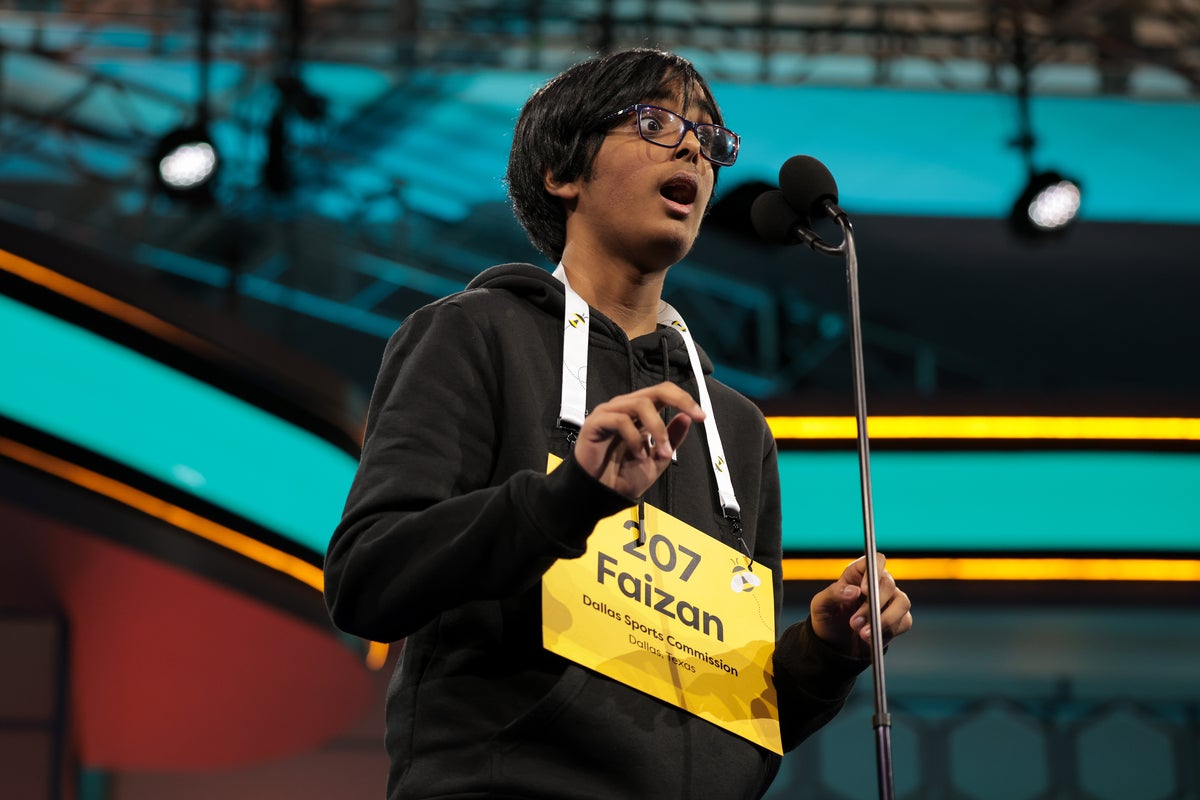
On this stage, a twelve-year-old boy named Akash stands alone. He is small for his age, swallowed by a button-down shirt that was crisp two hours ago but is now wilted from the heat of his own skin. He is not looking at the audience of thousands. He is not looking at the bright lights or the television cameras that are broadcasting his every blink to the nation. He is looking at Jacques Bailly.
Bailly is the official pronouncer, the gatekeeper of the dictionary, and for the next thirty seconds, the most important person in Akash’s universe.
"The word is psittacine," Bailly says.
Silence.
Akash breathes. He asks for the language of origin. He asks for the definition. He asks for the word to be used in a sentence. These are not just stalling tactics; they are the ritualistic tools of a high-stakes surgeon. In his mind, Akash is visualizing the Latin roots, the Greek suffixes, the weird, jagged edges of the English language that make no sense to anyone but the obsessed.
This is the 2026 Scripps National Spelling Bee. To the casual viewer flipping channels on Ion or Scripps News, it looks like a trivia contest. To the kids on stage, it is a gladiator pit where the only weapon is a mental alphabet.
The weight of a single letter
We often treat these kids like calculators in human skin. We marvel at their memory but forget their pulse.
The reality is that for every finalist standing under those hot lights, there were years of five-thirty a.m. study sessions. There were weekends spent staring at spreadsheets of obscure botanical terms while their friends were at the movies. There is a specific kind of heartbreak that comes from losing because of a silent 'h' you knew was there, but your tongue forgot to say.
Consider the stakes of this year’s competition. The winner doesn't just get a trophy; they walk away with a $50,000 cash prize from Scripps, along with additional rewards from Merriam-Webster and Encyclopedia Britannica. For a middle-schooler, that isn't pocket change. It’s a college fund. It’s the tangible proof that their obsession meant something.
But the money is secondary to the "Bee Family." If you walk through the hallways of the convention center during the preliminary rounds, you see a strange phenomenon. You see competitors teaching each other roots. You see a girl from Texas consoling a boy from Ohio who just tripped over chiaroscurist. It is a community built on the shared burden of knowing too much about a language that refuses to follow its own rules.
How the machine works
The 2026 Bee has evolved from the simple schoolhouse contests of a century ago. It is now a multi-stage gauntlet. It begins with the Preliminaries, where over 200 regional champions—the best of the best from every state and several countries—face a combination of written tests and on-stage spelling.
The written portion is the silent killer. It’s not just about spelling; it’s about vocabulary. You might be able to spell pfeffernuss, but if you don't know it’s a tiny spice cookie, the 2026 rules might still send you home. This shift toward "word meaning" was designed to ensure these kids aren't just memorizing strings of letters, but actually understanding the architecture of thought.
The schedule is grueling:
- The Preliminaries: Tuesday and Wednesday morning. This is the great thinning of the herd.
- The Quarterfinals and Semifinals: Wednesday afternoon. This is where the tension becomes physical. You can see the exhaustion in their eyes.
- The Finals: Thursday night. Prime time. The lights go down, the music swells, and the world watches.
For those trying to catch the action, the 2026 broadcast has moved toward a more immersive experience. Ion and Scripps News carry the live segments, but the real drama often happens in the "Comfort Room" backstage, where eliminated spellers go to cry, eat a snack, and realize that life goes on even if you misspelled hypotrichosis.
The ghost in the dictionary
There is a myth that spelling is a stagnant art. We think the dictionary is a finished book.
It isn't. Every year, new words are added—slang, scientific breakthroughs, cultural shifts—and the spellers have to keep up. They are chasing a moving target.
I remember talking to a former competitor who described the feeling of being at the microphone. She said it felt like standing on a narrow bridge in a fog. You can only see one step in front of you. If you think about the thousand people watching, you fall. If you think about the prize, you fall. You have to live entirely inside the word.
"You have to love the word more than you fear the mistake," she told me.
That is the human element we miss when we mock the "nerdiness" of the Bee. These children are practicing a level of mindfulness and presence that most adults pay thousands of dollars to learn in meditation retreats. They are facing the possibility of public failure—the kind that gets clipped and turned into a meme—and they are doing it with more grace than most corporate executives.
The final gauntlet
As the 2026 competition reaches its crescendo on Thursday night, the rules change slightly. If the pool of finalists is too large, the Bee may trigger a "spell-off." This is the linguistic equivalent of a penalty shootout.
In a spell-off, contestants have ninety seconds to spell as many words as possible from a pre-determined list. It is no longer about deep contemplation or asking for the language of origin. It is about raw, panicked speed. The sound of the keys clicking and the rapid-fire letters creates a rhythm that feels like a heartbeat.
But why do we watch?
We watch because we want to see someone be perfect. In a world of "good enough" and "auto-correct," the Spelling Bee is one of the few places left where a single mistake is final. There is no "delete" key. There is no "undo." There is only the bell.
The bell is the most brutal sound in sports. It’s a short, sharp ding that rings when a speller gets a letter wrong. It cuts through the air like a knife. The moment that bell rings, the speller's journey ends. The judge says the correct spelling, the audience gives a sympathetic "aww," and the child has to walk off the stage.
The walk off-stage
That walk is the most important part of the story.
Watch the kids who lose. They don't usually throw tantrums. They shake the hand of the person who stayed on stage. They walk to their parents. And then, usually within an hour, they are back in the lobby, talking to their peers about the words they got.
The 2026 Scripps National Spelling Bee will crown a champion who will hold a trophy high and be showered in confetti. They will go on the morning talk shows and spell supercalifragilisticexpialidocious for a laughing host.
But the real story is the other 200 kids. The ones who learned that they could survive the bell. They learned that they could stand alone on a stage in front of the world, face a word they had never heard of, and try anyway.
Akash stands at the mic. He takes a breath. He hears the word psittacine.
"P," he begins. His voice is steady. "S-I-T..."
The audience holds its breath. He pauses. He remembers a root he studied at four in the morning three months ago. He remembers his mother holding a flashcard. He sees the "T" in his mind.
"T-A-C-I-N-E."
"That is correct," Bailly says.
Akash doesn't smile yet. He just nods, turns, and walks back to his seat, a little less alone than he was thirty seconds ago.
The dictionary is vast, and the lights are bright, but for one more round, the bell stays silent.