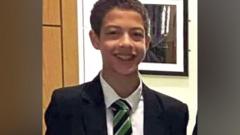
A courtroom in mid-summer carries a particular kind of silence. It is not the peaceful quiet of an empty room, but the heavy, airless stillness of people waiting for an explanation that may never fully come. For weeks, the Belfast Coroner’s Court has sat in this muted state. The legal teams have finished their arguments. The microphones are mostly quiet. What remains is a 105-page summation, a stack of unanswered phone logs, and the memory of a fourteen-year-old boy who rode his bicycle into a June evening six years ago and simply vanished from the surface of the earth.
The story of Noah Donohoe has consumed Northern Ireland since 2020. To the outside world, it is a complex legal puzzle—a tangle of conflicting forensic psychology reports, missing pieces of clothing, and a massive police log that didn't always connect the dots in time. But inside the courtroom, the abstraction drops away. The case has narrowed down to a single, devastating question that twelve ordinary citizens must now answer: Did the systematic errors of the institutions built to protect us contribute to a child’s lonely death in the dark?
To understand how a routine police search became a crisis of public trust, you have to look at the hours when the ground was still fresh and the trail was still warm.
The Clock That Couldn't Be Rewound
When a child goes missing, time does not behave normally. Minutes compress. Hours become canyons. On Sunday, June 21, 2020, Noah left his home on a bicycle, planning to meet friends at a nearby park. He was an intelligent, quirky teenager, deeply immersed in books and full of plans for the future. By that evening, his mother, Fiona, knew with the agonizing certainty only a parent possesses that something was terribly wrong. She called the Police Service of Northern Ireland (PSNI).
In the initial phase of any missing person investigation, the flow of information is everything. It is like assembling a map while running across the terrain. We now know, through weeks of grueling testimony, that the map used by the search teams had massive, empty spaces where vital data should have been.
Consider the timeline that the jury has been forced to dissect. It took seven hours for the police to relay Noah’s last known location to the actual personnel on the ground conducting the physical search. Think about what seven hours means when a teenager is missing in a city. It is the difference between a targeted, localized rescue operation and a blind, sprawling frantic gamble across square miles of urban landscape. While search parties were looking in one sector, Noah's actual path had already veered sharply into another.
But the breakdown wasn't just a matter of hours lost on a digital log. It was a failure to listen to the city itself.
During those first critical nights, as a mother waited at home, the neighborhood surrounding North Belfast was trying to speak. Two people reported hearing terrifying screams piercing the middle of the night. Another woman, awake at 3:30 in the morning with her newborn baby, heard the metallic clatter of her letterbox being opened and closed repeatedly. These were not vague, distant rumors; they were specific, localized distress signals from a community waking up to an unfolding tragedy.
The police never followed up on those statements at the time. No officers knocked on those doors to take official statements while memories were fresh. The logs were filed away, ignored, left to age into regrets. It wasn’t until years later, during the slow-moving gears of the inquest, that these witnesses finally stood in a witness box to tell a jury what they had heard in the dark.
The Unlocked Door
There is an old engineering maxim that safety is not the presence of good luck, but the absence of oversight. As the investigation drifted through that first week of June 2020, it eventually led to a patch of land owned by the Department for Infrastructure.
Behind a row of houses sits a culvert—a concrete inlet designed to swallow stormwater and channel it deep beneath the streets of Belfast. The entrance was shielded by a heavy metal grille. It was supposed to be a fortress, an impassable barrier separating the safe, daylight world of the neighborhood from a dangerous subterranean network of fast-flowing water and zero visibility.
But the gate was not padlocked. It could be easily swung open by anyone who stumbled upon it.
During the inquest, senior officials took the stand. When pressed on why a lethal underground tunnel system in a residential area was left accessible to any passing child, the answers crumbled into bureaucratic evasion. The department, by its own admission to the court, "didn't have a clue" if the culvert was securely locked or whose job it was to check. To them, the idea of someone wandering into that concrete throat was not "reasonably foreseeable".
Yet, Noah did.
The final images of the boy captured on CCTV show a sequence of events that forensic psychologists have spent years trying to decode. He began discarding his possessions—his rucksack, his laptop, his clothing—in a manner that suggested a sudden, profound psychological crisis. He was running naked through the streets, completely stripped of his bearings, drawn toward the sound or the coolness of the water.
If that gate had been secured with a standard ten-pound padlock, the narrative would have stopped at the perimeter fence. The boy would have been found on the surface, cold, confused, but alive. Instead, the open grille offered a path of least resistance into the earth.
What the Walls Remember
Six days after he disappeared, a search team finally entered the storm drain. The conditions inside were described by an officer on the stand as "horrendous". Total darkness. Cold water rushing past the knees. The air thick and damp.
They found Noah’s body deep within the tunnel system. The medical examiner concluded the cause of death was drowning. But the most haunting piece of evidence presented to the jury did not come from a laboratory or a medical chart. It came from a police constable who looked at the concrete walls of the drain near where the boy was discovered.
There, visible in the beam of the flashlight, were finger marks etched into the grime and silt on the walls. The officer testified that he believed those marks were made by Noah himself, trailing his hands along the dark concrete as he moved through the water.
That image is the emotional center of this entire tragedy. It bridges the gap between the dry, clinical language of "post-mortem examinations" and the terrifying human reality of a child lost in a pitch-black labyrinth underneath his own city. It is the point where the failure of institutional systems stops being an administrative error and becomes a human catastrophe.
The police have since apologized. The officer in charge of the investigation stood before the family and expressed deep regret for the breakdown in communication and the fractures that opened up between the authorities and a grieving mother. But an apology cannot patch the holes in a seven-hour delay, nor can it lock a gate that should have been sealed decades ago.
The Weight of the Verdict
The jury's task now is not to find a criminal. An inquest does not sentence people to prison, nor does it hand down fines. Its purpose is far older and more fundamental: to look directly at a tragedy, to strip away the excuses of bureaucracy, and to declare exactly how a member of the community lost their life.
The twelve people in that room are being asked to decide if the state's failures were merely unfortunate coincidences or if they form a direct chain of cause and effect that led to the bottom of that storm drain. They must weigh the value of those seven lost hours, the ignored cries in the night, and the unlocked gate that stood waiting in the shadows.
Every parent understands the implicit contract we make with the world when we let our children walk out the front door. We accept that we cannot protect them from every random illness or sudden twist of fate. But we rely on the invisible net of society—the police who watch the streets, the infrastructure designed to keep danger at bay, the neighbors who look out for one another—to catch them if they fall.
When that net unravels, piece by piece, hour by hour, the world becomes a vastly more terrifying place.
The jury will return with their findings soon. They will fill out the questionnaires, they will sign the forms, and the legal teams will pack up their heavy binders. The courtroom will eventually be wiped clean for the next case. But for a mother who spent six days searching the streets of Belfast, the verdict is not an ending. It is simply a formal, public acknowledgment of the size of the hole left behind when a boy rode away on his bicycle and the world failed to bring him home.