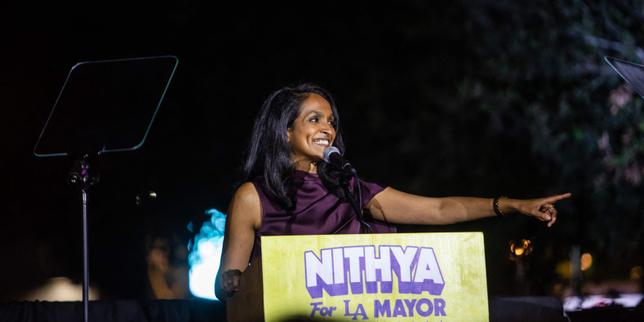
Municipal governance in the United States is shifting from machine-driven consensus to ideological execution. The 2026 Los Angeles mayoral election, culminating in the victory of Nithya Raman, demonstrates that the modern American progressive movement has evolved beyond protest politics into an operational governing apparatus capable of capturing executive power in major metropolitan economies.
Standard political commentary frames such victories as mere populist waves or temporary reactions to localized dissatisfaction. That framing misses the structural mechanics at play. An electoral win of this magnitude in the second-largest city in the United States requires a repeatable formula combining demographic realignment, asymmetric campaign infrastructure, and a fundamental shift in the voter value proposition. Also making waves in this space: The Quiet Erasure of 548 Death Sentences in California.
The Structural Anatomy of the 2026 Los Angeles Coalition
To understand how an insurgent urbanist and democratic socialist platform secured the executive office of Los Angeles, one must examine the breakdown of the traditional Democratic establishment. For decades, Los Angeles politics operated on a tripartite alliance between business interests, traditional public-sector labor unions, and moderate neighborhood homeowners. This coalition prioritized incrementalism, property value preservation, and low-friction commercial development.
The 2026 outcome signals the collapse of that equilibrium. The new winning coalition replaces the homeowner-business axis with an alliance of rent-burdened service workers, progressive public-sector unions, and younger, college-educated urbanites. Additional insights regarding the matter are covered by The Washington Post.
The Three Pillars of the Electoral Shift
The Renter Majority Threshold
Los Angeles is structurally a city of renters, yet historical off-cycle and primary turnouts were dominated by older, single-family homeowners. By aligning municipal election schedules with high-turnout federal cycles—a structural reform implemented earlier in the decade—the electorate expanded to reflect actual residential demographics. When the voting pool mirrors the tenancy rate, policies centered on tenant protections, rent stabilization, and aggressive social housing construction transition from fringe demands to median-voter priorities.Distributed Field Operations Over Broadcast Media
Traditional mayoral campaigns rely on capital-intensive television buys and institutional endorsements to manufacture name recognition. The victorious 2026 campaign inverted this cost function. By utilizing decentralized volunteer networks, relational organizing software, and hyper-local mutual aid frameworks established during prior City Council runs, the campaign achieved high-frequency voter contact at a fraction of the traditional customer acquisition cost.Executive Legibility of Progressive Policy
Voters frequently reject progressive candidates for executive roles due to perceived administrative incompetence, even when agreeing with their ideological goals. Raman’s trajectory from urban planner to City Councilmember representing District 4 provided the necessary operational credibility. Voters were not asked to take a leap of faith on an activist; they were presented with a technocrat fluent in municipal budgeting, zoning codes, and housing production metrics.
Deconstructing the Policy Matrix Housing, Policing, and Fiscal Reality
Capturing City Hall is an exercise in campaign logistics; governing Los Angeles is an exercise in resource allocation under severe statutory constraints. The administration inherits a structural deficit, a persistent homelessness crisis, and a municipal bureaucracy notoriously resistant to rapid reform.
The Housing Supply Bottleneck
The core mandate of the new administration rests on resolving the housing affordability crisis. In Los Angeles, the friction between housing demand and supply is exacerbated by exclusionary zoning laws, environmental review litigation under the California Environmental Quality Act (CEQA), and high construction financing costs.
The new left’s approach shifts the city away from relying exclusively on market-rate developers to subsidize affordable units through inclusionary zoning. Instead, the policy matrix prioritizes:
- Public-Sector Development: Utilizing municipal land and public financing vehicles to build social housing directly, bypassing private profit margins.
- Regulatory Deregulation for Density: Streamlining permitting processes for multi-family units near transit corridors while maintaining strict tenant anti-displacement mandates.
- Land Value Capture: Implementing targeted taxes on high-value real estate transactions to fund permanent supportive housing.
The primary operational risk in this strategy lies in capital flight. If regulatory burdens and transfer taxes exceed the risk-adjusted return thresholds of private institutional investors, overall housing starts will contract. The city cannot publicly finance enough units to offset a total freeze in private multi-family construction.
Public Safety and the Reallocation of Municipal Capital
In prior electoral cycles, progressive candidates struggled to neutralize attacks regarding crime and public order. The 2026 campaign neutralized this vulnerability by reframing public safety as an infrastructural and behavioral health issue rather than a purely punitive one.
The operational blueprint involves decoupling non-violent emergency response from armed law enforcement. By scaling unarmed crisis intervention teams and expanding municipal mental health infrastructure, the administration aims to reduce the overtime expenditures of the Los Angeles Police Department (LAPD)—a line item that consistently destabilizes the city’s general fund.
The limitation of this model is execution speed. Training, certifying, and deploying civilian crisis responders takes years, whereas public demand for immediate street-level order is instantaneous. Any spike in visible disorder during the transition period will be weaponized by moderate councilmembers and business coalitions to stall budget reallocations.
The National Template Asymmetric Urbanism in the 2026 Midterms
The significance of the Los Angeles mayoral race extends far beyond Southern California. In the broader context of the 2026 midterm elections, it serves as a proof of concept for a distinct strain of American left-wing politics that diverges sharply from national Democratic Party orthodoxy.
National Democratic strategists frequently advocate for ideological moderation to capture suburban swing districts in battleground states. The Los Angeles model demonstrates that in major metropolitan cores, moderation depresses base turnout without winning over conservative-leaning homeowners. Instead, ideological clarity coupled with hyper-local material promises generates the enthusiasm required to overcome massive spending disadvantages from corporate Political Action Committees (PACs).
The Mechanics of National Replication
This metropolitan blueprint is currently being deployed across other high-cost urban centers, including Chicago, New York, and Seattle. The replication relies on three transferable mechanisms:
- Down-Ballot Incubation: Progressive movements no longer target executive offices directly. They first capture legislative seats (city councils, state assemblies) to build policy fluency, establish constituent service networks, and demystify their governance style before scaling up to mayoral races.
- Labor Realignment: Traditional building trades unions, which often align with moderate pro-development candidates, are increasingly countered by service-sector, healthcare, and educators' unions. These organizations possess massive human capital for canvassing and view municipal government as the primary employer and regulator of their members' livelihoods.
- Ideological Insulation: By framing local elections around tangible municipal utilities—transit frequency, pothole repair, rent caps, and sanitation—progressive candidates insulate themselves from nationalized culture-war narratives that frequently damage Democrats in federal races.
Operational Vulnerabilities and the Governing Trap
Winning the executive seat exposes the new left to the exact institutional friction it previously critiqued from the outside. Los Angeles operates under a "weak mayor" charter system compared to cities like New York. The Mayor appoints department heads and proposes the budget, but the fifteen-member City Council holds immense legislative power, land-use veto authority within their individual districts, and budgetary amendment control.
The Council District Veto Dynamic
In Los Angeles, individual councilmembers historically exercise near-total autonomy over zoning and homeless shelter siting within their districts—a norm known as councilmanic prerogative. A progressive mayor attempting to distribute supportive housing equitably across affluent, low-density neighborhoods will immediately collide with moderate councilmembers protecting their homeowner constituencies. Without a unified legislative supermajority on the Council, executive directives risk stagnation in committee hearings.
Fiscal Constraints and Bond Market Discipline
Unlike the federal government, municipalities cannot run indefinite deficits. Los Angeles must balance its budget annually, and its borrowing costs are dictated by municipal bond rating agencies. If aggressive social spending or new municipal enterprise initiatives threaten the city's reserve funds, credit downgrades will increase the cost of debt service, eating directly into the capital available for progressive programs. The administration must manage the contradiction between expanding the social safety net and maintaining the fiscal conservatism demanded by institutional lenders.
Strategic Imperatives for the Incoming Administration
The transition from insurgent campaign to governing reality requires immediate structural adjustments. The ideological alignment that won the election will fracture if tangible material improvements do not materialize within the first twenty-four months.
To prevent administrative gridlock and secure a durable governing majority, the executive office must execute three immediate plays:
- Centralize Permitting Authority via Executive Directive: Bypass district-level land-use bottlenecks by declaring a continuous municipal housing emergency, utilizing executive authority to enforce by-right approvals for 100% affordable and public-sector developments across all residential zones, including single-family neighborhoods.
- Audit and Reallocate Departmental Overtime: Conduct an immediate zero-based budgeting review of the city’s largest operational agencies, redirecting unspent overtime allocations directly into civilian street-services and rapid-rehousing pipelines before the next fiscal year cycle locks in baseline spending.
- Institutionalize the Field Network: Convert the campaign’s volunteer infrastructure into a permanent civic-engagement apparatus. Use this distributed network to apply targeted constituent pressure on hesitant City Council members ahead of critical land-use and budgetary votes, turning campaign organizers into legislative lobbyists.


