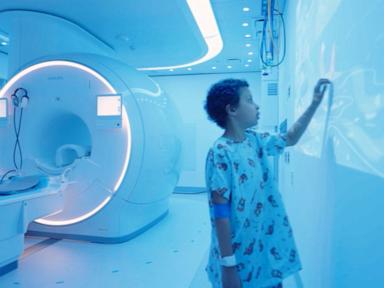
The noise hits you first. It is not a gentle hum or a predictable mechanical whir. It is a rhythmic, aggressive jackhammering, a metallic shrieking that sounds like a diesel engine trapping you inside a steel drum.
Now, subtract your adult understanding of physics and medicine. Strip away your knowledge of superconductive magnets and radiofrequency waves. Shrink your perspective until your eyes are barely three feet off the ground. You are six years old. You are wearing a scratchy hospital gown, cold air is biting at your ankles, and you are being slid backward into a narrow, dark plastic tunnel.
"Don't move," a disembodied voice tells you over an intercom. "If you move, we have to start all over again."
For a child, a magnetic resonance imaging (MRI) suite is not a marvel of modern diagnostic technology. It is a sensory assault. It is a spaceship built by villains. The sheer terror of the experience creates a massive, hidden crisis in pediatric medicine, one that has vexed hospital administrators and radiologists for decades.
To get a clear image of a brain tumor, a torn ligament, or a congenital heart defect, the patient must remain absolutely still. A single flinch, a sudden gasp of fear, or the involuntary trembling of a terrified child blurs the scan. The data becomes useless.
Historically, hospitals relied on a heavy-handed solution to this problem: general anesthesia. If a child cannot cope with the machine, put them to sleep.
But knocking a child out is never a casual decision. Anesthesia carries inherent risks, requires hours of fasting, necessitates a recovery room stay, and spikes the cost of a medical visit by thousands of dollars. It turns a scary afternoon into a full-scale medical ordeal for the entire family. Pediatric hospitals routinely report that up to 80 percent of pediatric patients under the age of nine require sedation just to get through an MRI.
Think about that number. Four out of five young children must be medically unconscious just so a machine can take a picture of their inside.
The real tragedy is that the fear is entirely manufactured by the environment. The machine isn't hurting them. The radiation doesn't exist. The pain is zero. The enemy is purely psychological.
A few years ago, a team of designers and medical professionals looked at this bleak reality and asked a different question. What if the solution isn't a stronger sedative, but a better story?
The human brain is a narrative engine. We make sense of chaos by wrapping it in a plot. When a child enters a standard MRI room, their brain fills the blank spaces of the cold, clinical environment with a horror story. The goal, then, was to replace that horror story with an adventure.
This is where an unexpected alliance formed between pediatric radiology departments and the master storytellers at Disney.
The concept seems deceptively simple on the surface: decorate the room. But true experiential design goes far deeper than sticking a few vinyl decals of Mickey Mouse on a plastic casing. It requires a total restructuring of the sensory journey, transforming a clinical trial into an interactive installation.
Let us walk through a hypothetical, yet entirely accurate, afternoon for a child named Leo under this new paradigm.
Leo does not walk into a room that smells of isopropyl alcohol and looks like a sterile laboratory. Instead, he steps into a vibrant, sun-drenched jungle. The walls are wrapped in floor-to-ceiling graphics of ancient trees and playful animals. The massive, intimidating MRI machine in the center of the room is no longer a technological monolith; it has been transformed into a hollowed-out log resting by a riverbank.
Before Leo even sets foot in the scanner, a child life specialist hands him a comic book. This is his briefing. He is not a patient undergoing a diagnostic procedure; he is an explorer on a critical mission. He learns that to find the hidden treasure, he must ride inside the magic log.
The specialist explains the terrifying noises before they happen, reframing them entirely within the context of the game. The jackhammer sound? That is just the canoe's engine revving up to go down the rapids. The high-pitched squealing? That is the warning signal from the ship's computer as they pass through an asteroid field.
By the time Leo lies down on the table, his heart rate is stable. His hands are not clenched into fists.
As the table slides into the bore of the machine, a specialized projection system activates. Right in front of Leo’s eyes, a tiny screen displays a customized animated short film. He watches favorite characters navigate the very same jungle he saw on the walls. The audio plays through specialized, non-magnetic headphones that dampen the roar of the scanner while delivering the dialogue and music directly to his ears.
Crucially, the narrative requires his participation. At certain moments in the cartoon, a character might say, "Shh! A tiger is coming! Everyone freeze like a statue!"
Leo freezes. He holds his breath. He complies perfectly with the medical requirements of the scan, not because he is terrified of messing up, but because he wants to help his animated friends complete their mission.
The technicians in the control room watch their monitors. The images coming through are crisp, sharp, and flawless. No motion artifacts. No blurred edges.
The metrics resulting from these themed suites tell a story that numbers alone can rarely capture.
When hospitals implement these immersive environments, the reliance on pediatric sedation plummets. Some institutions have reported a 50 to 60 percent reduction in the need for general anesthesia for children in the critical four-to-eight age range.
The ripple effect of that single statistic is profound.
Consider what happens next for the hospital's operational efficiency. An MRI scan that requires anesthesia can take hours of preparation, scheduling with an anesthesiologist, and post-procedure monitoring. A scan without sedation takes fifteen to twenty minutes. When children can sail through the process awake, the hospital can scan more patients per day. The waiting list for critical diagnostics shrinks from months to weeks. Families get answers faster.
Then there is the emotional ledger, the invisible metric that never shows up on a balance sheet.
Imagine the parent who has spent days sick with anxiety, knowing their child has to be put under anesthesia just to check on a chronic condition. They sit in the waiting room, bracing for the inevitable tears, the screaming, the post-sedation grogginess and vomiting.
Instead, the door opens. The child walks out, holding a sticker, talking animatedly about a jungle cruise. The parent breathes. A heavy, suffocating weight lifts from the room.
Medicine has spent centuries mastering the physical mechanics of healing. We have developed incredible tools to peer inside the human flesh, to map the brain down to the millimeter, to target disease with microscopic precision. Yet, in our pursuit of mechanical perfection, we often treat the human psyche as a secondary concern, an inconvenient variable to be managed or suppressed.
The transformation of the pediatric MRI reminds us that the mind and the body are not separate departments. Fear is a physical burden. Joy is a clinical tool.
By utilizing the art of illusion, color, and character, a terrifying tube of magnets becomes a stage for courage. We have not changed the technology itself; the magnets still spin, the currents still crash, and the noise remains incredibly loud. But we have changed what that noise means to the person listening.
A child steps out of the machine, looks up at their parents, and asks if they can come back tomorrow. That is the real magic. That is the triumph of a story well told over cold, unfeeling steel.