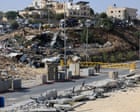
Every time an excavator rolls into the West Bank, legacy newsrooms dust off the exact same template.
They send a stringer to film weeping families. They snap a photo of a dust-covered teddy bear sitting in the rubble. They publish a headline screaming about soldiers razing a neighborhood, and then they pat themselves on the back for speaking truth to power.
It is lazy journalism. Worse, it actively misleads the public about why this happens, how it operates, and why standard international outrage has failed to stop a single bulldozer in over fifty years.
If you actually want to understand the mechanics of home demolitions in Hebron, stop reading emotionally manipulated wire copy. You have to look at the cold, hard, bureaucratic machinery of municipal zoning law, Ottoman land registries, and military court jurisdictions. Because the real story in Hebron isn't a chaotic burst of military aggression. It is a slow-motion, hyper-legalistic war of attrition fought with building permits.
The Lie of the Sudden Raid
Mainstream outlets love the framing of the sudden, unprovoked military strike. It makes for gripping television. It fits neatly into a good-versus-evil binary that requires zero historical or legal context from the reader.
That framing is a fiction.
In reality, the demolition of structures in Hebron—particularly in the H2 sector controlled by the Israeli military and the surrounding Area C territories—is almost never a spontaneous tactical decision by soldiers on the ground. It is the final, predictable step in a bureaucratic process that often drags on for years, sometimes decades, through the Israeli Civil Administration and the Supreme Court.
I have spent years dissecting geopolitical reporting and watching well-funded advocacy groups pour millions into media campaigns that completely miss this mechanism. They treat a demolition order like an artillery strike. You cannot lobby against a zoning ordinance using the same rhetorical tools you use against an airstrike. When journalists erase the bureaucratic paper trail to make the story punchier, they strip their audience of the only information that actually explains the conflict.
Here is the uncomfortable truth: the overwhelming majority of demolitions in the Hebron hills and surrounding neighborhoods are executed as administrative enforcement against "illegal construction."
Before you recoil at that phrase, understand what it actually means on the ground. Under the Oslo Accords of the 1990s, Hebron was divided into H1 (administered by the Palestinian Authority) and H2 (under Israeli military control, housing several hundred Israeli settlers amidst tens of thousands of Palestinians). Outside the city center, the rural hills fall into Area C, where Israel retains full civil and security control, including planning and zoning.
To build a home, dig a cistern, or even put up a goat pen in Area C or restricted zones of H2, a Palestinian resident must obtain a building permit from the Civil Administration.
The catch? Those permits are virtually impossible to get.
According to data compiled by the United Nations Office for the Coordination of Humanitarian Affairs (OCHA) and Israeli human rights organizations like B'Tselem, approval rates for Palestinian building permits in Area C consistently hover around one to two percent. Meanwhile, populations grow. Families expand. Children grow up and need places to live. So, people build without permits. The Civil Administration issues a stop-work order, followed by a demolition order. Years pass. Appeals are filed, rejected, and exhausted. Then, the bulldozers arrive.
When a news headline says "Israeli soldiers raze neighborhood," it implies a rogue military action. It hides the fact that the state is using the mundane, dry language of urban planning—the exact same legal concepts used by city councils in London, New York, or Paris—to reshape demographics.
Stop Asking Who Is to Blame and Start Asking How the System Works
If you look at search trends whenever a demolition hits the news, people are constantly asking the same surface-level questions.
Why are homes being demolished in Hebron?
Is destroying homes in the West Bank legal?
The standard media answers to these questions are useless because they are entirely circular. One side says it is illegal collective punishment under the Fourth Geneva Convention. The other side says it is standard enforcement of local municipal law against unauthorized structures. Both sides talk past each other, and the reader walks away knowing less than when they started.
Let's dismantle the premise of the "legality" question.
In international law, the Fourth Geneva Convention—specifically Article 53—prohibits an occupying power from destroying real or personal property belonging individually or collectively to private persons, except where such destruction is rendered absolutely necessary by military operations. Legal scholars from the International Committee of the Red Cross (ICRC) have stated repeatedly that administrative demolitions for lack of permits do not meet the threshold of "military necessity."
So, why does the Israeli Supreme Court repeatedly uphold them?
Because Israel applies a complex hybrid of legal frameworks. It relies on the British Mandate Defense (Emergency) Regulations of 1945, Jordanian planning laws from before 1967, and Israeli military orders. Under this domestic legal architecture, the High Court of Justice views itself as reviewing administrative compliance. If a structure was built without a permit, and the petitioner cannot prove ownership through historical Ottoman-era land deeds (known as Tabu), the court rules that the state has the right to enforce zoning laws.
Do you see the disconnect?
Critics yell about the Geneva Convention. The state responds with Jordanian zoning statutes from 1966. They aren't even playing the same sport, let alone arguing over the same rulebook. Journalists who fail to explain this jurisdictional chasm are committing malpractice. They present a clash of rigid legal systems as a simple bar fight.
The Three Categories Nobody Distinguishes
To understand Hebron, you have to stop lumping all demolitions together. Media outlets routinely conflate three entirely distinct practices, destroying any analytical clarity.
- Administrative Demolitions: These are the zoning enforcement actions discussed above. They account for the vast majority of destroyed structures in the South Hebron Hills (like Masafer Yatta) and the outskirts of the city. They target homes, schools, solar panels, and agricultural infrastructure built without Civil Administration permits.
- Punitive Demolitions: This is the practice of sealing or destroying the family home of a Palestinian accused or convicted of carrying out a deadly attack against Israelis. Here, the state drops the zoning pretext entirely and invokes Regulation 119 of the 1945 British Mandate regulations, arguing that the threat of leaving a family homeless acts as a deterrent to future attackers.
- Military/Operational Demolitions: Clearing structures deemed to pose an immediate tactical threat to troops or adjacent settlements, such as creating buffer zones or clearing lines of sight along patrol routes.
When a reporter writes a piece about a neighborhood being razed and casually blends the rhetoric of punitive deterrence with the reality of administrative zoning, the entire piece collapses into incoherence.
Take the case of Masafer Yatta, a collection of small herding villages just south of Hebron. For decades, residents fought a legal battle to prevent the eviction of over a thousand people. Why? Not because someone accused them of terrorism. Not because a general woke up angry. It was because in the 1980s, the Israeli military designated the area as "Firing Zone 918" for live-fire military training.
In May 2022, the Israeli Supreme Court ruled that the residents had failed to prove they were permanent residents of the area before it was declared a firing zone. That single ruling stripped away their legal protection and greenlit the clearing of the communities.
Think about the power dynamics of that scenario. Imagine a scenario where a government declares your rural county a military artillery range, freezes all building permits for forty years, and then uses the absence of modern permanent structures as legal proof that you never really lived there. That is the level of bureaucratic sophistication at play here. You cannot capture that in a 30-second soundbite about soldiers bulldozing houses.
The Uncomfortable Blind Spots of the Contrarian View
If you want to look at this clear-eyed, you have to acknowledge the friction points that make both activists and state defenders furious.
First, for the state defenders: the "it's just zoning law" argument collapses under basic scrutiny when you look at the numbers. A zoning system where one population (Israeli settlers in Area C) receives master plans, infrastructure hookups, and building permits, while the neighboring population (Palestinians) is denied master plans and sees 98% of its permit applications rejected, is not a neutral municipal system. You cannot enforce building codes in a system where legal building is functionally outlawed. Calling that standard municipal enforcement is an insult to basic logic.
Second, for the anti-occupation activists: pretending that punitive demolitions have zero strategic logic—or ignoring the security reality of Hebron—makes your critique easy to dismiss by policymakers. Hebron is not a quiet suburb. It is a hyper-dense, volatile flashpoint where a few hundred religious nationalists live directly inside a city of over 200,000 Palestinians, surrounding the Tomb of the Patriarchs (Ibrahimi Mosque). The friction is constant, lethal, and deeply rooted in a century of massacres and reprisals, stretching back to the 1929 Hebron massacre and the 1994 Cave of the Patriarchs massacre.
Furthermore, while internal Israeli military committees—such as the 2005 Shani Committee led by Major General Udi Shani—actually concluded that punitive house demolitions were ineffective as a deterrent and inflamed hatred, the political pressure inside Israel to maintain the policy remains immense. When an Israeli family is murdered, the public demands immediate, visible state retaliation. Politicians deliver demolished walls because it projects strength to a traumatized electorate, regardless of what the military's own analysts say about its long-term utility.
If you ignore the domestic political incentives driving these policies, you will never understand why they persist despite decades of international condemnation.
How to Actually Read News Out of the West Bank
If you want to stop being manipulated by rage-bait headlines and actually understand what is happening on the ground in Hebron, change how you consume the news.
- Look for the Area Designation: Immediately check whether the event occurred in H1, H2, or Area C. If a journalist doesn't tell you, they haven't done their homework. The governing legal regime changes entirely depending on which side of the street you are standing on.
- Identify the Legal Mechanism: Ask yourself: was this a Civil Administration stop-work order finally reaching execution, a Supreme Court ruling on a firing zone, or an IDF punitive demolition following an attack? Each has a totally different timeline, legal basis, and geopolitical implication.
- Follow the Data, Not the Adjectives: Strip away words like "razed," "rampaged," or "illegal squatters." Look at the primary source data from OCHA, Kerem Navot (an Israeli NGO that tracks land policy), or Regavim (a right-wing Israeli NGO that lobbies for the demolition of unauthorized Palestinian structures). Reading both Kerem Navot and Regavim on the exact same piece of land in Hebron will teach you more about the actual mechanics of the conflict in twenty minutes than ten years of reading mainstream newspapers.
- Watch the Master Plans: Real territorial control in the West Bank isn't decided by who wins a street clash on a Friday afternoon. It is decided in obscure planning committees in Beit El where municipal boundaries, road networks, and agricultural zones are drawn on maps.
The tragedy of Hebron isn't that the world isn't paying attention. The world pays endless attention. The tragedy is that the public is being fed a cartoon version of a complex, deeply entrenched legal and territorial struggle.
Outrage is cheap, clicks are easy, and headlines about bulldozers will always sell. But until you understand the zoning map, you are just staring at the dust.


