The Whisper in the Hallway
Budapest in February is a city of heavy coats and heavier silences. For fourteen years, the political air in Hungary has felt static, a thick fog where everyone knows the rules but few dare to change them. Then, a single man walked out of the fog. He didn’t come from the outside. He didn't arrive with the credentials of a lifelong dissident or the backing of a foreign NGO. He came from the very heart of the machine he was about to dismantle.
Péter Magyar was the ultimate insider. As the husband of Judit Varga, the former Justice Minister, he lived the life of the Fidesz elite. He saw the inner workings of the "System of National Cooperation." He attended the closed-door dinners. He understood exactly how power was concentrated, held, and protected.
But then, a pardon scandal involving a children’s home shook the nation to its core. It was a moment of profound moral friction. While the government scrambled to contain the fallout, Magyar did something unthinkable in the world of high-stakes Hungarian politics. He resigned from his positions in state-owned companies. He sat down in front of a camera. He started talking.
The Anatomy of a Defection
Most political challengers try to build a platform on policy papers and economic forecasts. Magyar built his on a confession. When he spoke, it wasn't the dry language of a bureaucrat. It was the raw, visceral energy of a man who had seen the mirror and realized he no longer recognized the person staring back.
Consider the risk. In a system where loyalty is the only currency that matters, turning on your tribe is a form of social and professional suicide. Yet, within weeks, he wasn't just a whistleblower; he was a phenomenon. He tapped into a reservoir of exhaustion that the traditional opposition had failed to reach for over a decade.
The traditional opposition had always felt like a different species to the average Fidesz voter. Magyar was different. He looked like them. He spoke like them. He wore the same crisp white shirts and carried the same cultural DNA. He wasn't telling them that their world was evil; he was telling them that it had been hijacked by a small circle of friends.
A Tape, a Protest, and a Tipping Point
The tension reached a breaking point with the release of a secret recording. In it, his ex-wife, then the Justice Minister, discussed the manipulation of court documents. It was the "smoking gun" the public had been waiting for—a rare, unfiltered glimpse into the mechanics of power.
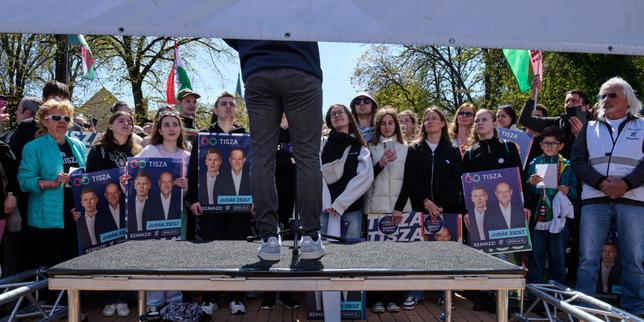
Suddenly, the streets of Budapest were no longer quiet. Tens of thousands of people gathered, not because they were lifelong activists, but because they felt a spark of genuine uncertainty in the status quo. You could see it in the faces of the crowd—grandparents holding the hands of teenagers, professionals in suits standing next to students.
Magyar’s rise isn't just about one man's charisma. It's about the psychological collapse of the "there is no alternative" narrative. For years, the prevailing wisdom was that Viktor Orbán was the only pilot capable of flying the plane. Magyar didn't just point out that the pilot was steering toward a storm; he claimed he knew exactly how the cockpit was rigged.
The Human Cost of the Inner Circle
To understand why this resonates, you have to look past the GDP numbers and the Brussels debates. Think of a hypothetical small-town business owner—let’s call him János. János doesn't care about geopolitics. He cares about why the local construction contract always goes to the mayor’s cousin. He cares about why his daughter, a talented doctor, is looking for work in Vienna because the local hospital is crumbling.
For János, the system wasn't a monster; it was a ceiling. He accepted it because he thought the ceiling was made of concrete. Magyar’s message is that the ceiling is actually made of glass, and he’s the one holding the hammer.
This is the "invisible stake." It’s the slow, grinding erosion of meritocracy. When a society realizes that who you know matters more than what you can do, the soul of that society begins to wither. Magyar’s defection gave people permission to be angry about that withering.
The Architecture of Fear
The counter-attack was swift and predictable. The state-controlled media machine, a vast and well-funded apparatus, turned its full attention to Magyar. They labeled him a disgruntled ex-husband, a traitor, and a tool of foreign interests.
This is where the story becomes a psychological thriller. In a narrative dominated by state narratives, truth becomes a matter of perspective. Magyar’s genius was in leaning into the attacks. Every time the media tried to bury him, he used the shovel to dig a new path to his audience via social media. He bypassed the gatekeepers entirely.
He used Facebook and YouTube not just for announcements, but for a constant, rolling dialogue. He made the struggle feel personal. It wasn't "The People vs. The State." It was "Péter vs. The Machine." And in that David and Goliath setup, the public instinctively knew who they wanted to win.
The European Paradox
Hungary’s relationship with the European Union has always been a dance of defiance and dependency. Orbán portrays himself as the defender of national sovereignty against the "Brussels bureaucrats." Magyar shifted the lens. He argued that the conflict with Europe wasn't about sovereignty at all—it was about accountability.
He pointed out that the freezing of EU funds didn't hurt the elite; it hurt the schools and the roads. By framing the EU conflict as a domestic failure rather than a foreign invasion, he stripped away the nationalist shield that Orbán has used so effectively for years.
It’s a delicate balancing act. Magyar has to stay patriotic enough to keep the rural voters while being modern enough to satisfy the urban liberals. He is trying to build a "Third Way" in a country that has been polarized into two warring camps for a generation.
The Weight of the Suit
Watching Magyar on stage is an exercise in studying high-wire tension. He often looks tired. There is a visible weight to his movements, a sense that he is perpetually aware of the target on his back. This vulnerability is part of his appeal. Unlike the polished, untouchable aura of long-term leaders, Magyar looks like a man who is making it up as he goes along, driven by a mixture of conviction and necessity.
The stakes are not just political; they are deeply personal. His move has fractured his social circles and put his private life under a microscope. When he speaks about the pressure, it doesn't sound like a press release. It sounds like a man describing a fever that won't break.
Beyond the Hero Myth
The danger in any narrative like this is the temptation to see one person as a savior. History is littered with "men on white horses" who ended up building the same walls they once tore down. Magyar himself is a product of the system he critiques. He was part of it. He benefited from it.
The real story isn't whether Péter Magyar is a saint. He isn't. The story is that the system has finally produced a crack large enough for the light to get in. Whether he leads Hungary into a new era or remains a brief, bright meteor in the political sky is almost secondary to the fact that he proved the machine is not invincible.
He has forced a conversation that cannot be un-had. He has reminded a cynical public that the status quo is a choice, not a law of nature.
The fog in Budapest hasn't lifted yet. The coats are still heavy, and the winter is long. But for the first time in fourteen years, people are looking at the mirror and wondering what happens if they finally decide to break it.
A nation is not a collection of buildings or a set of borders. It is a shared story. For over a decade, that story was written by one hand. Now, the pen is rolling across the floor, and millions of people are reaching for it at the same time.