The wind off the Persian Gulf used to carry the scent of salt and desperation. Less than a century ago, the peninsula we now know as Qatar was a quiet, sun-scorched thumb of sand where survival was a daily negotiation with the elements. The economy rested entirely on the fragile backs of pearl divers who plunged into the crushing dark of the sea with nothing but a nose clip and a woven basket. When the Japanese perfected cultured pearls in the 1930s, that fragile economy shattered. Poverty was absolute. The desert was silent.
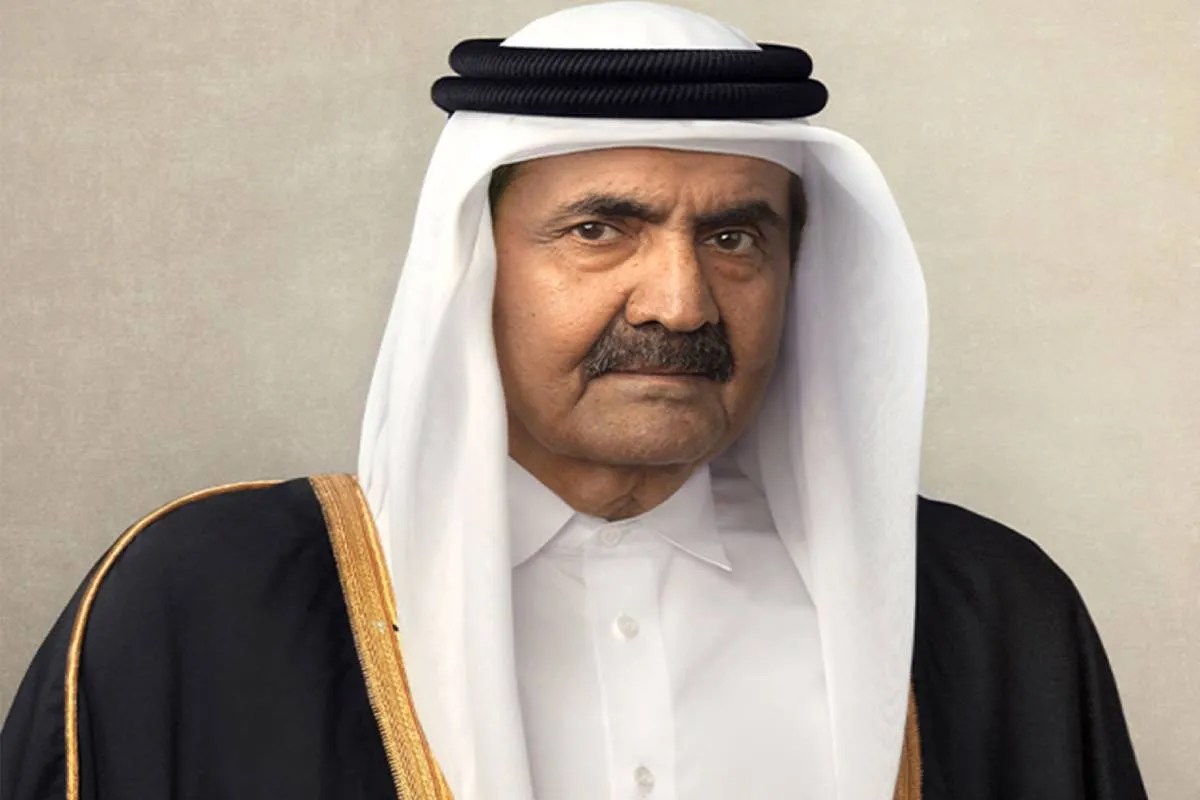
Then came the news that a man who completely rewrote the destiny of that sand has passed away. Sheikh Hamad bin Khalifa Al Thani is gone. To the outside world, he was the billionaire monarch, the architect of a glittering skyline, the man whose checkbook bought pieces of London, legendary football clubs, and global political influence. But to understand the true weight of his departure, one must look past the glass towers of Doha and into the terrifying, high-stakes gamble that occurred in the summer of 1995.
It was a bloodless coup. While his father, the ruling Emir, was vacationing in Switzerland, the 45-year-old Crown Prince seized power. It was a move born not out of simple greed, but out of absolute impatience with stagnation. Qatar was sitting on a secret, and the old guard was too terrified to exploit it.
The Monster Under the Seabed
To understand the gamble, we have to look beneath the waves. In 1971, engineers discovered the North Field, a massive reservoir stretching across the maritime border between Qatar and Iran. It was not oil. It was natural gas.
Today, we look at natural gas as liquid gold. In the late twentieth century, it was viewed as a massive, volatile nuisance. Oil was easy. You pumped it into a tanker and shipped it away. Gas required thousands of miles of pipelines, or it required an incredibly complex, wildly expensive process called liquefaction. You had to catch the gas, cool it down to a mind-boggling minus 161 degrees Celsius until it turned into a liquid, pack it into highly specialized thermos-like ships, and send it across oceans.
The international oil giants looked at the North Field and walked away. The costs were too high. The technology was too unproven. The risk was total ruin.
But Sheikh Hamad saw something else. Power.
He looked at a tiny nation sandwiched between two predatory giants, Saudi Arabia and Iran, and realized that obscurity was a death sentence. Qatar needed to become indispensable to the world. If the global powers depended on Qatari energy to keep their lights on and their factories running, Qatar would survive. If not, it could be swallowed up overnight.
He chose to bet everything.
The Audacity of Borrowed Billions
Imagine standing on a coastline of empty sand, knowing your country is nearly broke, and deciding to sign contracts worth tens of billions of dollars. Sheikh Hamad went to foreign banks, to Western energy companies like Mobil, and to Asian buyers in Japan and South Korea. He borrowed money on a scale that defied imagination. If the price of gas collapsed, or if the technology failed, the country would be bankrupt, indebted for generations, and likely annexed by its neighbors.
Fear hung heavy in the air during those early years. Old traders in the souks whispered that the young Emir was mad. They feared he was trading their quiet, traditional life for a mountain of unpayable debt.
The turning point was mechanical, brutal, and spectacular. In the industrial city of Ras Laffan, massive cooling units began to roar to life. The gas was captured, compressed, chilled, and loaded onto ships. The first tankers sailed toward Japan.
Money did not just flow into Qatar; it erupted.
Within a decade, the country’s Gross Domestic Product skyrocketed. A nation of former pearl divers suddenly possessed the highest per-capita income on earth. The transformation was so rapid it caused cultural whiplash. Grandfathers who remembered fetching water from communal wells by camel were suddenly watching their grandsons drive Italian sports cars down twelve-lane highways.
The Human Weight of Infinite Wealth
Wealth on this scale changes the human psyche. When survival is no longer a question, identity becomes the new battleground. Sheikh Hamad knew that money alone could not buy security or respect.
He used the gas revenues to build Al Jazeera, a satellite news network that shook the Arab world to its core by broadcasting dissenting voices and challenging absolute rulers. He built Education City, importing branches of prestigious Western universities to the middle of the desert. He accumulated global assets like trophies: Harrods, the Shard in London, stakes in Volkswagen, and eventually, the right to host the 2022 FIFA World Cup.
Yet, inside the air-conditioned majlises of Doha, a quiet anxiety lingered. What does it mean to be a citizen when the state provides everything? Qatari citizens received free education, free healthcare, free land, and guaranteed jobs. The physical labor was outsourced to millions of migrant workers, a reality that brought intense international scrutiny and ethical criticism to the kingdom's doorstep. The stark contrast between the lives of the citizens and the legions of foreign laborers became the defining paradox of the modern Qatari state.
Sheikh Hamad had built a fortress of wealth, but the walls were lined with the complex moral calculations of the twenty-first century.
The Quiet Departure
In 2013, at the height of his influence, Sheikh Hamad did something virtually unheard of for an Arab monarch. He voluntarily stepped down. He handed the reins of power to his British-educated son, Sheikh Tamim.
He did not wait for old age or illness to force his hand. He stepped back into the role of the Father Emir, watching from the sidelines as the machinery he set in motion faced its greatest tests, including a crushing diplomatic blockade by its neighbors in 2017. The fortress held. The gas kept flowing. The world could not afford to let Qatar fall.
Now, the silence has returned to his personal story. His passing marks the definitive end of the pioneer generation of the Gulf—the leaders who bridged the ancient world of the bedouin and the hyper-modern world of the global elite.
His legacy is not found in the official obituaries or the diplomatic statements of condolence. It is found in the physical reality of the peninsula. It is in the hum of the massive liquefaction plants at Ras Laffan, turning invisible vapor into the lifeblood of distant economies. It is in the sharp lines of the Doha skyline rising out of the haze where, not so long ago, men stared out at an empty sea, praying for a single pearl.