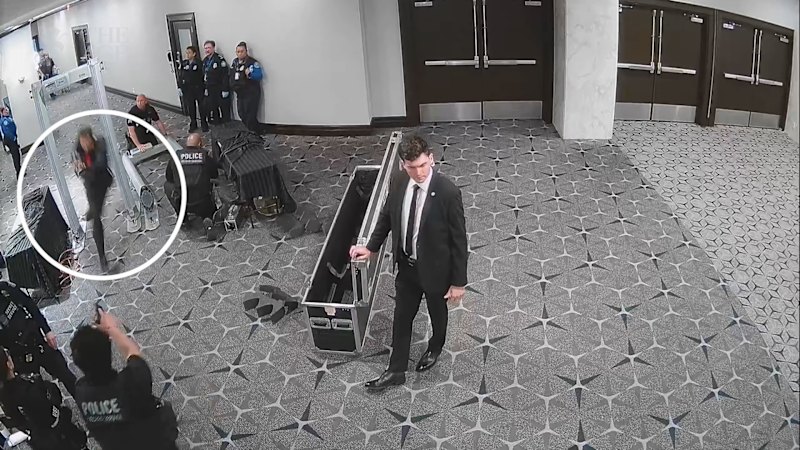
The camera shakes. It is a grainy, handheld perspective of a world that was supposed to be predictable. We are looking at a stretch of fence, a patch of gravel, and the unremarkable silhouette of a human being moving with a purpose that feels wrong even before the first shot is fired. When the FBI released the footage of the suspect linked to the attempt on Donald Trump’s life, they weren't just providing evidence for a case file. They were showing us the terrifying anonymity of modern political violence.
We like to think of history as a series of grand gestures, of clear-eyed villains and obvious heroes. But the reality is often found in the mundane movements of a person in a nondescript shirt, walking through a crowd while carrying a burden that would change the trajectory of a nation. You might also find this similar story useful: The Empty Barracks of Bavaria.
The Weight of a Single Second
Every security perimeter is a promise. It is a silent agreement between the state and the people that the stage—regardless of who stands upon it—is a sacred space where ideas, not lead, determine the future. When that perimeter is breached, the air changes. You can feel it in the footage. There is a specific kind of stillness that precedes chaos, a moment where the mundane reality of a political rally in Butler, Pennsylvania, or a golf course in West Palm Beach, begins to fray at the edges.
Consider the mechanics of the event. To the casual observer, it’s a man with a rifle. To those tasked with the impossible job of protection, it is a failure of geometry and time. The FBI’s decision to pull back the curtain on these clips serves a dual purpose. They need the public's eyes to find the gaps they missed, but they are also inadvertently showing us how thin the line is between a normal Tuesday and a national tragedy. As discussed in latest coverage by TIME, the effects are widespread.
The suspect moves with a chilling lack of fanfare. There is no cinematic buildup. In the digital age, we are used to high-definition drama, but true threats often look like background noise. They look like the person you didn't notice because they weren't doing anything "wrong" until the very moment they were.
The Ghost in the Machine
Public figures live in a fishbowl made of bulletproof glass, yet even glass has its breaking point. The investigation into these attempts reveals a disturbing pattern of radicalization that doesn't always happen in dark corners. It happens in the bright light of day, fueled by an atmosphere where the stakes are framed as existential. When every election is described as the "last one" and every opponent is labeled a "mortal threat," the mental guardrails of the vulnerable begin to erode.
The FBI isn't just looking for a name or a motive in these videos. They are looking for the "why" that lives in the stride of a man walking toward a rooftop. They are looking at the equipment, the clothes, and the subtle gestures that might link one isolated act to a broader intent.
Imagine being the analyst tasked with watching these loops. Thousands of times. You watch the sun hit the suspect's shoulder. You watch the way they adjust their grip. You become an expert in the mundane habits of a person who intended to create a vacuum in the heart of the American government. It is a haunting intimacy with someone who, until that moment, was a ghost in the system.
The Invisible Toll on the Public Psyche
The real casualty in these moments isn't just the target or the bystanders—though their trauma is physical and permanent. The casualty is our collective sense of peace. When we see a video of a suspect creeping toward a vantage point, we stop seeing our neighbors as fellow citizens. We start looking for the rifle in every shadow.
The stakes aren't just about who wins an election. They are about whether we can have an election at all without the specter of a sniper’s nest hanging over the podium. This is the invisible cost of political violence: the slow, steady withdrawal of the public from the public square.
We see the footage and we feel a tightening in the chest. It’s not just partisan fear. It’s the realization that the system is only as strong as the restraint of its angriest members. And right now, that restraint looks as thin as a single layer of fencing.
The Mechanics of the Investigation
The FBI's release of the video is a tactical maneuver. By crowdsourcing the identification of specific movements or items, they turn three hundred million people into a secondary investigative layer.
- Forensic Mapping: Every frame is analyzed for geographical markers that confirm the suspect's path.
- Behavioral Analysis: Experts look for "leakage," or signs that the individual was practicing or scouting the location days in advance.
- Digital Footprints: The video provides a timestamp that can be cross-referenced with cell tower pings and local surveillance.
But beyond the technical, there is the human element of the hunt. There is a family somewhere who recognizes that gait. There is a store clerk who remembers selling that specific backpack. The FBI is banking on the fact that no one is truly a ghost; we all leave a wake.
The Fragility of the Stage
Politics is, at its core, a performance of power. But for that performance to work, both the actors and the audience have to believe they are safe. When the FBI shows us the grainy reality of a man with a gun, they are reminding us that the stage is made of wood and the actors are made of flesh.
There is a profound vulnerability in the way we conduct our democracy. We want our leaders to be accessible. We want to see them in the sun, among the people, shaking hands and kissing babies. But every video like the one released by the Bureau makes that accessibility feel like a liability.
We are caught in a paradox. To protect the leader, we must distance them from the people. But to lead the people, they must be among them. The suspect in the video exploited that very tension. He found the gap where the need for optics outweighed the need for absolute security.
The Echo in the Silence
The footage ends abruptly. There is no resolution in the clip itself, only the lingering image of a person moving toward a choice that cannot be undone.
We wait for the next update. We wait for the trial, the manifestos, the explanations that never quite satisfy the "why." We look at the grainy pixels and try to find a monster, but often we just find a man. That is the most uncomfortable truth of all. The people who change history with a trigger pull aren't always the ones we expect. They are the ones who were hiding in plain sight, caught on a security camera that no one was watching in real-time.
The camera keeps rolling. The gravel stays where it is. The fence remains. And we are left to wonder how many other shadows are currently moving toward their own perimeters, waiting for the moment when the world stops being a place of debate and starts being a place of impact.
The video isn't just a piece of evidence. It is a mirror. It asks us what kind of world we have built where this is the only way some people feel they can be heard. It asks us if we are willing to look at the graininess of our own division and find a way to sharpen the focus before the next frame begins.
The silence after the video stops is the loudest part of the story. It is the sound of a country holding its breath, hoping that the next time the camera shakes, it’s just the wind.