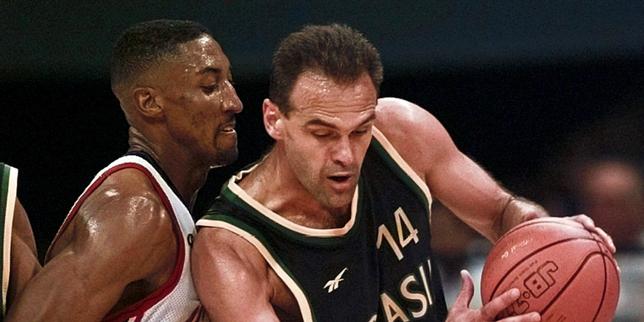
The floorboards of the Ginásio do Ibirapuera in São Paulo do not just hold the weight of athletes; they hold the ghosts of a specific, frantic energy. If you stand there long enough, you can almost hear the rhythmic, hypnotic thud-thud-thud of a leather ball hitting the wood. It was a sound that defined Brazil for nearly thirty years. It was the heartbeat of Oscar Schmidt.
On a Tuesday that felt too quiet for a man of his volume, that heartbeat stopped. Oscar died at 68. The headlines will tell you he was a basketball legend, a Hall of Famer, and the greatest scorer to ever live. They will give you the number: 49,737. That is how many points he scored in a career that spanned four decades. It is more than Kareem Abdul-Jabbar. It is more than LeBron James. But numbers are cold, and Oscar was a furnace. To understand why a whole nation is weeping today, you have to look past the box score and into the eyes of a man who looked at the NBA—the highest altar of his profession—and simply walked away. Read more on a similar issue: this related article.
The Holy Machine of Natal
Imagine a kid in Natal, a coastal city where the sun bleeds into the Atlantic, who sprouted up until he hit 6'8" and realized his arms were built for one thing: reaching toward the sky. Oscar didn't just play basketball. He obsessed over it. He was a "Holy Machine." That was his nickname, but it wasn't about being robotic. It was about a religious devotion to the arc of a shot.
He would stay after practice until the lights were dimmed, taking 500, 1,000, sometimes 2,000 shots. Every flick of the wrist was a prayer. He believed that if he missed, it wasn't because of luck or a bad bounce. It was because he hadn't worked hard enough to earn the basket. This wasn't a game to him. It was a moral obligation. Additional reporting by NBC Sports explores similar perspectives on the subject.
When he suited up for the Brazilian national team, he wasn't just representing a country; he was carrying its pride like a physical weight on his shoulders. Brazil is a land of football. To make people care about a round ball handled with palms instead of feet, you have to be more than good. You have to be a miracle.
The Day the Giants Fell
The defining moment of Oscar’s life—and the reason he is a deity in South America—happened in 1987. The Pan American Games were held in Indianapolis. At the time, the United States was invincible on home soil. They had a roster of future NBA stars like David Robinson and Danny Manning. No one beat the Americans. It didn't happen.
By halftime, the U.S. was up by 14 points. The script was written. The crowd was ready for the coronation. But Oscar Schmidt decided to tear the script into confetti.
He started shooting from distances that felt disrespectful. In an era before the three-point line was used as a primary weapon, Oscar was pulling up from thirty feet. He scored 46 points. He didn't just score; he demoralized. He moved with a strange, jagged grace, finding pockets of space where none existed. When the final whistle blew, Brazil had won 120-115. It was the first time the U.S. had ever lost a major international tournament at home.
The image of Oscar collapsed on the floor, sobbing into the hardwood, became the iconography of a generation. He wasn't crying because he won a gold medal. He was crying because he had proven that a boy from Brazil could look the masters of the game in the eye and make them blink.
The Greatest Contract Never Signed
This is where the story shifts from a sports biography to a character study in sacrifice. The New Jersey Nets drafted Oscar in 1984. They wanted him. They needed his scoring. At the time, the NBA had a rule: if you played in the league, you were considered a "professional" and were barred from playing for your national team in the Olympics.
For most men, the choice would take a heartbeat. The NBA offered money, fame, and the chance to be a global icon.
Oscar looked at the contract and then looked at the green and yellow jersey of Brazil. He chose the jersey. He turned down the NBA three times. He spent his prime years playing in Italy and Spain, lighting up arenas in Caserta and Valladolid, because it allowed him to keep representing his home. He sacrificed the chance to prove he was the best in the world to ensure he could remain the best for his people.
"I would have been one of the ten best players in the NBA, easily," he once said, not with arrogance, but with the matter-of-fact tone of a man who knows his worth. "But I wanted to play for Brazil."
Consider the stakes of that decision. He played in five Olympic Games. He led the scoring in three of them. In Seoul in 1988, he averaged 42.3 points per game. Think about that. Forty-two points every time he stepped on the floor. It is a statistical anomaly that feels like a printing error. But it was real. He was a man possessed, a scoring engine that never overheated.
The Longest Shadow
Eventually, the knees start to grind. The jump shot loses its lift. Oscar retired in 2003 at the age of 45. He had played longer than most people hold a single career. But the end of his playing days was merely the start of his hardest fight.
In 2011, he was diagnosed with a brain tumor.
The man who had faced down the greatest athletes in the world was suddenly facing an enemy he couldn't outshoot. He underwent multiple surgeries. He did chemotherapy. He lost weight, his face thinned, but his voice never lost its thunder. He became a motivational speaker, traveling across Brazil to tell people that life is about the "clutch shot"—the moment when you are tired, broken, and the clock is ticking, but you still have to let the ball go.
He refused to be a victim. He talked about his cancer with the same directness he used to talk about a defender. It was just something in his way. He outlived the initial projections of his doctors by years, fueled by a stubbornness that seemed to defy biology.
The Final Buzzer
To lose Oscar Schmidt is to lose a piece of the Brazilian soul. He was the bridge between the amateur era and the modern global game. Without Oscar, there is no Dirk Nowitzki. There is no Luka Dončić. He was the prototype for the "stretch" player, the big man who could kill you from the perimeter.
But more than that, he was a reminder of what happens when a person finds their singular purpose and refuses to compromise it. He didn't need the bright lights of Madison Square Garden to feel validated. He found his heaven in a sweaty gym in São Paulo, practicing a shot until his arms burned and the sun went down.
There is a hollow feeling in the basketball world today. The numbers remain—the 49,737 points, the five Olympics, the Hall of Fame jacket. But the fire has gone out.
Somewhere, on a court we can't see, the lights are being dimmed. A tall man with a tireless arm is picking up a ball. He takes a breath, finds his rhythm, and shoots.
The ball snaps through the net without touching the rim.
Nothing but net.
Everything but time.