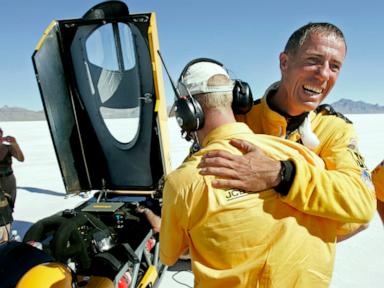
Silence does not exist at seven hundred miles an hour.
There is only violence. A concussive, atmospheric fury that beats against the aluminum skin of a vehicle like heavy stones. Your teeth ache. Your vision blurs at the edges, pulled wide by raw acceleration until the salt flats of Utah turn into a smear of blinding white and pale sky. If you liked this post, you should look at: this related article.
Most people spend their lives running away from fear. A few chase adrenaline. But Andy Green chases a line on a map that physics says should tear the world apart.
He knows what happens when you cross the threshold where sound surrenders. Back in 1997, on the sun-baked pan of the Black Rock Desert, he became the first person to break the sound barrier on land, driving ThrustSSC to a staggering 763 miles per hour. That is not driving. That is strapping yourself to a winged missile and hoping the math of aerodynamics holds up against the chaos of reality. For another look on this event, refer to the latest update from NBC Sports.
For most, that achievement would be enough. A lifetime of dinner party stories. A permanent place in the history books. A quiet retirement watching the sun set over a normal, unbroken horizon.
Instead, he is back. In the unforgiving expanse of the Utah salt flats, the engine hums again.
The Weight of the Salt
Utah does not forgive mistakes.
If you have never stood on the Bonneville Salt Flats, you need to understand that it feels less like the earth and more like the moon. Miles upon miles of crusty, mineralized salt stretching out to a hazy, indistinct horizon. It is a place of absolute extremes. In the summer, the sun beats down with a relentless, blinding glare, turning the flat surface into a shimmering mirror of heat. In the winter, a skim of water turns it into a treacherous slick.
When you bring a jet-powered car to this environment, you are entering a pact with an ancient, volatile landscape.
(Note: To picture the sheer scale of this machinery, imagine a cylindrical fuselage built like an aerospace rocket, fitted with fighter-jet engines, resting on solid aluminum wheels designed not to melt under extreme friction.)
Andy Green understands this salt better than almost anyone alive. He is not just a pilot; he is a Royal Air Force fighter veteran with a mind for mathematics and the steady pulse of a surgeon. When we talk about land speed records, people tend to focus on the hardware. They look at the horsepower, the thrust-to-weight ratios, the pounds per square inch of tire pressure.
They forget the human being inside the capsule.
Imagine sitting inches away from a powerplant that consumes thousands of pounds of fuel per minute, encased in a tight carbon-composite cocoon where a single steering adjustment at supersonic speeds means the difference between history and catastrophe. There are no guardrails out here. No runoff areas. Just you, the salt, and the relentless ticking of a stopwatch.
Why We Push the Boundary
People always ask the same tired question when a new record attempt makes the news. Why? Why risk life and limb for a number on a digital readout? Why spend millions of dollars and years of engineering heartbreak just to go slightly faster than you did last time?
Utility is not the point.
Efficiency is not the point.
The desire to break limits is encoded into our marrow. Long before we had jet engines, our ancestors looked across the ocean, stared at the horizon, and built vessels out of braided reeds and hollowed logs simply because they had to know what lay on the other side. Speed records are our modern ocean. They are an existential rejection of the word impossible.
When Green strapped into his vehicle for the first time decades ago, the goal wasn't just personal glory. It was an engineering laboratory moving at the edge of human endurance. Every single time we push a machine past the speed of sound on solid ground, we learn something vital about material science, shock wave management, and high-speed stability. The lessons learned on the salt flats eventually trickle down into everyday aerospace engineering and automotive safety.
Yet, looking at the numbers misses the pulse of the thing.
The real story happens in the quiet moments before ignition. The crew working late into the night under harsh halogen lights, wiping corrosive salt crust from delicate sensor wires. The meteorologists scanning satellite maps, praying the wind stays low and the salt remains dry. The quiet, profound focus of a man who has already looked death in the eye at Mach 1 and decided he wants a closer look.
The Horizon Beckons
Out on the flats, the light is changing. The afternoon shadows stretch long and thin across the white crust.
The engines are cold now. The telemetry screens flicker in the dim interior of the mobile command trailer. Outside, the wind whispers across the empty basin, carrying the faint, bitter scent of brine.
Andy Green is not a young man anymore, but when he talks about the upcoming runs, his eyes retain that exact same quiet intensity. It is the look of someone who refuses to let age bargain away his curiosity. He knows the risks intimately. He has felt the violent buffeting of transonic shock waves. He has felt the terrifying moment when a vehicle lightens up, losing crucial downforce as it skims across the earth like a skipping stone.
And still, he prepares to climb back inside.
The world will watch the digital counters spin. Headlines will flash across screens around the globe, reducing years of sweat, grease, and sleepless nights into a neat, digestible statistic.
But out there, beneath the vast, indifferent Utah sky, it is much simpler than that. It is just a man, a machine, and the eternal human urge to see how fast we can run before the world catches up.