Maps are the security blanket of the intellectually lazy.
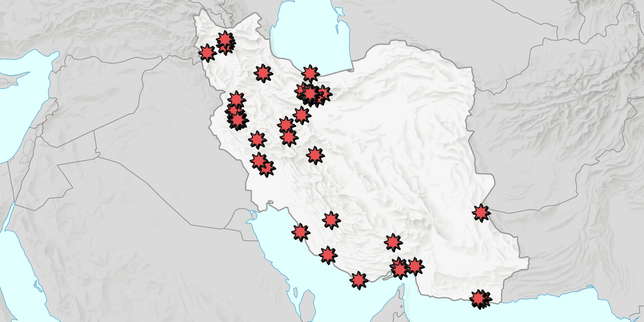
When news outlets splash colorful arrows across a digital rendering of the Middle East, they aren't informing you. They are selling you a narrative of control that doesn't exist. They want you to believe that a missile hitting a specific GPS coordinate in Isfahan or Tehran is a move on a chessboard. It isn't. It’s a press release written in high explosives. If you found value in this post, you might want to check out: this related article.
The "lazy consensus" suggests that these strikes represent a breakdown of diplomacy or a slide toward "total war." That’s wrong. These strikes are the new diplomacy. We have entered an era where kinetic action is the only remaining form of credible signaling between powers that no longer trust the written word.
If you’re looking at a map to understand the conflict between Iran and its adversaries, you’re looking at the wrong data set. You should be looking at supply chain logistics and the price of atmospheric sensors. For another look on this development, check out the latest coverage from TIME.
The Myth of the Strategic Target
Mainstream analysis obsesses over what was hit. Was it a drone factory? A radar installation? An enrichment site?
This focus misses the point. In modern asymmetric warfare, the physical infrastructure is often the least valuable thing on the table. Iran has spent decades mastering the art of the "disposable facility." They bake redundancy into their geography. You can't "decapitate" a program that is designed to function as a distributed network of workshops and hardened silos.
When a Western-aligned power strikes an Iranian site, they aren't trying to reset Iran’s clock by five years. They know they can’t. They are testing the "Latency of Response."
The real metric isn't the crater diameter; it’s how long it takes for the Iranian command and control (C2) to authorize a counter-signal. If the response is instant, the strike failed to cause friction. If there is a forty-eight-hour silence, the strike was a surgical success—not because it blew up a building, but because it blew up the decision-making process.
Why Your "Regional War" Fear is Factually Flawed
Every time a map shows arrows crossing borders, the pundits scream about "the Big One." They’ve been saying it since 1979. They’re still wrong.
War is expensive. Not just in lives, but in political capital and resource allocation. Iran’s current strategy is Strategic Patience, a term often mocked but rarely understood. It is a mathematical approach to conflict.
Imagine a scenario where a regime knows it cannot win a head-on naval engagement in the Strait of Hormuz. Does it build a bigger navy? No. It builds 10,000 $20,000 drones. This isn't "warfare" in the Clausewitzian sense; it's an economic siege.
The goal of the Iranian "Axis of Resistance" is to make the cost of presence higher than the benefit of stability. They don't need to win a battle. They just need to make sure their opponents' spreadsheets don't balance at the end of the quarter. When you see a map of strikes, you see "escalation." I see a frantic attempt by traditional powers to use 20th-century kinetics to solve a 21st-century accounting problem.
The Satellite Imagery Trap
We live in the age of OSINT (Open Source Intelligence). Everyone with a Twitter account and a Maxar subscription thinks they are a general. This has created a dangerous "Transparency Illusion."
Just because you can see a charred roof from space doesn't mean you know what happened inside. I’ve spoken with analysts who have seen "confirmed destroyed" targets back online within 72 hours because the vital components were never there to begin with. We are witnessing the weaponization of decoy architecture.
Iran is the world leader in building "hollow targets." They know where the satellites are. They know when the shutter clicks. They leave things out in the rain for the cameras to find, while the real work happens in tunnels that don't appear on your precious maps.
Stop Asking "Who Won the Day?"
The "People Also Ask" sections of search engines are flooded with questions like "Who has the stronger military, Iran or Israel?" or "Can Iran's air defenses stop a stealth jet?"
These are the wrong questions. They assume a symmetric finish line.
In this theater, strength isn't measured by the ability to prevent a strike. It’s measured by the ability to absorb a strike and remain relevant.
- Traditional Military Logic: Success = Intercepting 100% of incoming threats.
- The New Reality: Success = Forcing your opponent to spend $2 million on an interceptor to kill a $15,000 drone.
By this metric, the "flawless" defense systems touted by the West are actually an existential vulnerability. You cannot win a war of attrition when your shield costs a thousand times more than your enemy's sword.
The Logistics of the "Shadow Zone"
If you want to actually understand the "narrative of the day," stop looking at the maps of the strikes and start looking at the shipping manifests in the Port of Bandar Abbas.
The real conflict is happening in the "Shadow Zone"—the space between peace and declared war. In this zone, kinetic strikes are just punctuation marks in a much longer, boring sentence about semiconductors, fertilizer exports, and fiber-optic cables.
The media focuses on the explosions because explosions are easy to film. They don't focus on the fact that Iran has successfully integrated its tactical ballistic missile doctrine into the domestic industrial base of three other countries. You can't bomb a supply chain out of existence with a single night of "precise" strikes.
The Failure of Deterrence via Cartography
The competitor's article spends a lot of time showing you where things happened. It fails to tell you why it will happen again next week.
Deterrence is dead. You cannot deter an opponent who views the "punishment" as a necessary data point for their next iteration. Every time a Western power uses a high-end kinetic asset to strike a target in the Middle East, they are handing over a free masterclass in their own capabilities. They are revealing their signatures, their flight paths, and their sensor fusion limits.
We aren't seeing a "containment" of Iran. We are seeing a live-fire laboratory where the West pays for the equipment and Iran provides the testing ground.
The Hard Truth for the "Map Enthusiasts"
If you want to be an insider, you have to accept that the maps are theater.
The borders drawn in red and blue on your screen are psychological markers, not tactical ones. The Middle East isn't a collection of states anymore; it's a collection of overlapping influence bubbles and logistical arteries.
When you see a map of "The Day’s Strikes," remember:
- The target hit was likely replaced before the smoke cleared.
- The cost-to-kill ratio favored the defender, even if they "lost" the building.
- The arrows on the map suggest a movement toward a goal, but the goal is the movement itself.
The status quo isn't being challenged by these strikes. The status quo is the strikes. This is the permanent state of 21st-century competition. It’s a high-stakes, low-yield cycle of kinetic PR that satisfies domestic audiences while changing absolutely nothing on the ground.
Stop looking at the arrows. Start looking at the bill.
If you think a map can tell you who is winning, you've already lost the war of information.
Throw away the map. Watch the money. Period.