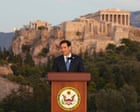
Foreign policy orthodoxy loves a clean narrative. Take Marco Rubio touching down in Greece, standing against ancient ruins, and trying to graft a twenty-first-century nationalist slogan onto Mediterranean geopolitics. The mainstream media treats these photo ops as strategic masterclasses, parsing every soundbite for clues about the next administration's grand design. They assume that political branding travels as easily as container ships, that domestic slogans work overseas just because you say them louder.
It is a lazy framework built on institutional memory that expired a decade ago.
I have watched career diplomats spend millions of dollars trying to export domestic populist messaging to foreign capitals, only to watch it dissolve into local factionalism within forty-eight hours. The assumption that you can package a domestic grievance narrative and deploy it as foreign policy is worse than naive; it is actively destructive to the very alliances it pretends to protect.
Let us look at what actually happens when domestic political branding collides with foreign sovereign reality.
The Myth of Exportable Grievance
The conventional press corps loves to frame foreign visits through the lens of ideological alignment. If a high-ranking American official nods at a local leader while invoking national sovereignty, reporters write about a united front against globalism. This analysis ignores how power actually functions outside the Beltway.
Sovereignty is not an ideological franchise you can buy into. It is a local resource shaped by geography, debt obligations, and immediate security threats. When an American politician goes to Athens and talks about putting national interests first, Greek policymakers do not hear a shared philosophy. They hear a transaction. They hear a creditor state telling a debtor state to manage its optics while navigating a volatile neighborhood defined by maritime borders, energy pipelines, and complex European Union dependencies.
To understand why this approach fails, you have to look at the mechanics of statecraft rather than the aesthetics of a podium speech.
True national strength does not come from rhetorical posturing abroad. It comes from economic resilience and industrial capacity at home. When you try to project a domestic populist brand into a foreign parliamentary democracy with its own distinct economic anxieties, you expose the hollow core of the strategy. You get polite applause in the banquet hall and quiet divergence in the committee rooms.
History as a Prop
Rubio’s Hellenic tour relied heavily on historical stagecraft, leaning on the cradle of democracy to lend gravity to modern political friction. This is a tired playbook. Politicians love ancient stones because stones cannot talk back or correct your geopolitical analogies.
Comparing contemporary great-power competition to the Peloponnesian War is intellectually lazy shorthand for people who refuse to read trade ledgers. Athens and Sparta were locked in a zero-sum struggle for regional hegemony based on direct military conquest. Today, power is mediated through semiconductor supply chains, lithium extraction rights, and sovereign debt restructuring.
Imagine a scenario where a foreign delegation arrives in Washington, stands in front of the Lincoln Memorial, and lectures Congress on how their domestic agricultural subsidies violate local tribal customs from three thousand years ago. American lawmakers would laugh them out of the room. Yet when the script is flipped, we treat historical cosplay as profound diplomacy.
The strategic reality in the Eastern Mediterranean has nothing to do with ancient philosophy and everything to do with leverage. Greece sits at the crossroads of European energy diversification, particularly regarding liquefied natural gas pipelines coming up from Egypt and Israel. That is real leverage. That matters infinitely more than whether a visiting senator can successfully invoke Pericles in a press briefing.
The Cost of Performative Nationalism
When foreign policy becomes an extension of domestic branding, policy execution degrades. Officials spend more time crafting the narrative for the evening news cycle back home than they do negotiating hard concessions on defense burden-sharing or port access agreements.
I have sat in rooms where foreign counterparts nodded along with passionate speeches about sovereignty, only to quietly sign trade agreements with rival powers twenty minutes later because the numbers made more sense. Money talks. Slogans walk.
The refusal of political elites to acknowledge this disconnect creates a dangerous blind spot. They mistake compliance for commitment. They believe that if a foreign leader poses for a photograph under the right banner, the strategic alignment is locked in. It is an administrative delusion.
If you want to secure American interests abroad, stop treating foreign capitals as satellite television studios for your domestic campaign. Stop pretending that local allies are ideological converts rather than sovereign actors looking out for their own balance sheets.
The Uncomfortable Bottom Line
The next time an official steps off a plane in a historic capital to declare a new era of nationalist solidarity, look past the cameras. Look at the trade balance. Look at the infrastructure investments funded by rival nations. Look at the actual terms of the security agreements being signed in the dark.
The world does not care about your branding. It cares about your capacity to project power, maintain economic stability, and keep your promises when the cameras are turned off. Until Washington realizes that exporting slogans is not the same as exporting strength, these diplomatic tours will remain expensive theater.
Stop buying the script. Watch what they sign, not what they say.