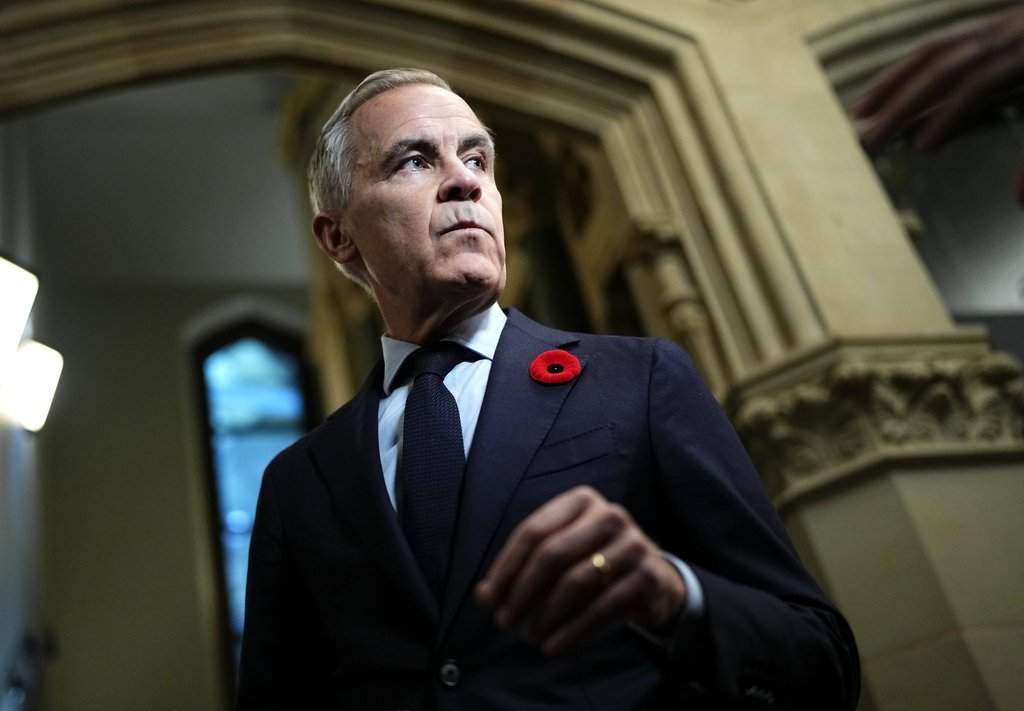
Mark Carney stepped up to the microphones in late October 2026 and delivered the exact soundbite Ottawa’s political class wanted to hear. Canada wasn't near a trade deal with the United States before the midterms. Ottawa was holding out for "the right deal".
The mainstream press ate it up. Reporters framed it as disciplined statecraft—a former central banker refusing to blink while waiting for American voters to rebuke Donald Trump’s tariff regime at the ballot box. You might also find this connected story insightful: What Most People Get Wrong About Uzbekistan U.S. Trade Relations After the Business Summit.
That narrative is pure fantasy.
Carney’s pre-midterm stall wasn't a masterclass in patience. It was a massive strategic miscalculation that misread American constitutional mechanics, ignored the brutal math of North American supply chains, and left Canadian manufacturers staring down the barrel of a January 1 tariff cliff. If you think waiting out the U.S. electoral cycle weakens the White House's hand on trade, you don't understand how executive tariff authority actually works. As extensively documented in detailed reports by Bloomberg, the implications are widespread.
The Midterm Illusion That Blinded Ottawa
The lazy consensus in Ottawa and Bay Street went like this: hold the line through October, let inflation-weary American voters flip Congress on November 3, and watch a newly empowered Democratic majority clip Trump’s wings on trade.
Democrats did sweep back into control of Congress. And what happened to the 50 percent tariffs hammering Canadian exports? Nothing. What happened to the Section 232 levies strangling medium- and heavy-duty trucks, or the Section 338 duties slapping steel, aluminum, and lumber? Not a single basis point moved.
Why? Because Congress doesn't negotiate trade deals, and a new congressional majority cannot magically repeal unilateral executive tariffs without a veto-proof two-thirds supermajority in both chambers.
I’ve watched corporate boards blow tens of millions of dollars on lobbyist retainers in Washington because they confused legislative noise with executive power. When you deal with Section 232 national security tariffs, Section 301 trade remedies, or dusty statutory weapons like Section 338 of the Tariff Act of 1930, the Oval Office holds all the cards. Even Carney had to admit after the election dust settled that the Trump administration remains the sole decision-maker that matters.
By burning the autumn clock waiting for a midterm miracle, Ottawa forfeited its best window to lock in relief before the holiday slowdown. Worse, it handed Washington an asymmetrical clock. Trump can threaten to jack auto and parts tariffs up to 50 percent on January 1 via a social media post, forcing Canadian Tier-1 suppliers to freeze capital expenditures today without the White House even filing a formal Federal Register notice.
What Ottawa’s "Right Deal" Rhetoric Actually Costs
Let’s strip away the diplomatic varnish around the August collapse and the October deep freeze.
Carney’s team walked away because Washington demanded poison pills: restrictions on Canada’s ability to strike independent trade pacts with third countries (read: China), rollbacks on French-language and cultural protections, and rules of origin that would make assembling vehicles in Ontario structurally uneconomic over time.
Standing up for sovereignty plays brilliantly in Montreal and Toronto. Polling proves it. Carney’s approval ratings soared precisely because voters love a prime minister who treats a trade dispute like wartime mobilization.
Politicians measure success in news cycles. Plant managers measure success in landed unit costs and cross-border border crossings per shift.
Here is the math the pundits leave out:
- Asymmetric Exposure: Roughly three-quarters of Canadian merchandise exports go south, representing nearly a fifth of Canada’s entire GDP. U.S. exports to Canada account for less than two percent of American GDP.
- The Integration Trap: A single automotive piston or wiring harness crosses the Detroit-Windsor corridor up to seven times before final assembly. A 25 or 50 percent tariff isn't a one-time tax; it is a compounding margin killer that forces OEMs to quietly shift next-generation tooling to Michigan, Ohio, and Mexico.
- Capital Flight: You don't need a factory closure announcement to lose an industry. You lose it when Detroit decides in a closed-door budget meeting to place the 2028 battery-pack line in Tennessee instead of Ingersoll because Ottawa can't guarantee tariff-free access past New Year's Day.
Look at what happened by mid-November. After boasting in October that Canada wasn't ready to deal, Carney’s cabinet was suddenly scrambling behind closed doors and on the sidelines of the APEC summit in Shenzhen to beg for an "interim tariff arrangement" before year-end. Dominic LeBlanc even had to warn Canadians that some sectoral tariffs are going to remain permanently regardless of what gets signed.
That isn't leverage. That is damage control after the bill came due.
Why "Trade Diversification" Is a Dangerous Distraction
Whenever Ottawa hits a wall with Washington, the fallback talking point is always the same: We’re busy diversifying.
Carney trotted this exact line out at the DealBook summit and APEC, touting fresh trade agreements with ASEAN, the Philippines, and a prospective pact with India alongside warmer commercial ties with Beijing. The media treats these deals like a counterweight to American protectionism.
Let’s be brutally honest about economic geography. Gravity models in international trade—pioneered by Nobel laureate Jan Tinbergen and validated across decades of empirical data—prove that trade volume scales directly with economic mass and inversely with distance.
You cannot replace a $900-billion-a-year frictionless land border with container ships crossing the Pacific to Manila or Mumbai.
- Services and Commodities Don't Save Manufacturing: Selling more canola to China or engineering consulting to India helps specific balance sheets, sure. It does zero for an aluminum smelter in Quebec or a stamping plant in Windsor built to feed Midwest assembly lines within a four-hour trucking radius.
- The Beijing Trap: Cozying up to China on trade while trying to negotiate tariff exemptions with a hawkish White House is like pouring gasoline on your own negotiating table. Washington’s primary demand in August was preventing Canada from becoming a backdoor for non-market Chinese goods into North America. Every photo-op in Shenzhen strengthens the exact hawks in the U.S. Trade Representative’s office who want to gut CUSMA.
What People Actually Get Wrong About This Standoff
If you follow the standard coverage of the U.S.-Canada trade war, you're asking all the wrong questions. Let’s dismantle the three biggest myths dominating the conversation right now.
"Won't U.S. border-state Republicans force Trump to back down?"
No. People point to Michigan Senate candidates running ads begging for an end to the Canadian trade war and assume political pressure will crack the White House. It won't. Trump views tariffs not as a temporary bargaining chip to be traded away for Senate seats, but as a permanent revenue source and industrial policy tool. Border-state lawmakers complain in public and vote with the administration in private. Relying on Rust Belt Republicans to rescue Canadian exporters is a strategy with a zero percent historical success rate.
"Can't Canada just retaliate dollar-for-dollar until Washington hurts?"
Retaliation is a sugar high that burns your own house down. When Ottawa slaps counter-tariffs on American steel, orange juice, or consumer goods, Canadian importers and households pay that tax at the border. In a country already fighting sluggish productivity growth and housing-driven cost-of-living fatigue, retaliatory tariffs act as a self-imposed consumption tax. Targeted retaliation works as a tactical signal during a three-week dispute; over a multi-year grinding war of attrition, the smaller economy always runs out of ammunition first.
"Isn't waiting for the 2026 CUSMA review the smart play?"
Waiting for the formal CUSMA joint review while bleeding under unilateral Section 232 and 338 tariffs is like refusing to patch a leaking roof because you plan to remodel the kitchen next summer. By the time formal review panels convene, the supply chains you're trying to protect will have already re-routed south.
The Contrarian Playbook Ottawa Should Actually Run
I’ll admit the obvious downside to cutting an early, imperfect deal with a transactional White House: you give up ideological purity, you accept managed-trade quotas you hate, and you take brutal political heat at home from provincial premiers and opposition leaders screaming sellout.
Take the heat anyway.
If Ottawa wants to protect Canadian industrial capacity instead of just winning applause lines on Parliament Hill, it needs to scrap the grandstanding and execute three ruthless moves immediately:
- Ring-Fence North American Fortress Rules: Stop flirting with Beijing as a bargaining chip. Harmonize external tariffs on Chinese EVs, steel, aluminum, and critical minerals completely with Washington. Remove the single biggest national-security excuse U.S. hawks use to justify border friction.
- Trade Quotas for Tariff Elimination: Stop demanding a return to pre-2025 pure free trade—that world is dead. Offer hard, volume-based export caps on Canadian steel, aluminum, and softwood lumber tied to historical market share in exchange for immediate, zero-tariff access within those quotas. Industry survives on predictability, not theoretical free-market purity.
- Weaponize Energy and Critical Minerals: Stop treating oil, hydroelectricity, and uranium as passive commodities. Tie guaranteed, long-term supply agreements for U.S. AI data centers and Midwest grids directly to automotive rules-of-origin exemptions. Washington cares about grid reliability and compute dominance far more than it cares about dairy supply management.
Carney built his reputation as a central banker who steps in with overwhelming force to stabilize markets before panic becomes permanent. Right now, he’s acting like a politician hoarding approval ratings while Canada’s industrial base absorbs body blows.
Stop waiting for American voters to save Canadian factories. Cut the ugly deal before January 1, lock in the rules, and get back to building. Watch Canada not near trade deal with US before midterms, Carney said to see Carney's original October remarks claiming Ottawa wasn't ready to deal before the midterm elections.