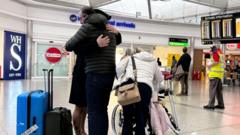
The modern aviation network operates on a razor-thin margin where a single afternoon of disruption ripples across continents for days. On March 5, that fragile equilibrium collapsed again as 281 flights were scrubbed from the boards, leaving thousands of passengers stranded in terminal limbo. While the headlines focused on the immediate chaos of those 281 cancellations, the real story lies in the preceding 24 hours. On March 4, over 5,300 travelers finally reached their destinations after being displaced by a prior wave of systemic failures. This isn't a string of bad luck. It is the predictable result of an industry that has prioritized high-load factors and lean staffing over the basic necessity of operational resilience.
When an airline cancels a flight, they don't just lose a route; they lose a chess piece. That aircraft was scheduled to be somewhere else four hours later. The crew had a legal limit on their working hours that is now ticking away in a hotel lobby. When 281 flights vanish from the schedule in a single day, the recovery time isn't measured in hours. It is measured in days of frantic rebooking and "deadheading" crews across the country to fix the holes in the map. For a different view, read: this related article.
The Logistics of a Broken Hub
Airports are often described as hubs, but they behave more like pressure cookers. When weather or mechanical failures hit a major node, the steam has nowhere to go. On March 4, the 5,300 passengers who finally "returned home" represented the tail end of a previous disruption. They were the lucky ones. They were the people who slept on terminal floors or shelled out $400 for a last-minute airport motel because the airline’s automated rebooking system had categorized them as a low-priority recovery.
The industry relies on a concept called the recovery ratio. This is the speed at which an airline can return to normal operations after a mass-cancellation event. Currently, that ratio is failing. In decades past, airlines kept "hot spares"—extra aircraft and standby crews—ready to jump in when things went wrong. Today, that is considered a waste of capital. Every plane must be in the air. Every pilot must be scheduled to their maximum allowable hours. When 281 flights are cancelled, there are no extra planes to pick up the slack. The system just stops. Further coverage on this matter has been provided by AFAR.
The Hidden Cost of Automated Agony
Passengers today are being managed by algorithms rather than humans. When those 281 flights were cancelled on March 5, the vast majority of those passengers received a push notification telling them they had been rebooked for March 7 or 8. The human element of travel—the gate agent who could find a creative routing through a different city—has been largely replaced by a software logic that prioritizes the airline's seat inventory over the passenger's schedule.
This digital gatekeeping is why we see these massive numbers of "returning" passengers days later. The system is designed to fill empty seats on existing flights rather than adding new capacity to handle the overflow. If you are one of the 5,300 who moved on March 4, you weren't "rescued." You were simply slotted into a hole that the algorithm finally found for you.
Crew Fatigue and the Legal Ceiling
The public often blames "operational issues," a vague term that usually masks a staffing crisis. Federal regulations on crew rest are absolute. Once a pilot or flight attendant hits their duty limit, they are legally prohibited from flying. During a day of 281 cancellations, crews are often sitting on the tarmac waiting for gates, "burning" their legal hours without ever leaving the ground.
By the time the plane is ready, the crew is "timed out." This creates a secondary wave of cancellations that has nothing to do with the original cause. You can have a perfectly functional airplane and a clear sky, but if your crew spent six hours waiting for a de-icing truck that never came, that flight is grounded.
The Financial Incentives of Failure
Airlines have done the math. They have realized that it is cheaper to pay for a few thousand hotel vouchers and endure a week of bad press than it is to maintain a 10% buffer of spare capacity. This is a business model built on the assumption that nothing will go wrong, despite the fact that in aviation, something always goes wrong.
The 5,300 passengers who arrived on March 4 are proof that the system can eventually clear the backlog, but at what cost to the traveler? Lost wages, missed weddings, and the sheer psychological toll of being trapped in a transit zone are never factored into the corporate balance sheet. The "return to home" is treated as a success story by the industry, but it is actually an indictment of how long it takes to fix a single day's failure.
Infrastructure and the Tech Debt
Beneath the sleek apps and modern terminals sits a layer of legacy technology that is increasingly unable to handle the volume of modern air travel. Scheduling software at some major carriers still runs on systems designed in the 1990s. When massive disruptions occur, these systems often "lose" crews, failing to track where staff are located in real-time. This leads to the absurd scenario of a plane sitting at a gate with passengers ready to board, while a crew sits in a hotel across town waiting for a call that never comes.
The 281 cancellations on March 5 were likely exacerbated by these technical bottlenecks. If the software can't re-optimize the schedule within minutes of a weather delay, the delays compound until the only solution is to wipe the slate clean and cancel everything.
The Passenger Power Gap
There is a massive imbalance in the contract of carriage. If a passenger is late, they lose their ticket. If an airline is late, or cancels 281 flights in a day, the passenger is essentially a hostage to the airline’s next available opening. While some regions have implemented "passenger bills of rights" that mandate immediate cash compensation, many markets still allow airlines to hide behind "force majeure" clauses to avoid paying for the inconvenience they’ve caused.
The 5,300 people who finally got home on March 4 likely spent a significant portion of their own money to do so. They bought meals, paid for extra transport, and in many cases, had to advocate for themselves against a wall of "no" from customer service. This isn't just a travel problem; it's a consumer rights crisis.
Strategic Fragility is the New Normal
We have traded reliability for lower ticket prices. That is the hard truth of the 21st-century sky. The reason 281 flights were cancelled is that there was no "plan B." The reason 5,300 people were still trying to get home on a Monday from a Friday disruption is that there is no "plan B."
The industry has optimized for the perfect day, and as a result, it is paralyzed by the average day. To fix this, the conversation needs to move away from "weather delays" and toward mandated reserve capacity. Until airlines are forced to keep a percentage of their fleet and staff in reserve, the sight of thousands of people camping on suitcases will remain a regular feature of our travel maps.
The next time you see a headline about hundreds of cancellations, look at the date. Then look at the date three days later. That is when the system will finally stop shaking. If you find yourself in that 281-flight pileup, don't wait for the app to save you. By the time the algorithm finds you a seat, the world will have moved on without you. Take the refund, book a train, or rent a car. The system isn't designed to get you home quickly; it's designed to get you home eventually.
Stop trusting the automated rebooking link and start looking for the exit.