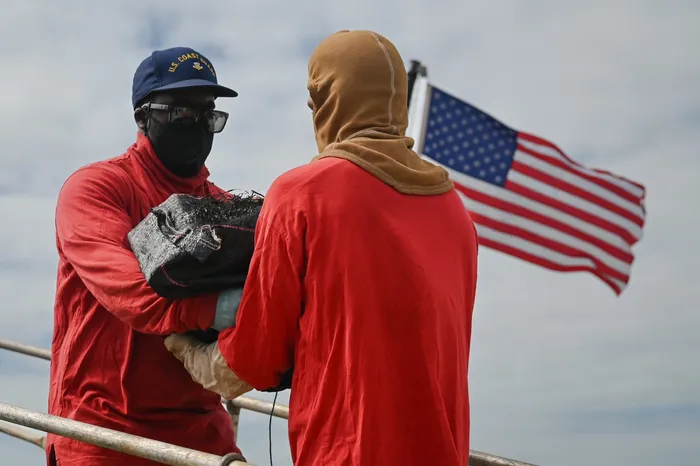
The sight of white bundles stacked high on a Coast Guard deck isn't just a photo op for local news. It’s a message. When the crew of the USCGC Margaret Norvell pulled into Miami Beach to offload $28 million worth of cocaine, they weren't just clearing out a cargo hold. They were showing exactly how much pressure is sitting on the Caribbean transit zones right now.
We’re talking about more than 1,850 pounds of high-grade narcotics. That’s nearly a ton of product that was destined for American streets, intercepted before it could disappear into the domestic supply chain. If you think these busts are getting more frequent, you’re right. The game has changed, and the smugglers are getting bolder, which means the Coast Guard has to be smarter.
The Strategy Behind the Coast Guard Narcotics Interception
Interdicting nearly $30 million in drugs doesn't happen by accident. It isn't a lucky break during a routine patrol. These operations are the result of weeks, sometimes months, of international intelligence sharing. The Coast Guard works with a web of agencies, including the DEA, FBI, and international partners, to track these vessels from the moment they leave South American shores.
Most people don't realize the sheer scale of the ocean these crews have to cover. It’s like trying to find a specific needle in a thousand different haystacks while the haystacks are moving at 40 knots. The "go-fast" boats used by cartels are designed for one thing: speed. They’re low-profile, painted to blend with the water, and packed with enough outboard engines to outrun almost anything that isn't a specialized interceptor.
The Margaret Norvell is a Sentinel-class Fast Response Cutter. It’s built for this. With advanced command and control systems, it can coordinate with overhead surveillance aircraft to pinch these smugglers in a tactical vise. When the Coast Guard moves in, it’s often a high-speed chase in the pitch black of night, miles from any coastline.
Why Miami Beach Remains the Epicenter for Drug Offloads
There’s a reason you keep seeing these offloads happening in Miami Beach. It’s symbolic, sure, but it’s also practical. Base Miami Beach is a primary hub for Seventh District operations. This area covers the Southeast U.S. and the entire Caribbean basin.
Miami has always been the gateway. The logistics are already there. When the Coast Guard brings in a haul this size, they need a secure facility where federal agents can immediately take custody of the evidence. You have a massive presence of Customs and Border Protection (CBP) and Homeland Security Investigations (HSI) right in the backyard.
The proximity to the Florida Straits makes this the front line. Smugglers try to exploit the heavy maritime traffic in the region, hoping to blend in with fishing boats or pleasure craft. It doesn't work as often as it used to. The tech has caught up.
The Economic Impact of a $28 Million Seizure
Let's look at the numbers. $28 million is the "wholesale" value. By the time that cocaine is stepped on, cut, and sold in gram increments on the street, that value triples. We’re looking at a massive hit to the operational budget of the cartels.
When the Coast Guard removes a ton of cocaine from the market, it creates a temporary supply shock. This doesn't just stop the drugs; it stops the money from flowing back south. That’s money that would have been used to buy more boats, more weapons, and more influence.
Critics often say these busts are just a drop in the bucket. I disagree. Every time a cutter like the Margaret Norvell returns to port with a deck full of contraband, it represents dozens of lives saved from overdose and a significant disruption to organized crime networks. It's about making the "business" of smuggling too expensive to maintain.
Challenges Facing Maritime Law Enforcement in 2026
The ocean is big. The bad guys have money. That's the core problem. As we move through 2026, the technology used by traffickers is evolving. We’re seeing more "low-profile vessels" (LPVs) and even semi-submersibles. These are basically home-made submarines that sit just inches above the water line, making them nearly invisible to standard radar.
The Coast Guard is fighting back with better drones and AI-driven pattern recognition. They’re looking for anomalies in sea surface temperatures or wake patterns that shouldn't be there. But equipment costs money. Maintenance for these cutters is a constant battle against the salt and the sea.
The human element is the most taxed. These crews spend weeks away from their families, operating in some of the most dangerous environments on earth. When you see them standing on the pier in Miami Beach, they’re exhausted. They’ve been living in tight quarters, chasing shadows in the dark, all to ensure that $28 million in poison never reaches your neighborhood.
What Happens to the Drugs After the Offload
The process doesn't end at the pier. Once the pallets are moved off the ship, they’re turned over to federal authorities. Every single brick is cataloged. Samples are taken for lab testing to determine the purity and the origin of the product. This helps intelligence agencies map out which cartels are currently dominant in specific regions.
Eventually, the vast majority of this seized cocaine is incinerated. It’s destroyed in high-temperature facilities under heavy guard. A small amount is kept for evidence in the upcoming trials of the individuals captured during the interdiction.
The legal side of this is just as intense as the sea chase. These cases often involve international law and complex jurisdictional issues. But when the Coast Guard makes a bust of this magnitude, the evidence is usually overwhelming.
How to Stay Informed on Local Maritime Security
If you live in South Florida or frequent the coast, you’re part of the eyes and ears of the region. Maritime security isn't just a federal job. It's a collective effort.
- Watch for anomalies. If you see vessels operating without lights at night or offloading crates in unusual areas, report it to the Coast Guard or local police immediately.
- Support the mission. Understand that the Coast Guard’s role in search and rescue is funded through the same channels as their drug interdiction missions.
- Stay updated. Follow the official Coast Guard Seventh District feeds. They provide real-time updates on these operations and the safety of our local waters.
The $28 million offload in Miami Beach is a win, but the ocean is still wide. The Norvell will head back out soon. The cycle continues, and the stakes stay just as high.