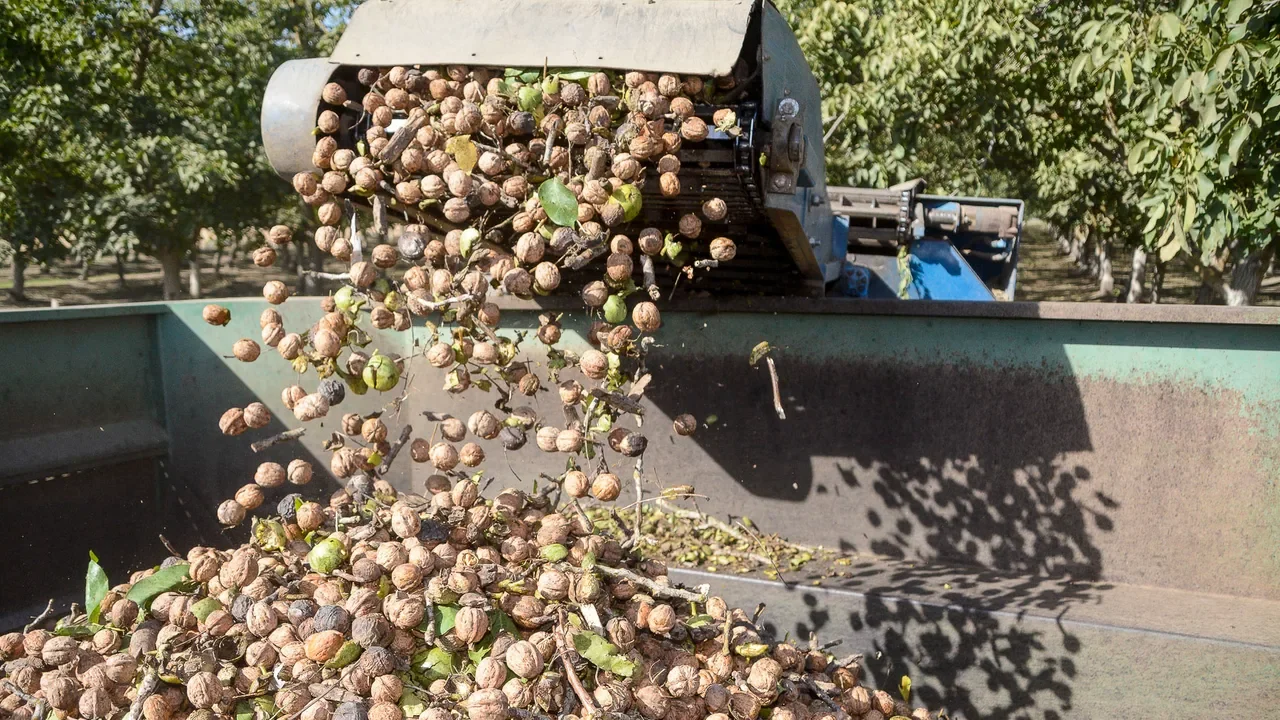
October in the Central Valley smells like damp earth, diesel exhaust, and tannin. If you have ever walked an orchard just after the mechanical shakers have rattled the trunks, you know the sound of harvest. It is a heavy, rhythmic rain of green hulls hitting dry dirt.
For decades, that sound meant survival. You grew the crop. You hauled it to the huller. You handed your harvest over to a massive cooperative or a global processor, shook hands, and waited for a check to arrive in the mail months later. You were a price-taker. You accepted whatever the commodity board dictated, swallowed the rising costs of diesel and water, and prayed the global market didn't tank while your nuts sat in a silo.
Then the math broke.
Between 2021 and 2023, California walnut growers watched wholesale prices crater to roughly thirty to forty cents a pound. Meanwhile, the actual cost to grow, irrigate, prune, and harvest those same walnuts hovered closer to eighty cents or a dollar a pound. Imagine waking up every morning at four, working twelve hours in hundred-degree heat, managing multi-million-dollar equipment, and knowing with mathematical certainty that every single pound you pull off a tree loses you fifty cents.
Bankruptcy.
That single word hung over the Highway 99 corridor like summer smog. Multi-generational orchards—trees planted by grandfathers who had survived droughts, floods, and recessions—were being bulldozed into piles of kindling because it was cheaper to burn the wood than to water the roots.
Yet in the middle of that agricultural collapse, one California grower looked at his ledger, walked away from the commodity middlemen, and tripled his walnut revenue. He didn't buy more land. He didn't invent a patented hybrid tree. He didn't secure a shelf contract with a national grocery chain.
He built an email list of ten thousand people, convinced just three hundred of them to buy directly from his farm, and rewrote the rules of survival.
The Trap of the Anonymous Commodity
To understand why three hundred customers could outperform a global supply chain, you first have to understand how agricultural middlemen quietly suffocate family farms.
Let's construct a hypothetical scenario—call him Arthur—to make the hidden mechanics of commodity farming visible. Arthur runs eighty acres of Chandler walnuts outside Chico. In a standard season, his trees yield around four thousand pounds per acre. That gives him 320,000 pounds of walnuts.
Under the traditional model, Arthur sells his crop in bulk to a processor. At the bottom of the market cycle, the processor pays him forty cents a pound. Arthur brings in $128,000 in gross revenue. Once he pays his water district fees, his harvest crew, his insurance, and his bank note, Arthur isn't just broke. He is $130,000 in the hole.
Now walk into a specialty grocery store in San Francisco, Austin, or Brooklyn, three hundred miles or three thousand miles away from Arthur's dirt. Look at the price tag on a one-pound bag of raw, unbleached California Chandler walnut halves.
Twelve dollars. Sometimes fourteen.
Read those numbers again. The farmer receives forty cents. The consumer pays twelve dollars. Somewhere between the orchard floor and the checkout scanner, 96 percent of the retail value evaporates into the pockets of hullers, shellers, brokers, freight haulers, distributors, and retail slotting fees.
I have sat across kitchen tables from growers holding those exact settlement sheets, their hands stained black from walnut hulls, trying to make sense of a system that rewards everyone except the person who actually risks their livelihood to grow the food. The confusion isn't just financial; it is existential. When you spend forty years perfecting soil biology only to be told your harvest is worth less than gravel, you start questioning your own sanity.
The commodity system works like a funnel turned upside down. Thousands of farmers pour their anonymous harvests into the wide mouth at the top. Once your walnuts are dumped into a massive bin alongside ten million other pounds, your story vanishes. Your soil quality vanishes. Your name vanishes. You become a line item on a spreadsheet in a corporate office, easily replaced by a cheaper grower in Chile or China.
Why Ten Thousand Subscribers Beats Ten Million Strangers
The farmer who tripled his revenue realized something profound that most business schools completely miss: you do not need to feed the world to save your farm. You just need to feed your corner of it.
Instead of trying to compete on volume in a rigged wholesale market, he pivoted to direct-to-consumer sales. He started capturing emails. Not through slick venture-backed ad campaigns, nor through aggressive pop-ups that annoy visitors, but by telling the unvarnished truth about what happens on a working farm.
He gathered ten thousand email addresses.
To a Silicon Valley marketer, ten thousand subscribers is a rounding error. To a farmer accustomed to moving hundreds of tons of freight, ten thousand people sounds almost impossibly small. How could a tiny digital list replace an industrial distribution network?
Consider what happens next: he didn't even need all ten thousand people to buy.
Out of that list of ten thousand, roughly three hundred people became regular, committed direct buyers. That is a conversion rate of just three percent. In almost any online industry, a three percent conversion rate is considered entirely normal, even modest.
Yet in agriculture, three percent changes everything.
When you sell directly to a customer, you bypass the five layers of middlemen taking their cut. Instead of receiving forty cents a pound, you sell a five-pound box of fresh, orchard-direct walnuts for fifty or sixty dollars—roughly ten to twelve dollars a pound. Even after paying for shelling, food-safe packaging, and shipping labels, your net margin jumps by orders of magnitude.
Let's look at the math of those three hundred customers. Suppose each of those three hundred buyers orders twenty or thirty pounds of walnuts over the course of a year—some for holiday baking, some for daily snacking, some sent as gifts to relatives. At twelve dollars a pound, three hundred customers buying thirty pounds each generates $108,000 in revenue from a mere nine thousand pounds of walnuts.
Nine thousand pounds. That is less than three acres of production.
By moving just a fraction of his harvest directly to three hundred households at retail prices—while scaling his direct subscriptions and seasonal boxes—his total farm revenue tripled compared to what the wholesale market would have given him for the entire orchard. He no longer needed to pray for commodity prices to rebound. He had decoupled his livelihood from the global market.
The Invisible Power of Kevin Kelly’s Math
If this ratio sounds familiar, it is because technology writer Kevin Kelly articulated the exact mechanism back in 2008 in his famous essay, 1,000 True Fans.
Kelly argued that a creator, artist, or independent producer does not need millions of casual customers to make a living. They only need one thousand true fans—people who will buy anything you produce because they believe in you, trust your craft, and want a direct connection to the source.
For decades, people assumed Kelly’s rule only applied to musicians, authors, and software developers. Physical goods, especially agricultural crops, were thought to be too heavy, too perishable, and too complex for small-scale direct fulfillment.
That assumption was dead wrong.
Food is the most intimate product on earth. People put it inside their bodies and feed it to their children. Yet modern supermarkets have stripped food of every trace of human origin. When you buy a bag of nuts at a big-box store, you have no idea when they were harvested. Often, those walnuts have been sitting in cold storage for twelve to eighteen months, slowly oxidizing and turning bitter.
When a customer buys directly from a California grower, they receive walnuts harvested weeks earlier. They taste the difference immediately—sweet, crisp, creamy, without a trace of that harsh, papery astringency that makes people think they dislike walnuts.
Once you taste a genuinely fresh walnut straight off the harvest floor, you can never go back to stale grocery store inventory. You don't just become a customer. You become a patron.
How a Dirt Farmer Builds a 10,000-Person List
Whenever I share this story with skeptical growers or small business owners, the immediate pushback is always the same: That sounds great on paper, but how does a farmer actually get ten thousand people on an email list without going broke on advertising?
The answer lies in asymmetry. Farmers possess something that corporate food brands spend millions of dollars trying to fake: authenticity.
A corporate marketing agency has to hire actors, rent an orchard for a day, and manufacture a story about "heritage" and "sustainability." A real farmer just has to pull a phone out of their dusty pocket while waiting for a water valve to pressurize and show what is actually happening.
Building that list requires three deliberate shifts in how a producer communicates with the outside world:
- Documenting the friction, not just the highlight reel. People are exhausted by polished corporate perfection. When a farmer writes an honest update about an unexpected late frost, the stress of repairing a broken hydraulic line at midnight, or the sheer absurdity of wholesale pricing, readers lean in. Vulnerability builds trust faster than any discount code ever could.
- Educating the palate. Most consumers don't know that walnuts are a perishable fat-rich seed that belongs in the refrigerator, not a warm pantry. They don't know the difference between a Chandler variety and a Howard, or why unbleached shells matter. Teaching buyers how to store, toast, and use the crop turns a commodity into a culinary ingredient.
- Making the transaction feel like an alliance. People love supporting underdogs, especially when doing so gives them a superior product. When a buyer realizes their sixty-dollar purchase keeps an actual family orchard alive instead of padding a conglomerate's quarterly earnings, buying walnuts stops being an errand and becomes an act of defiance.
To grow from zero to ten thousand subscribers, a grower doesn't need viral fame. They can partner with regional food bloggers, appear on gardening or homesteading podcasts, trade newsletter shout-outs with small-batch olive oil or honey producers, and include a simple QR code on every single bag sold at local farmers' markets. If you collect fifty emails a week through honest storytelling and small partnerships, you hit ten thousand in under four years.
The Logistics Nobody Talks About
It would be dishonest to pretend that pivoting from bulk wholesale to direct fulfillment is easy. It isn't. In fact, the first season you try it, it will probably feel like a mistake.
When you sell to a processor, you load fifty-thousand-pound trailers with a forklift and wave goodbye. Your job is done in October. When you sell directly to three hundred families, your job stretches across all twelve months.
Suddenly, you are not just an agronomist. You are a fulfillment warehouse, a customer service desk, and a shipping logistics coordinator. You have to figure out how to get your raw inshell walnuts cracked and sorted into clean halves without losing half your yield to breakage. You have to buy cardboard boxes in bulk, source food-grade barrier pouches that keep oxygen out, print thousands of shipping labels, and deal with the occasional box that gets crushed in a sorting facility in Memphis.
There are nights in November and December when the kitchen table disappears beneath packing tape, thermal printers, and manifests. Your back aches differently than it does from driving a tractor. You will make mistakes. You will miscalculate shipping weights on your first batch of orders and watch UPS eat half your profit margin on zones seven and eight.
I have watched small producers nearly quit during that first holiday rush because the administrative friction felt overwhelming. It is scary to trade the predictable, albeit miserable, simplicity of a single wholesale check for the messy complexity of hundreds of individual transactions.
Yet once you survive that first steep climb, the economics invert permanently.
You stop guessing what your income will be next year. You own the customer relationship. No buyer at a corporate grocery chain can suddenly drop your SKU because a competitor offered a cheaper rebate. No global trade tariff can wipe out your margin overnight. If fuel prices rise by fifteen percent, you send an honest email to your list explaining why boxes cost three dollars more this season—and your three hundred true fans pay it without blinking.
The Quiet Revolution in the Orchard
Walk through the Central Valley today, and you can still see the scars of the commodity crash. You can still see the stacked piles of uprooted walnut trees waiting for the chipper, and the faded real estate signs nailed to fence posts along county roads.
The industrial food system was built on a simple premise: get big or get out. Scale up, borrow more money, buy the neighbor's land, shave another penny off your production costs, and hope you outlast the guy down the road. For fifty years, that model turned American agriculture into a marvel of efficiency and a graveyard for independent families.
The farmer who tripled his revenue with three hundred customers proved that the old rule is broken. Scale is no longer the only shield against extinction. Connection is.
He didn't need a miracle from Washington, and he didn't need global markets to rescue him. He needed an email list, a cardboard box, a shipping scale, and the courage to speak directly to the people eating the food he grew.
Next time you crack open a walnut and taste that clean, buttery crunch, think about the distance it traveled to reach your hand. If it came through five middlemen, someone in a sunlit California orchard probably lost money growing it. If it came in a plain brown box with a handwritten thank-you note tucked inside, you aren't just eating dinner. You are keeping the trees standing.