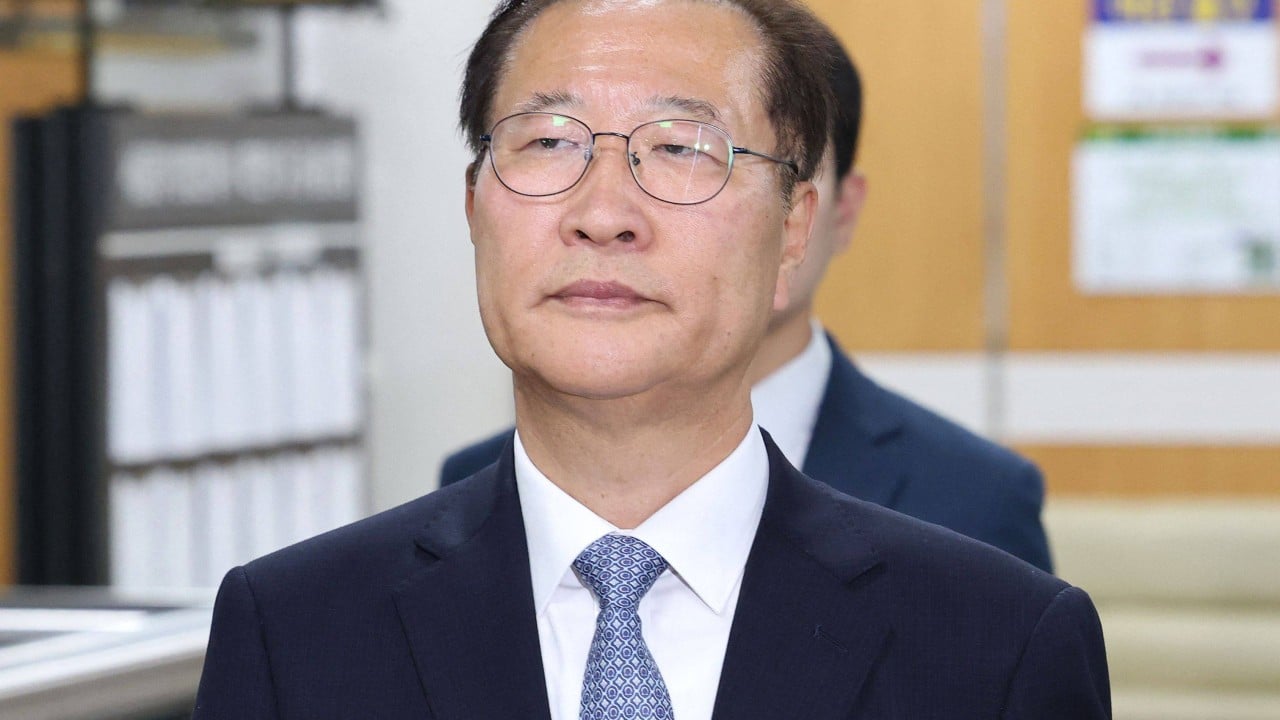
The modern democratic state relies on a delicate matrix of constitutional boundaries, where civilian institutions act as a structural firewall against executive overreach. When those internal firewalls fail, the transition from governance to state insurrection occurs not through spontaneous violence, but through deliberate administrative orchestration. The sentencing of former South Korean Justice Minister Park Sung-jae to 25 years in prison by the Seoul Central District Court exposes the precise operational architecture required to convert a functional bureaucracy into an instrument of authoritarian consolidation.
By analyzing the specific legal findings and structural mechanics behind the failed December 2024 martial law bid by ousted President Yoon Suk Yeol, we can isolate the exact operational vectors utilized during the attempt to subvert the South Korean state. This case demonstrates that the survival of a constitutional democracy depends less on public sentiment and more on the structural resilience of its administrative apparatus.
The Three Pillars of Administrative Insurrection
The court convicted Park Sung-jae on charges of playing a key supporting role in an insurrection and abusing his power. While traditional narratives frame coup d'états through the lens of kinetic military movement, this legal outcome highlights the administrative dependencies of state subversion. An executive declaration of martial law cannot achieve operational efficacy without the explicit coordination of the civilian legal apparatus. Park’s actions immediately following Yoon's late-night decree on December 3, 2024, fell into three distinct functional categories, which form the core pillars of administrative insurrection.
1. Logistical Capacity Scaling
An executive decree to detain political opponents requires immediate physical infrastructure. The prosecution demonstrated that Park called an emergency meeting of senior Ministry of Justice officials to audit and secure spare capacity within national correctional facilities. This step was designed to accommodate the mass arrest and detention of lawmakers, opposition leaders, and key civic figures flagged by the martial law command.
2. Legal Enforcement Weaponization
To prevent institutional resistance, the conspirators sought to utilize existing legal mechanisms under a distorted mandate. Park ordered ministry officials responsible for international travel restrictions to report for duty immediately to implement sweeping exit bans on targeted personnel. Concurrently, he initiated reviews to dispatch state prosecutors to a joint investigation headquarters, effectively turning the investigative power of the judiciary into an enforcement arm for the executive.
3. Institutional Bureaucratic Suppression
The true catalyst for an administrative coup is the suppression of internal dissent. The judicial findings indicated that Park explicitly ignored multiple warnings raised by senior ministry subordinates regarding the flagrant illegality of the martial law declaration. By bypassing internal compliance mechanisms and forcing bureaucratic alignment, the leadership attempted to manufacture an artificial legal mandate to paralyze lower-level institutional resistance.
The Strategic Asymmetry of the Sentencing Matrix
The 25-year prison sentence handed to Park Sung-jae represents a severe judicial escalation, notably surpassing the 20-year term initially requested by special counsel Cho Eun-suk's team. This structural severity reflects a calculated effort by the South Korean judiciary to re-establish deterrence against executive overreach. The sentencing hierarchy across the co-conspirators illustrates a deliberate strategy to penalize the systemic breach of institutional trust.
| Individual | Institutional Role | Judicial Outcome | Primary Legal Mechanism |
|---|---|---|---|
| Yoon Suk Yeol | Former President / Commander-in-Chief | Life Imprisonment (Appealed) | Leading an Insurrection; Manufacturing National Crisis |
| Park Sung-jae | Former Minister of Justice | 25 Years Imprisonment | Key Role in an Insurrection; Abuse of Power |
| Kim Yong-hyun | Former Minister of National Defense | Convicted (Varying Sentences) | Deployment of Kinetic Forces; Operational Execution |
| Han Duck-soo | Former Prime Minister | Convicted (Varying Sentences) | Cabinet Deceptive Ratification; Executive Endorsement |
The court's decision to surpass the prosecutor's recommendation rests on a fundamental principle of constitutional law: the asymmetric duty of the justice ministry. While military commanders operate under a chain of command where execution is the primary metric, the minister of justice is uniquely tasked with the defense of constitutional boundaries. By actively repurposing the instruments of law to support an insurrection, the court ruled that Park committed a compounding offense—turning the defensive shielding of the state into a weapon against its own citizens.
The Failure Function of the 2024 Decree
The operational failure of the December 2024 martial law attempt offers critical insights into the friction points inherent in rapid state subversion. For an executive coup to succeed, the speed of administrative capture must exceed the speed of institutional counter-mobilization. The failure function of Yoon’s decree was driven by two structural bottlenecks.
The first bottleneck was the Kinetic-Legislative Velocity Differential. The physical deployment of military personnel to seal the National Assembly building was outpaced by the rapid physical mobilization of opposition and independent lawmakers. Because the administrative apparatus failed to immediately neutralize legislative communications, lawmakers entered the chamber and exercised their constitutional prerogative under Article 77, Clause 5 of the Constitution, which mandates that the president must lift martial law when a majority of the National Assembly requests it.
[Executive Decree] ──> [Administrative Processing Delay] ──> [Legislative Counter-Vote] ──> [Structural Collapse of Mandate]
The second bottleneck was the Bureaucratic Compliance Drag. While top-tier cabinet officials like Park Sung-jae actively participated, middle-management civil servants and institutional actors faced immediate legal ambiguity. The brief six-hour window of the crisis meant that orders could not be institutionalized before the National Assembly voted down the decree. This friction demonstrates that without total, pre-arranged systemic co-optation, the inertia of an existing democratic bureaucracy acts as a passive stabilization mechanism against sudden executive decrees.
Long-Term Institutional Stabilization Metrics
The systematic prosecution of the Yoon cabinet—culminating in Yoon's life sentence in February, his formal removal from office via a unanimous Constitutional Court impeachment validation in April 2025, and Park's recent 25-year sentence—has transformed South Korea's political landscape. However, this aggressive judicial response introduces distinct operational risks and structural considerations for the state's ongoing stability.
The primary limitation of relying on post-hoc judicial prosecution is that it addresses systemic vulnerabilities only after an existential breach has occurred. The fact that an executive could successfully command military deployments and freeze ministry functions for even six hours reveals a dangerous over-concentration of emergency powers within the presidency.
To mitigate the risk of future structural failures, constitutional experts and legislative reformers are tracking three primary institutional metrics:
- The Codification of Statutory Disobedience Rights: Establishing clear, explicit statutory protections for civil servants and military personnel who refuse to execute executive orders that have been formally declared illegal by a legislative majority.
- The Decoupling of Prosecutorial and Executive Apparatuses: Implementing structural reforms to ensure the Ministry of Justice cannot unilaterally reallocate investigative and detention assets during a declared state of emergency without prior legislative sign-off.
- Emergency Power Decentralization: Modifying constitutional provisions to require mandatory, real-time legislative co-signing within the first 60 minutes of any emergency decree, effectively shifting the default state of martial law from "valid until revoked" to "invalid until ratified."
The definitive trajectory for South Korea depends on whether the upcoming snap presidential administration treats the current judicial outcomes as a final resolution or as a diagnostic map for deep structural reform. If the state fails to decentralize the executive powers that allowed the December 2024 crisis to occur, the institutional vulnerability will persist, leaving the door open for future, more sophisticated attempts at administrative subversion.