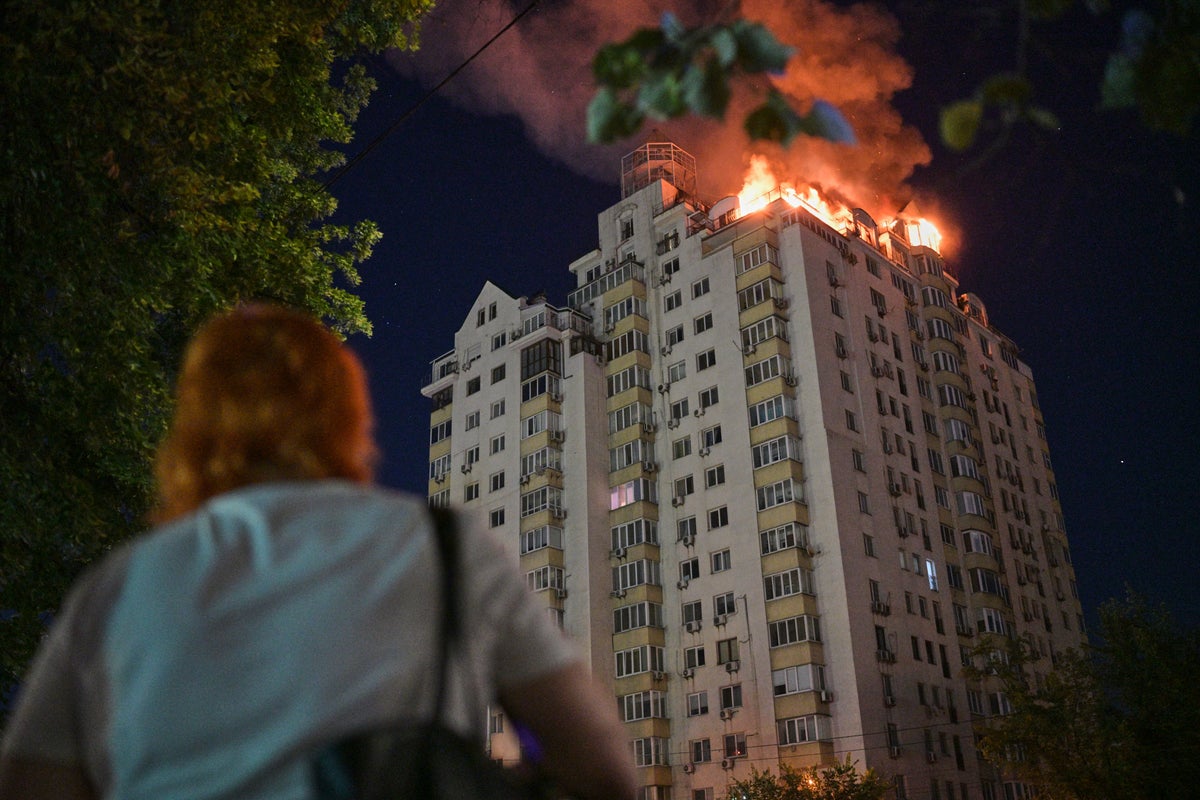
Massive aerial bombardments of urban administrative centers are frequently mischaracterized in popular media as unstructured acts of aggression or simple retaliatory impulses. This perspective ignores the underlying military logic of coordinated, multi-axis vector strikes. The large-scale overnight bombardment of Kyiv on July 2, 2026—which utilized a synchronized assortment of cruise missiles, ballistic missiles, and low-cost uncrewed aerial vehicles (UAVs)—serves as a case study in modern attrition warfare. The strike resulted in at least eight civilian fatalities and structural failure or fire across 28 distinct locations, including residential high-rises and a medical facility in the Shevchenkivskyi district.
Evaluating this operation requires moving past surface-level descriptions of destruction. Instead, analysts must look at the specific mechanisms of modern air defense saturation, the economic equations that govern weapon systems, and the strategic interplay between Ukrainian long-range strikes and Russian domestic pressures.
The Tri-Vector Saturation Model
The operational core of the strike rests on a deliberate sequencing model engineered to compromise layered air defense networks. Modern integrated air defense systems rely on radar tracking, target prioritization, and interceptor management. By mixing radically different aerial profiles, the offensive operation exploits structural limitations in these detection and engagement loops.
[Phase 1: Low-Cost UAVs] ──> Floods Radar Systems & Depletes Interceptors
                                  │
[Phase 2: Cruise Missiles] ───> Exploits Terrain & Subverts Tracking Routing
                                  │
[Phase 3: Ballistic Vectors] ─> Terminal Velocity Pierces Defensive Windows
Phase 1: Low-Cost Loitering Munitions
The assault begins by deploying slow, low-altitude uncrewed aerial vehicles across multiple approach corridors. These platforms have two main functions: mapping active radar positions as they fire, and forcing the defensive network to deplete its ready-to-fire ammunition on inexpensive targets. This phase strains the air defense network's target processing systems through sheer volume.
Phase 2: Low-Altitude Cruise Missiles
As the defensive radar systems focus on tracking and engaging the initial wave of drones, cruise missiles are introduced along variable flight paths. Traveling at high subsonic speeds and navigating close to the ground, these systems use local geography to evade early radar detection, targeting specific critical facilities and command nodes.
Phase 3: High-Velocity Ballistic Missiles
The final layer of the strike uses ballistic missiles traveling at high speeds with steep terminal descent angles. These assets are launched while air defense radar systems are processing data from earlier waves, or during the brief window when missile systems are reloading, maximizing the chance of getting past defenses.
The data from the July 2 attack reveals that damage occurred across all ten administrative districts of Kyiv on both sides of the Dnipro River. This wide dispersion confirms that the operation was explicitly designed to stretch and divide local air defense assets, rather than focusing on a single point of failure.
The Cost Function of Modern Air Defense
A major challenge for defenders in this style of warfare is the cost asymmetry between offensive delivery systems and defensive interceptors. The financial math behind defending a major city favors the attacker over extended campaigns.
- Offensive Component Costs: Loitering munitions like the Shahed-136 family cost roughly $20,000 to $40,000 per unit. Even advanced cruise and ballistic variants, while expensive, are produced within structured defense budgets.
- Defensive Component Costs: High-tier anti-ballistic interceptors, such as those used by Patriot or SAMP/T systems, routinely cost between $2 million and $4 million per launch.
This imbalance means the defender must spend orders of magnitude more capital to protect a city than the attacker spends to bomb it. When an air defense commander faces a mixed swarm of targets, they must make immediate, automated decisions about whether to launch a multi-million dollar missile to destroy a low-cost drone. If they choose not to fire, the drone risks hitting a high-value piece of infrastructure. If they do fire, they risk running out of interceptor missiles before the high-speed ballistic wave arrives.
This cost calculation explains why Ukrainian leadership called for faster development of domestic European anti-ballistic missile production during the July 2026 diplomatic visits to Dublin. Relying on fixed, finite stockpiles of foreign interceptors creates a clear operational vulnerability when facing persistent, high-volume saturation tactics.
Reciprocal Attrition and Domestic Pressures
The timing of this attack points to a clear strategic relationship with Ukraine's ongoing long-range drone campaign. In the months leading up to July 2026, Ukrainian forces concentrated deep drone strikes on Russian energy infrastructure, including major oil refineries and logistics hubs in the Moscow and Leningrad regions. These operations created real, measurable friction points for the Russian domestic economy.
Supply Disruption
Targeting oil refineries has led to localized fuel shortages, long lines at gas stations, and temporary price spikes inside Russia. This directly challenges the Kremlin's efforts to keep the civilian population insulated from the economic realities of the war.
Air Defense Redeployment
To safeguard these valuable economic assets, Russian military planners have had to move air defense systems away from the front lines and occupied territories to protect domestic factories and refineries.
This dynamic creates a strategic balancing act. The July 2 strike on Kyiv acts as a counterweight, designed to show domestic audiences a strong response while forcing Ukraine to pull its own air defense networks back toward major cities and away from the front lines.
Defensive Resilience and Infrastructure Limits
The physical impact of the July 2 bombardment shows the reality of urban resilience under sustained pressure. Industrial and residential areas bore the brunt of the strikes, with structural collapses reported in the Desnianskyi and Darnytskyi districts, alongside fires on central Shevchenko Boulevard.
The fact that thousands of citizens used the underground metro network as bomb shelters highlights the value of pre-existing civilian infrastructure built for civil defense. However, relying on passive shelters cannot stop the erosion of key infrastructure over time. When water, power, and medical facilities take repeated hits, it places an compounding strain on the city's logistics and emergency services, even if the population remains secure underground.
To counter these saturation tactics, defensive strategies must shift toward asymmetric interception methods. This means moving away from a total reliance on expensive, high-altitude missiles and investing heavily in low-cost alternatives, such as automated anti-aircraft guns and directed-energy weapons, to handle drone waves. At the same time, top-tier anti-ballistic missile systems must be reserved exclusively for high-speed, high-altitude threats. Without adjusting the cost equation and improving interceptor supplies, managing a long-term defense against multi-layered aerial assaults remains a difficult operational challenge.
The video below details how these competing long-range strategies impact infrastructure and energy supplies on both sides, providing deeper context on the economic realities shaping the conflict.