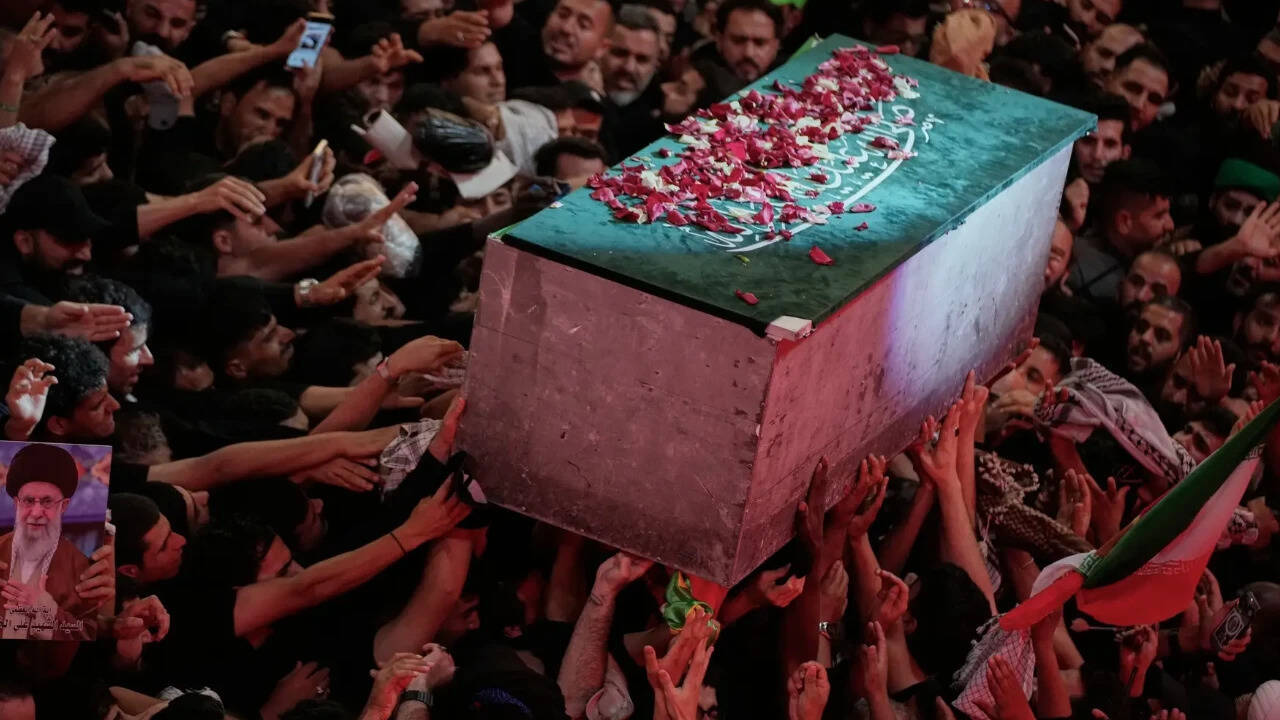
Mass mobilization during state funerals in authoritarian regimes is frequently mischaracterized as a mere emotional or cultural phenomenon. In the context of the Islamic Republic of Iran, public mourning rituals function as a highly engineered political technology. State-orchestrated funerals serve three precise systemic objectives: reinforcing the internal hierarchy of power, signaling deterrence to foreign adversaries, and measuring the operational capacity of the state’s mobilization apparatus.
When high-ranking figures—such as Supreme Leader Ayatollah Ali Khamenei or other pivotal state actors—become the focus of these rites, the state deploys specific choreographies designed to project stability during moments of acute systemic vulnerability. Analyzing these events through the lens of political risk and strategic signaling reveals how the regime converts the physical loss of a leader into a mechanism for institutional preservation. Don't forget to check out our earlier article on this related article.
The Tri-Pillar Framework of State-Sponsored Mourning
The political utility of a state funeral relies on three interdependent variables. If any single pillar fails, the state risks exposing internal fractures to both domestic dissidents and external rivals.
1. The Succession and Legitimacy Vector
The primary internal function of the funeral is the codification of the incoming power structure. The physical arrangement of elites around the casket serves as an explicit data point for the public and foreign intelligence services. If you want more about the context here, The Washington Post offers an in-depth summary.
- The Presiding Cleric: The individual selected to lead the funeral prayers (Namaz-e Mayyet) is rarely chosen at random. This role is a leading indicator of ideological alignment and proximity to the center of succession. For instance, when a Supreme Leader presides over a subordinate’s funeral, it signals a direct blessing. Conversely, the individual chosen to lead prayers for a deceased Supreme Leader is often the de facto or de jure successor, using the platform to claim spiritual and political continuity.
- Proximity Mapping: The physical distance of military commanders, judiciaries, and clerical factions from the body establishes the immediate hierarchy. Those relegated to the periphery are functionally marked as politically diminished.
2. The Mobilization Efficiency Index
Western analysts frequently debate whether funeral crowds are coerced or genuine. This dichotomy misses the operational reality. For the regime, the absolute volume of the crowd acts as a stress test of its patronage networks and administrative coercion capabilities.
The state activates a complex logistics chain to guarantee density:
- The Basij Network: Local chapters of the paramilitary organization are mobilized to coordinate neighborhood-level attendance, linking participation to hyper-local economic incentives or surveillance compliance.
- State Sector Mandates: Government employees, civil servants, and students are integrated into mandatory attendance structures, providing a predictable baseline of crowd volume.
- Logistical Subsidies: The provisioning of free transportation from rural provinces to metropolitan centers (primarily Tehran or Qom) serves to skew the demographic representation of the crowd, offsetting urban, secular dissent with rural, economically dependent loyalists.
The resulting crowd density is a quantifiable metric of the state's logistical health. A diminished turnout signals an operational bottleneck or a degradation of the state’s command-and-control apparatus over its base.
3. External Deterrence Signaling
On the geopolitical stage, the funeral crowd is weaponized as an asymmetric defense asset. The regime utilizes the visual scale of the mourning population to communicate a specific calculation to foreign adversaries: an attack on the leadership will trigger a deeply consolidated, mass-mobilized asymmetrical response. The message is intended to shift the cost-benefit analysis of foreign intelligence agencies weighing regime-change strategies or targeted strikes.
The Strategic Cost Function of Successor Transitions
The death of a foundational figure introduces a critical equilibrium vulnerability. The state must balance two competing vectors: the necessity of projecting absolute ideological continuity versus the pragmatic reality of factional consolidation.
The transition process can be calculated as a function of friction between institutional players:
$$F_t = f(I_c, M_a, E_s)$$
Where:
- $F_t$ represents the overall Transition Friction.
- $I_c$ represents Ideological Consensus among the senior clergy.
- $M_a$ represents Military Alignment, specifically the stance of the Islamic Revolutionary Guard Corps (IRGC).
- $E_s$ represents External Security Pressure.
When external pressure ($E_s$) is elevated, internal factions are highly incentivized to suppress their differences publicly to present a unified front during the funeral proceedings. The funeral space temporarily artificially reduces $F_t$ by creating an environment where dissent is equated with apostasy or treason.
The Role of the Islamic Revolutionary Guard Corps (IRGC)
During these high-stakes transitions, the IRGC shifts from an economic and paramilitary actor to the ultimate guarantor of structural stability. The funeral provides the IRGC with a public stage to project its veto power over the succession process. By dominating the security architecture of the funeral route, managing the airspace, and ensuring the physical security of visiting foreign dignitaries—particularly leaders from the Axis of Resistance—the IRGC implicitly signals that any internal political configuration must secure its institutional consent.
Operational Vulnerabilities in the Signaling Architecture
While the state-orchestrated funeral is designed to project total control, the mechanism contains inherent structural fragilities.
The Problem of Counter-Narratives
In a hyper-connected information environment, the state no longer holds a monopoly on visual narrative. While state media broadcasts tightly framed, high-angle shots of packed avenues to imply unanimity, decentralized digital networks counter with low-angle, localized footage showcasing empty parallel streets, boycotts, or active counter-protests. This friction degrades the efficacy of the external deterrence signal. If foreign adversaries detect significant variance between state propaganda and open-source intelligence (OSINT) data, the deterrent value of the crowd collapses.
Logistical Exhaustion and Over-Saturation
The regime’s reliance on mass mobilization introduces a diminishing marginal utility. Consecutive security crises or the sequential deaths of multiple high-profile figures within a short timeframe place an unsustainable strain on the state’s mobilization infrastructure. Continuous mobilization exhausts financial resources, strains public transport systems, and increases the risk of security lapses. A poorly attended funeral following a series of high-profile events exposes structural fatigue, signaling to both domestic critics and foreign intelligence that the regime's capacity to command its base has degraded.
The Strategic Path for Foreign Observers
To accurately gauge the stability of the Iranian state during a high-stakes transition funeral, analysts must bypass the emotional rhetoric and focus on quantifiable operational indicators.
First, track the precise composition and seating arrangements of the Supreme National Security Council and the Assembly of Experts during the state proceedings. Any sudden deviation from established protocol—such as the absence of a major factional leader or an unexpected individual leading the public prayers—indicates an unresolved succession bottleneck.
Second, cross-reference state media footage with independent satellite imagery and localized cellular data to calculate the actual density-to-area ratio of the crowds. If the mobilization is confined strictly to highly secure, subsidized zones rather than organic, widespread urban centers, the regime's domestic reach is fracturing. The ultimate indicator of structural resilience is not the passion of the crowd, but the cold efficiency of the state's logistical deployment under pressure.



