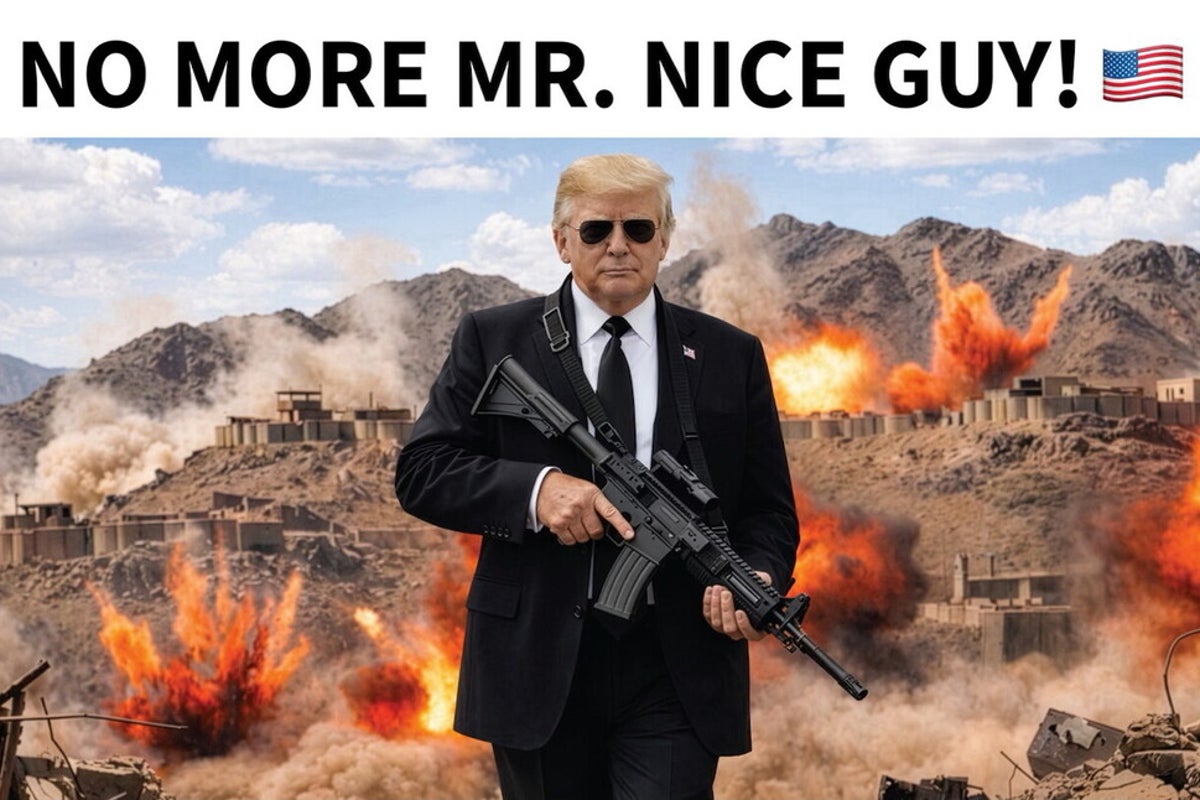
The convergence of digital imagery and geopolitical signaling represents a calculated shift from traditional diplomacy toward a high-frequency psychological operations framework. When a political leader distributes visual content depicting themselves armed with tactical weaponry directed at a sovereign adversary like Iran, the objective is rarely immediate tactical deployment. Instead, it serves as an exercise in Symbolic Deterrence, a mechanism designed to alter an opponent's perception of risk without the immediate overhead of kinetic mobilization. This strategy relies on the intentional blurring of personal intent and national policy, creating a "madman theory" effect that forces adversaries to recalibrate their expected utility of aggression.
The Architecture of Visual Posturing
To understand the efficacy of such messaging, one must deconstruct the components of the communication. The use of a specific firearm—an "assault rifle" or tactical carbine—is not a random choice; it functions as a semiotic anchor. In the context of American political theater, this imagery communicates a specific set of variables to different audiences simultaneously: Recently making news in related news: Taiwan Independence is a Zombie Term and Your Geography Teacher is Lying.
- Domestic Base Mobilization: It reaffirms a commitment to second-amendment values and "strongman" optics, consolidating internal support.
- Adversarial Uncertainty: For the Iranian leadership, the image acts as a non-verbal "tripwire" signal. It suggests that the threshold for military engagement has been lowered, or at least that the actor wishes to appear as though it has.
- Institutional Bypass: By utilizing social media platforms rather than formal state department channels, the communicator removes the "buffer of bureaucracy," making the threat feel more visceral and unpredictable.
The primary risk in this architecture is the Decoupling of Intent and Interpretation. In traditional signaling, a formal communique is vetted for clarity. In visual signaling, the ambiguity is the point. This ambiguity, however, increases the probability of an "accident of perception," where the adversary miscalculates a defensive posture for an imminent offensive strike.
The Cost Function of Asymmetric Rhetoric
Every act of public aggression carries a hidden price tag in the form of Diplomatic Capital Erosion. While the immediate benefit is a surge in perceived strength, the long-term cost manifests in three specific areas: More details on this are covered by Reuters.
1. The Credibility Gap
If a high-intensity threat—like "No more Mr. Nice Guy"—is not followed by a tangible policy shift or military maneuver when a red line is crossed, the potency of future threats diminishes. This is the Inflationary Cycle of Rhetoric. To achieve the same level of deterrence next time, the actor must escalate the visual or verbal intensity, eventually reaching a ceiling where only kinetic action can restore credibility.
2. Multi-Lateral Alienation
Global allies rely on predictability to manage their own regional security. When a primary security partner engages in high-variance signaling, it incentivizes allies to pursue "strategic autonomy." This creates a fragmented alliance structure where partners may begin independent negotiations with the adversary to hedge against the risk of an unplanned conflict.
3. The Adversary’s Domestic Consolidation
External threats are the most effective tool for internal regime stability. For the Iranian government, aggressive imagery from a Western leader provides the necessary justification for increased defense spending and the suppression of internal dissent. The threat becomes a "gift" to the adversary's hardliners, who use it to validate their narrative of Western belligerence.
Strategic Frameworks of Iranian Response
The Iranian state does not view such imagery through a lens of personal emotion; it views it through the Framework of Rational Actor Survival. Their response typically follows a three-stage counter-signaling protocol:
- Mirroring: Responding with equivalent visual displays of force (e.g., missile tests or naval drills) to demonstrate that the deterrent signal was received but rejected.
- Proximal Pressure: Utilizing non-state actors in the Levant or Yemen to signal that they can inflict costs on Western interests without a direct, traceable state-on-state confrontation.
- Nuclear Latency Acceleration: Using the threat as a justification for increasing uranium enrichment levels, framing the move as a "defensive necessity" in the face of perceived imminent aggression.
The Cognitive Dissonance of "Nice Guy" Diplomacy
The phrase "No more Mr. Nice Guy" implies a transition from a state of cooperation or restraint to one of unbridited hostility. However, when applied to US-Iran relations, the baseline has rarely been "nice." Since 1979, the relationship has been defined by Maximum Pressure, sanctions, and shadow wars.
This linguistic choice is a form of Framing Manipulation. It attempts to reset the historical clock, positioning previous constraints as a voluntary choice of "kindness" rather than a calculated geopolitical necessity. By reframing past restraint as "being nice," the actor creates a psychological "sunk cost" in the mind of the public, suggesting that since "niceness" failed, only "toughness" remains as a viable path.
Quantitative Impact on Market Volatility
Geopolitical threats of this nature have a direct, measurable impact on global energy markets. The "Fear Premium" in Brent Crude pricing often spikes following such high-profile escalations.
- Short-term Volatility: Algorithmic trading bots scan for keywords related to "Iran," "Rifle," and "Threat," triggering automated buy orders in oil futures.
- Risk Assessment Shift: Insurance premiums for maritime shipping in the Strait of Hormuz undergo immediate recalculation by actuarial models, increasing the cost of global trade even if no shot is ever fired.
The economic reality is that "tough" talk is a tax on the global supply chain. The uncertainty introduced into the market forces a reallocation of capital away from growth and toward risk mitigation.
Operational Limitations of Visual Deterrence
A leader holding a rifle is a potent image, but it lacks the Operational Depth of a carrier strike group deployment or a change in DEFCON levels. Military analysts distinguish between "Cheap Talk" and "Costly Signaling."
Cheap Talk includes social media posts, speeches, and interviews. These require zero resource allocation.
Costly Signaling involves the movement of troops, the activation of reserves, or the implementation of secondary sanctions that hurt the domestic economy of the signaler.
The Iranian intelligence community is trained to ignore the Cheap Talk and monitor the Costly Signaling. If the rifle photo is not accompanied by a change in the posture of the U.S. Central Command (CENTCOM), it is categorized as domestic political theater rather than a change in military doctrine.
The Feedback Loop of Digital Escalation
We are currently observing the "Gamification of Geopolitics." In this environment, the success of a signal is measured by "engagement metrics" rather than diplomatic concessions. This creates a dangerous feedback loop:
- Stimulus: A leader posts a provocative image.
- Reaction: The media and the adversary respond with high-volume outrage or counter-threats.
- Reinforcement: The leader perceives the high volume of noise as "success" and "impact."
- Repetition: The leader repeats the behavior with higher intensity to achieve the same dopamine and political hit.
This loop ignores the actual strategic objective—the stabilization of the Middle East or the cessation of Iranian nuclear ambitions—in favor of short-term optical dominance.
Redefining the Threshold of Conflict
The traditional binary of "Peace" vs. "War" is obsolete. We operate in a Grey Zone of constant competition. Within this zone, the rifle imagery is a weaponized narrative. It aims to win the "Information War" by projecting an aura of inevitability.
However, the efficacy of narrative weaponry is dependent on the target's susceptibility. If the adversary has high internal cohesion and a clear long-term strategy, they are immune to visual intimidation. They simply wait for the news cycle to rotate, knowing that the "threat" is tied to a specific political moment rather than a permanent shift in national interest.
Strategic Recommendation for Risk Management
To navigate the fallout of such high-variance political signaling, corporate and diplomatic entities must adopt a Multi-Factor Verification Protocol:
- Ignore the Optics: Discount all social media-based threats by a factor of 80% unless corroborated by department-level statements.
- Monitor Logistics: Track the movement of heavy lift aircraft and tanker support in the region. These are the true indicators of intent.
- Hedge for Volatility: Maintain liquid reserves to absorb the 2-5% fluctuations in energy costs that follow these "optical spikes."
- Maintain Dual-Channel Communication: Ensure that behind-the-scenes "backchannel" communications remain active to clarify that the public optics do not necessarily signal a change in the fundamental "rules of the game."
The move from "Nice Guy" to "Armed Antagonist" is a shift in marketing, not necessarily a shift in mechanics. The most dangerous mistake a strategist can make is confusing a change in the packaging for a change in the product. Deterrence is maintained through the quiet, consistent application of power, not the loud, erratic display of its symbols.