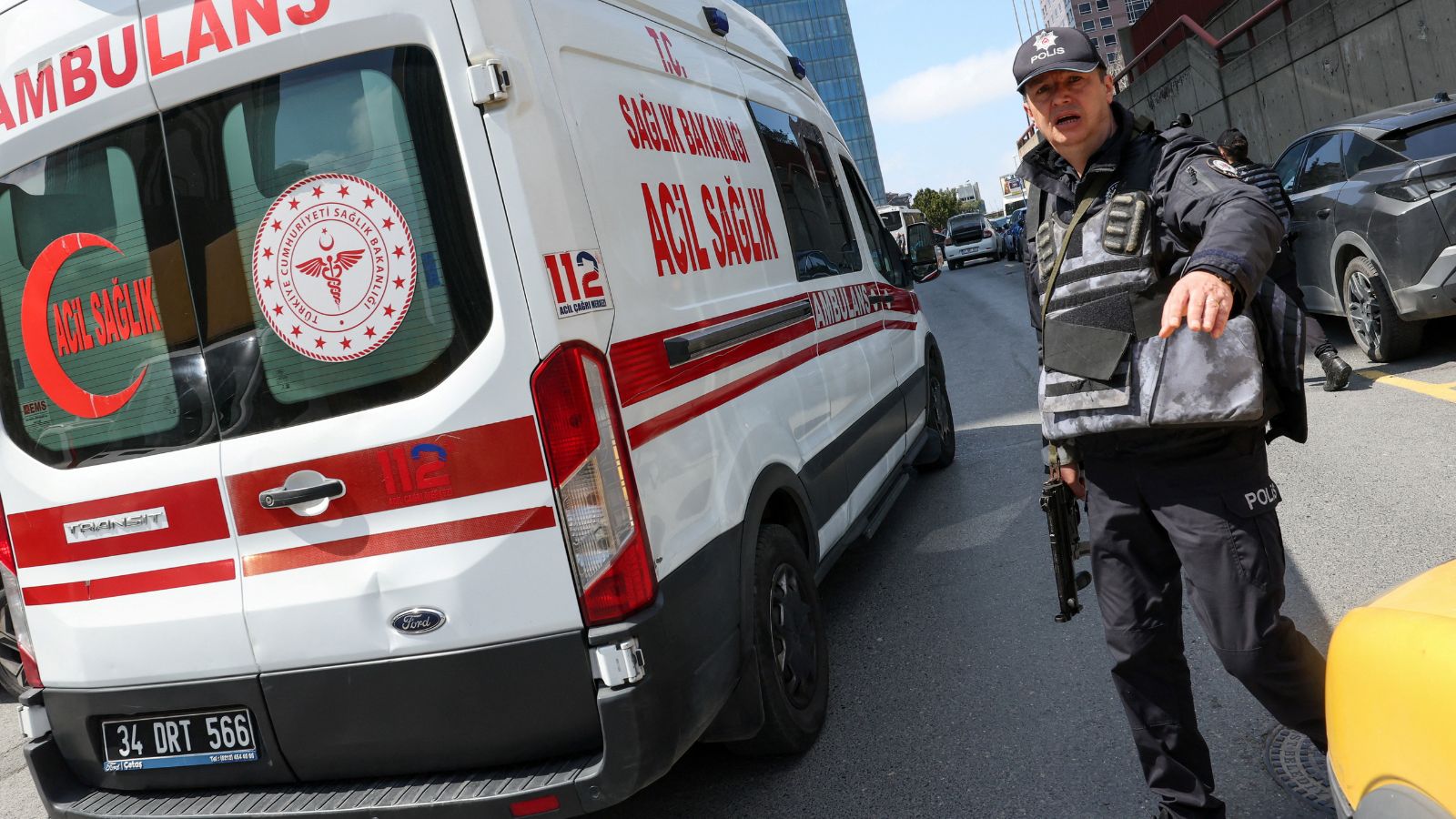
The kinetic assault on the Israeli consulate in Istanbul serves as a stark demonstration of the escalating volatility in urban diplomatic security. While standard reporting focuses on the casualty count and the immediate exchange of fire, a rigorous analysis reveals a more complex failure of deterrence and a specific evolution in the threat profile facing high-profile diplomatic missions. The incident highlights a fundamental shift from sophisticated, state-sponsored operations toward decentralized, high-impact tactical strikes designed to exploit the friction between host-nation sovereignty and foreign mission protection.
The Triad of Diplomatic Vulnerability
The security of a consulate exists at the intersection of three competing variables: geographic permanence, public accessibility, and host-nation cooperation. Unlike military installations, which can be hardened behind expansive perimeters and stand-off zones, urban consulates are often integrated into the dense fabric of a city. This integration creates a persistent structural deficit in defensive depth. Meanwhile, you can explore similar events here: The Uniform and the Bloodline.
Structural Exposure
Consulates are fixed targets. Their coordinates are public knowledge, and their operational hours are predictable. This allows attackers to conduct extensive pre-operational surveillance without triggering typical behavioral anomalies. The consulate in Istanbul, situated within a bustling district, lacks the luxury of a "gray zone" where security forces can identify and intercept threats before they reach the Hardened Perimeter.
The Host-Nation Dependency
Under the Vienna Convention on Consular Relations, the primary responsibility for protecting the mission lies with the host state. This creates a reliance on local police forces whose training, response times, and political directives may not align perfectly with the mission’s internal security protocols. When a gunfight erupts on the sidewalk, the consulate’s internal security team is legally and tactically restricted; they cannot easily engage targets beyond their gate without risking a diplomatic incident or legal repercussions from the host government. To see the bigger picture, check out the detailed report by The Washington Post.
The Vector of Proximity
Urban terror relies on "close-quarters saturation." By initiating an attack at the entrance or during a shift change, attackers maximize the psychological impact while minimizing the window for a coordinated response. The Istanbul incident confirms that the most dangerous point in the security chain is the transition point—the moment an individual or vehicle moves from the public street into the controlled consulate environment.
Tactical Deconstruction of the Incident
The engagement outside the Istanbul consulate was not an act of random violence but a calculated attempt to penetrate a high-security node. Analyzing the mechanics of the gunfight reveals the specific operational choices made by the attackers.
Firearms and Firepower Parity
The use of automatic weapons indicates a level of procurement that surpasses lone-wolf capabilities. By engaging the Turkish police and consulate guards with high-volume fire, the attackers attempted to suppress the defenders' ability to take aimed shots. In urban environments, suppressive fire is disproportionately effective because of the acoustics and the presence of civilian bystanders, both of which slow down the decision-making process of security personnel.
The Failure of Initial Interception
The fact that the attackers reached the immediate vicinity of the consulate suggests a failure in the "Outer Ring" of security. Effective counter-terrorism requires layered defense.
- The Intelligence Layer: Identifying the procurement of weapons or the planning phase.
- The Transit Layer: Interdicting the attackers while they are en route to the target.
- The Static Layer: The physical barriers and guards at the target.
In this instance, the first two layers were bypassed, forcing the entire weight of the defense onto the Static Layer. While the attackers were neutralized, the success of the defense is a technical one—they did not enter the building—but the strategic failure remains: an attack occurred at the doorstep of a major diplomatic mission.
The Geopolitical Cost Function
Attacks on Israeli diplomatic interests carry a unique set of geopolitical externalities that differ from attacks on other nations. The cost is not merely human or structural; it is measured in the strain placed on bilateral relations between the sending and receiving states.
The friction in the Turkey-Israel relationship creates a "Security Ambiguity." When political rhetoric between two nations is heated, security cooperation often suffers at the operational level. Local security forces may feel less urgency, or intelligence-sharing channels may become clogged with bureaucracy. Attackers exploit this perceived or actual gap in the shield.
The cost of this incident is calculated through:
- Escalation of Hardening: Every successful or near-successful attack necessitates a massive capital expenditure in physical upgrades.
- Diplomatic Retraction: Consulates may reduce public-facing services, which limits the mission's ability to conduct cultural and economic diplomacy.
- Intelligence Reallocation: Resources must be shifted from broad monitoring to specific, high-intensity protection of a single site, creating potential blind spots elsewhere.
Asymmetric Tactics in the Modern Urban Theater
The evolution of urban terror has moved toward "Low-Tech, High-Will" operations. You do not need a suitcase bomb to disrupt a city's stability; two determined individuals with rifles can achieve a similar geopolitical result with significantly less logistical overhead.
The Psychology of the Doorstep
Attacking a consulate is an act of symbolic decapitation. It signals that the host nation cannot guarantee the safety of its guests. For the attackers, the goal is often not the total destruction of the mission, but the creation of a visual narrative of chaos. The proximity of the gunfight to the consulate doors ensures that the event is inextricably linked to the sovereign entity being targeted, regardless of who fired the fatal shots.
The Media Feedback Loop
In Istanbul, a city with high smartphone penetration and a massive media presence, an attack is broadcast in real-time. This provides the attackers with an immediate global platform. The tactical failure of the attackers (being killed before entering) is often secondary to the strategic success of forcing the consulate to close, dominating the news cycle, and projecting an image of insecurity.
Quantifying the Risk Environment
To manage the risk of future engagements, security consultants must move away from qualitative "threat levels" and toward quantitative "vulnerability metrics." This involves calculating the probability of a breach based on:
- Pedestrian Density: The number of unvetted individuals passing within 10 meters of the entrance per hour.
- Response Latency: The time delta between the first shot fired and the arrival of tactical reinforcements.
- Visual Obstruction: The amount of urban clutter (kiosks, bus stops, parked cars) that provides cover for an approaching threat.
The Istanbul incident suggests that the "Response Latency" was low, which prevented a catastrophic breach. However, the "Visual Obstruction" and "Pedestrian Density" of the area continue to provide an advantage to the aggressor.
Operational Redesign for Diplomatic Nodes
The traditional model of a static guard in a booth is obsolete. The defense of urban diplomatic missions must transition toward a more dynamic, proactive posture.
Active Surveillance Integration
Moving beyond CCTV, missions must utilize AI-driven behavioral analysis to identify "loitering patterns" or "velocity anomalies" in the surrounding streets. Detecting a person moving at an unusual pace or carrying a concealed heavy object 50 meters away provides the extra seconds needed to lock down the facility.
The Buffer Zone Mandate
There must be a move toward creating "sterile corridors" around sensitive missions. This involves the removal of street parking and the installation of retractable bollards that can be deployed instantly. While this creates friction with the local municipality, it is the only way to mitigate the risk of vehicle-borne or rapid-approach infantry attacks.
Joint Tactical Drills
The discrepancy between consulate security (often private contractors or elite military units) and local police (municipal officers) must be bridged through joint training. If the two forces do not speak the same tactical language, the "fog of war" during an engagement leads to friendly fire risks and delayed neutralization of the threat.
The neutralization of the attackers in Istanbul was a tactical success for the responding units, yet it serves as a definitive warning. The current security posture for urban consulates is reactive. Until the "Outer Ring" of security is expanded through both technology and host-state policy, the transition point of the consulate will remain the most volatile square meter in urban warfare.
Diplomatic missions must now operate under the assumption that the street is a contested space. The strategy moving forward requires a decoupling of the mission's public presence from its physical vulnerability. This involves migrating high-risk administrative functions to "Dark Sites" while maintaining a symbolic, low-risk public storefront. Without such a structural pivot, the consulates of high-profile nations will continue to serve as magnets for asymmetric kinetic strikes that carry diplomatic consequences far outweighing their tactical scale.