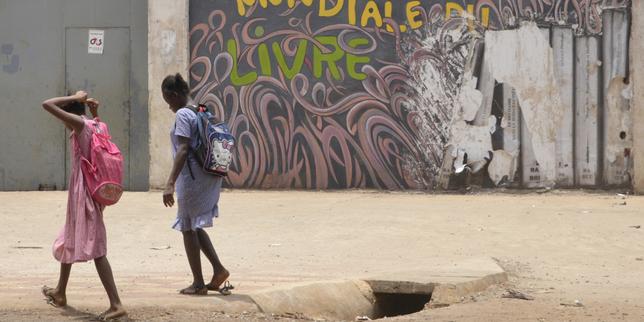
The global development industrial complex loves a simple narrative. It packages neatly into fundraising brochures, satisfies corporate social responsibility quotas, and requires zero deep thinking. The current darling of this crowd is the "period poverty" narrative in West Africa, specifically concerning school dropout rates for girls in Guinea.
The standard thesis goes like this: girls hit puberty, they lack access to sanitary pads, they miss a few days of school every month out of shame, and eventually, they drop out entirely. The prescribed solution? Ship containers of plastic maxi pads or fund local reusable pad workshops.
It is a comforting story. It is also fundamentally wrong.
By focusing obsessively on menstruation as the primary driver of female dropouts in Guinea, international NGOs and well-meaning activists are treating a minor symptom while completely ignoring the terminal illness. Menstruation is not the wall blocking Guinean girls from an education; it is merely a convenient scapegoat for a systemic collapse of basic infrastructure and economic reality.
The Flawed Logic of the Period Dropout Epidemic
The idea that distributing sanitary products will magically keep girls in school relies on a massive logical leap. It assumes that a piece of cotton can fix a school system that lacks running water, doors on latrines, or qualified teachers.
Let us look at the actual mechanics of a school day in rural regions like Labé or Kankan. If a girl has a pack of premium sanitary pads but attends a school with no functional toilets, no privacy, and no running water, those pads change absolutely nothing. She cannot change them hygienically. She cannot wash her hands. The issue is not a lack of products; it is a lack of plumbing.
Data from human development indices regularly shows that water, sanitation, and hygiene (WASH) infrastructure in Guinean schools is abysmal. When a girl stays home during her period, she is not necessarily fleeing the stigma of menstruation itself. She is making a rational choice to avoid a public infrastructure nightmare. Treating this as a "distribution problem" for hygiene products is like giving a driver a new set of tires when the car lacks an engine.
Furthermore, the obsession with pads completely ignores the brutal economic realities that force girls out of the classroom.
The Real Drivers of Descolarisation
If you want to know why a fourteen-year-old girl in Guinea stops going to school, look at the family ledger, not her anatomy.
- Opportunity Costs: As children grow older, their labor becomes valuable. In agricultural or informal trading economies, the immediate economic return of having a daughter work at home or in the market heavily outweighs the distant, uncertain promise of a flawed educational system.
- The School Fee Squeeze: While public primary education is technically free, secondary education incurs significant hidden costs. Uniforms, textbooks, transport, and informal "teacher fees" add up. When a family living on less than two dollars a day has to choose which child stays in school, patriarchal norms dictate they invest in the son.
- Early Marriage and Pregnancy: The legal age of marriage might be set on paper, but traditional practices often override statutory law in rural areas. Once a girl is married, her educational trajectory is effectively ended by societal expectation, not by her monthly cycle.
I have spent years analyzing development data and watching international organizations dump millions into single-issue campaigns. I have seen warehouses full of donated hygiene kits rotting in tropical humidity while the local school across the street literally crumbled from neglect. The Western obsession with funding pad distributions is driven by a desire for quick, quantifiable metrics—"we distributed 10,000 pads this month"—rather than long-term, structural impact that is harder to measure on a spreadsheet.
The Dark Side of the Pad Obsession
Am I saying access to menstrual hygiene products does not matter? Of course not. Comfort and dignity matter. But elevating it to the status of a "major cause of dropout" creates several dangerous unintended consequences.
First, it creates a dependency loop. Foreign donations of disposable products create a demand that cannot be sustained once the NGO grant runs out. When the free supply dries up, the girls are right back where they started, except now they are judged by a new, westernized standard of what constitutes "proper" hygiene.
Second, it crowds out funding for actual structural reform. Every dollar spent shipping boxes of pads across the Atlantic is a dollar not spent drilling boreholes, building private latrines, or training local teachers. It allows local authorities to dodge accountability. Why should a regional education board bother fixing the plumbing when they can just let a foreign charity hand out reusable underwear and claim the problem is being solved?
Dismantling the Premise: The Data Context
To understand how skewed the current narrative is, we have to look at comparative data. Studies across sub-Saharan Africa, including comprehensive research by institutions like the Population Council, have repeatedly found that providing sanitary products has a negligible impact on actual school attendance.
In many trials, girls who received pads did not show significantly higher attendance records than those who did not. Why? Because the other barriers—poverty, household labor demands, lack of safety on the walk to school, and abysmal teaching quality—remain completely unchanged. A girl does not walk five kilometers through an unsafe area to sit in an overcrowded classroom with no teacher just because she has a sanitary pad.
Shift the Strategy: What Actually Works
If the goal is to keep Guinean girls in school, the entire playbook needs to be rewritten. We must stop viewing African girls solely through the lens of vulnerability and biology, and start looking at them as economic and social actors.
Instead of funding more period awareness campaigns, resources must be aggressively directed toward two areas:
1. Direct Cash Transfers to Families
The most effective way to keep a girl in school is to make her presence there more financially viable than her absence. Conditional cash transfers to mothers, explicitly tied to their daughters' school attendance, directly counteract the economic pressure to pull girls out of the classroom for labor or early marriage. It shifts the math for the family.
2. Universal School Infrastructure Standards
No school should receive state accreditation or international aid unless it features secure, gender-segregated toilets with a self-contained water source. This is not a "girls' issue"; it is a basic human dignity issue that affects both male and female students, as well as teachers.
Stop funding the band-aid solutions. Stop pretending that a monthly biological process is the structural anchor dragging down female literacy in Guinea. If you want girls to stay in school, build schools worth staying in, and make it financially possible for their families to send them there. Anything else is just corporate virtue signaling disguised as development aid.


