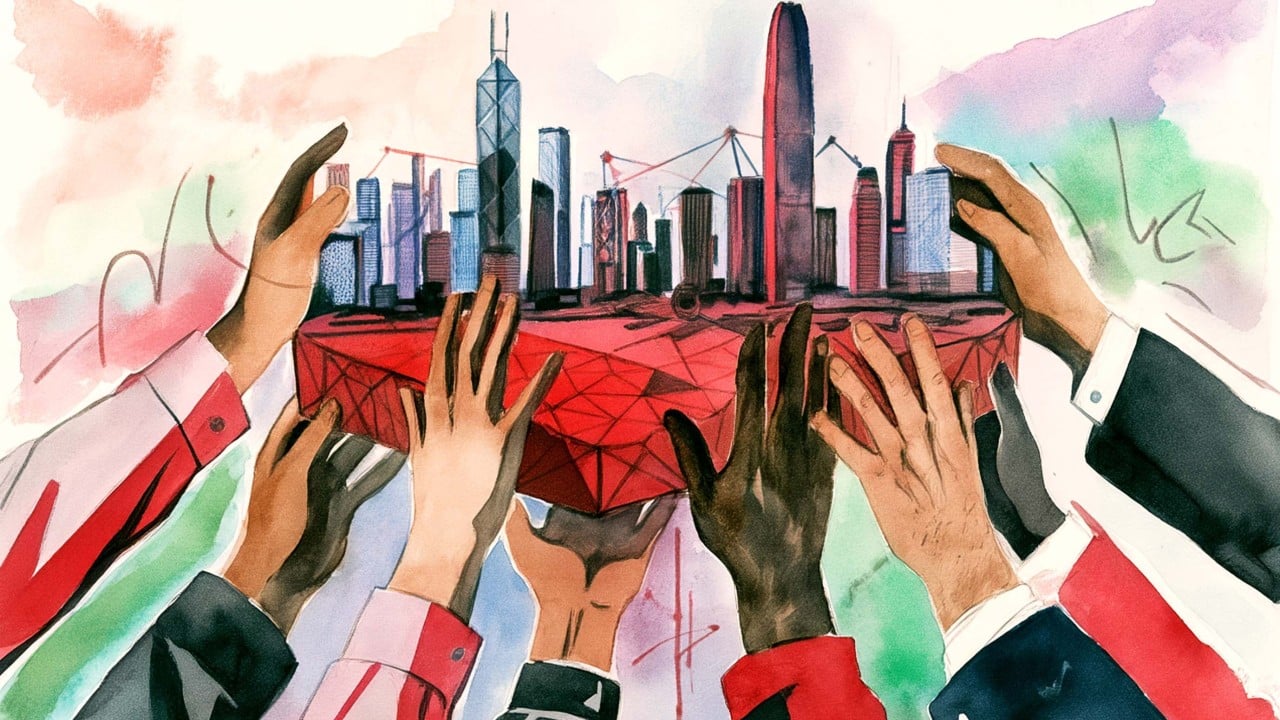
Diplomats in Canberra love a good bedtime story. The latest favorite is that mid-sized nations—countries like Australia, South Korea, Canada, and Indonesia—can band together to avoid becoming collateral damage in the brawl between Washington and Beijing. Foreign policy elites pitch this multilateral group hug as the smart, adult alternative to picking a side.
It is a dangerous illusion.
According to speeches from Australian leadership, including Prime Minister Anthony Albanese and Foreign Minister Penny Wong, the core pitch is straightforward: middle powers must pool their diplomatic weight to uphold international norms and protect their sovereignty from great-power coercion. The logic sounds neat on a conference stage in Singapore or Davos. In the actual trenches of international trade, defense, and supply chains, it falls apart on contact.
If you run a multinational supply chain, manage sovereign risk, or negotiate bilateral trade deals, treating "middle power solidarity" as a viable shield will get you burned. Nations do not act out of collective class consciousness. They act out of cold, hard national interest. When a superpower applies real economic or military pressure, your fellow middle powers will not jump on the grenade for you. They will quietly take your market share while issuing a press release expressing "deep concern."
The Myth of the Middle Power Bloc
To understand why this diplomatic orthodoxy fails, you first have to strip away the polite fiction of what a "middle power" actually is.
In international relations theory, the term refers to states that are not superpowers or great powers, yet still possess significant economic, military, or diplomatic influence. Think G20 members outside the permanent UN Security Council. The fatal flaw in grouping these nations together is assuming they share a unified strategic baseline. They do not.
Take the Indo-Pacific, the exact theater Canberra claims to be organizing.
- Australia is a treaty ally of the United States, hosts American rotational forces, and is acquiring nuclear-powered submarines under AUKUS. Its security is inextricably wired into Washington's deterrence architecture.
- Indonesia practices bebas aktif—an independent and active foreign policy rooted in the Non-Aligned Movement. Jakarta views AUKUS with deep suspicion, fearing an arms race in its northern approaches, and relies heavily on Chinese capital for its nickel processing and infrastructure.
- South Korea sits within artillery range of a nuclear-armed North Korea, depends on the U.S. nuclear umbrella for survival, and sends roughly a fifth of its exports to China.
- India views itself as a rising civilizational great power, not a "middle" anything, and maintains deep defense ties with Russia while partnering with the U.S. in the Quad.
Expecting this group to form a cohesive, self-reinforcing bloc against superpower coercion is like expecting a wolf, a sheep, and a bear to agree on dinner. Their threat perceptions are fundamentally incompatible.
I have sat in rooms with trade negotiators and defense planners across the Asia-Pacific over the last decade. Whenever a crisis hits, the multilateral solidarity evaporates within forty-eight hours. Bilateral survival instincts take over immediately. Diplomats who bet their national strategy on collective middle-power pushback consistently misread the room because they confuse shared anxiety with shared interest.
What Happened When Beijing Actually Pulled the Trigger
You do not need a crystal ball to see how middle-power cooperation performs under live fire. You only need to look at 2020.
When Canberra called for an independent international inquiry into the origins of COVID-19, Beijing did not just send a sternly worded letter. It slapped punitive tariffs and informal bans on roughly $20 billion AUD worth of Australian exports, targeting barley, wine, coal, beef, lobster, and timber. It was textbook economic coercion designed to make an example out of a middle power.
Where was the middle-power coalition? Nowhere.
While Canberra stood its ground, exporters from other middle powers—and fellow Western allies—rushed to fill the vacuum in the Chinese market. Canadian barley and timber, Chilean and French wine, and American beef and coal flowed into China to replace the banned Australian goods. Nobody boycotted the Chinese market in solidarity with Australia. Nobody formed a collective trade-defense mechanism to absorb the shock.
Canberra survived the coercion not because middle powers banded together, but because global commodity markets are fungible. Australian coal and barley eventually found buyers in other markets like India, Vietnam, and the Middle East, while Chinese buyers paid higher prices for non-Australian alternatives. Market mechanics—not diplomatic clubs—neutralized the blockade.
Why "Strategic Autonomy" Is Often Just Hedging Without Leverage
Advocates of the middle-power thesis argue that cooperation builds "strategic autonomy." They claim that by diversifying partnerships, smaller states avoid becoming hostages to either Washington or Beijing.
Here is the precision check: strategic autonomy requires the independent military and industrial capacity to deter threats without external rescue. France has a degree of strategic autonomy because it possesses an independent nuclear triad and a domestic defense-industrial base. Most middle powers do not. When countries like Australia or Canada talk about strategic autonomy through multilateralism, they are really describing hedging—trying to capture economic upside from China while outsourcing hard security to the United States.
Hedging worked brilliantly between 1995 and 2015, when the U.S. and China were deeply integrated and Washington tolerated allies getting rich off Beijing. That era is dead. Today, trade policy is national security policy. Semiconductors, critical minerals, undersea cables, and AI compute are dual-use assets.
When Washington restricts advanced chipmaking equipment from reaching China, as it did with the Dutch firm ASML and Japanese suppliers, The Hague and Tokyo do not form a middle-power coalition to tell the White House "no." They comply, because their survival and technological ecosystems are anchored to the United States.
The Hard Questions Nobody Wants to Answer
When foreign policy thinkers push the cooperative middle-power line, they dodge the core friction points that actually govern statecraft.
Can middle powers realistically deter a superpower?
No. Deterrence requires credible, overwhelming force or economic leverage that hurts the aggressor more than the target. Pooling the navies or trade ministries of five mid-sized countries does not magically create superpower deterrence, because political will fractures under pressure. As international relations scholar John Mearsheimer has long argued in his offensive realism framework, states prioritize survival above all else, and alliances without a dominant security guarantor suffer from acute collective-action problems. If a superpower threatens a middle power with severe economic pain or military escalation, the other middle powers will almost always defect rather than share the cost.
Does multilateralism protect smaller economies from trade wars?
Multilateral institutions like the World Trade Organization (WTO) were designed to constrain power politics with rules. Today, the WTO's Appellate Body is paralyzed, and major powers routinely ignore rulings that threaten their domestic industrial policy. Relying on rules-based coalitions when the rules are no longer enforced by a hegemon is bringing a rulebook to a knife fight.
What is the actual alternative to middle-power multilateralism?
Targeted, asymmetric leverage and ruthless bilateralism. Instead of spreading diplomatic capital thin across dozens of summits and joint communiqués, successful mid-sized states identify the exact chokepoints they control and weaponize them quietly.
The Playbook That Actually Works: Chokepoint Statecraft
If middle powers want to avoid becoming hostages to geopolitics, they need to stop acting like a trade union and start acting like specialized monopolies.
Look at the nations that actually command respect—and concessions—from both Washington and Beijing. They do not get it through speeches about multilateral norms. They get it by owning something neither superpower can easily replace.
Control the Chokepoints, Not the Narrative
Taiwan does not survive because of middle-power solidarity; it survives because TSMC manufactures the vast majority of the world's most advanced semiconductors. The Netherlands commands outsized geopolitical weight because ASML holds a monopoly on extreme ultraviolet (EUV) lithography machines. Australia's real leverage with Beijing was never its diplomatic rhetoric—it was the fact that China's steel industry relied on Pilbara iron ore that could not be quickly replaced at scale. Identify your indispensable asset, subsidize it, protect its IP, and make sure both superpowers know what happens to their domestic economies if supply stops.Build Asymmetric Denial, Not Balanced Militaries
Mid-sized nations go broke trying to build miniature versions of the U.S. military. Expensive surface ships and small fleets of crewed fighter jets are easy targets in an era of precision strike and saturation drone warfare. Smart middle powers invest in asymmetric denial: long-range anti-ship missiles, autonomous underwater vehicles, hardened logistics, and cyber capabilities that make any coercion or blockade prohibitively expensive for a larger power.Execute Transactional Minilateralism
Forget sprawling, consensus-driven organizations like ASEAN or broad middle-power forums where the lowest common denominator dictates action. Focus on small, issue-specific coalitions of three or four nations with aligned hard interests. Intelligence sharing via Five Eyes works because the participants have deeply integrated security apparatuses and shared threat assessments. Critical mineral processing agreements between Australia, Japan, and the U.S. work because they directly solve a tangible supply-chain vulnerability—breaking China's refining monopoly. Keep the guest list short and the deliverables concrete.Price Geopolitical Risk Into Corporate Balance Sheets
Governments cannot preach resilience while letting their private sectors remain overwhelmingly exposed to a single authoritarian market. Canberra eventually learned this the hard way, but the lesson applies universally. If 40 percent of a nation's export revenue flows to one buyer, that nation does not have a trade relationship; it has a single point of failure. Governments should use tax incentives, sovereign wealth co-investment, and export credit guarantees to force market diversification before a crisis hits, not after.
The Downside of Cold Realism
Adopting a transactional, chokepoint-driven strategy carries real costs. It strips away the moral high ground that middle-power diplomats love to occupy. When you treat international relations as a series of hard-nosed bilateral transactions rather than a crusade for rules and norms, you invite accusations of cynicism and selfishness.
It also exposes you to domestic political backlash. Building asymmetric defense capabilities, subsidizing strategic industries, and forcing companies to diversify away from lucrative markets cost money upfront. Voters hate paying an insurance premium for a geopolitical crisis that has not happened yet. Politicians find it much cheaper—and much better for photo ops—to fly to international summits and sign non-binding declarations about cooperation.
The world is entering an era of fractured supply chains, industrial subsidies, and raw power politics. Great powers are rewriting the rules in real time to suit their domestic priorities, whether through tariffs, export controls, or gray-zone coercion.
Mid-sized nations can keep holding conferences, drafting communiqués, and pretending that collective goodwill will shield them when the pressure mounts. Or they can accept that in geopolitics, nobody is coming to save you—and build the hard leverage required to save themselves.