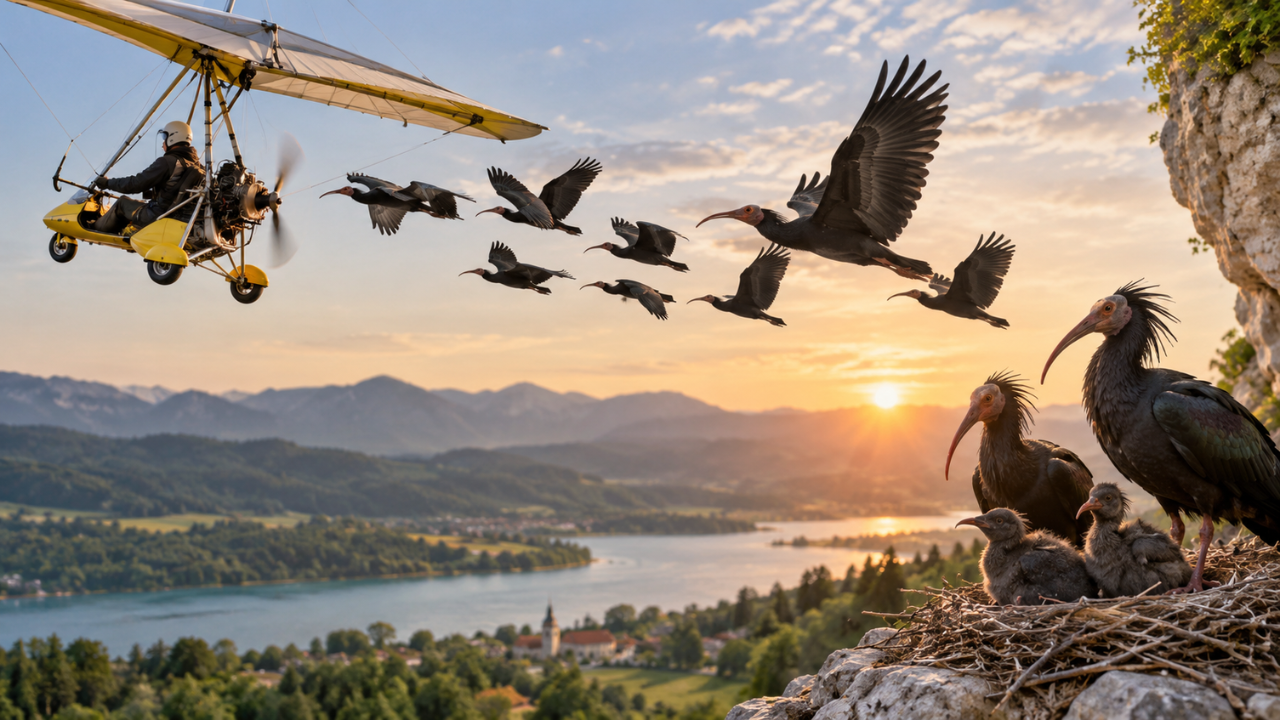
Birds don't usually follow motorized aircraft across international borders. Yet, conservation history changed when a dedicated team strapped into microlight planes and led endangered northern bald ibises across the Alps. For four centuries, these striking birds had vanished from Europe as breeding residents. Traditional reintroduction efforts failed because young ibises lacked older mentors to show them the way south to wintering grounds in Tuscany. Without social learning, captive-bred birds stayed put, freezing when winter arrived.
Biologists realized they had to step in as adoptive parents. They raised chicks by hand, habituated them to human foster parents, and then physically guided them over high mountain passes using buzzing, noisy flying machines. It sounds absurd. It worked.
Let's look at what most people get wrong about rewilding. We assume nature heals itself the second we stop polluting. Sometimes, ecosystems break so thoroughly that human intervention becomes the only bridge back to balance. The northern bald ibis, scientifically known as Geronticus eremita, is a prime example of a species whose cultural knowledge—migration routes passed down from parents to offspring—was entirely wiped out by human hunting and habitat loss.
The Lost Heritage of Europe's Wild Ibises
Long before modern conservation, northern bald ibises nested on European cliffs from the Alps to Spain and across North Africa and the Middle East. Historical records show they were common enough in sixteenth-century Europe to appear in regional art and local cuisine. By the seventeenth century, overhunting and agricultural expansion wiped out the European population entirely. A tiny, isolated population clung to survival in Syria, while a small migratory flock survived in Morocco.
Captive populations remained in zoos, but captive breeding programs faced a massive roadblock. Migration isn't just an instinctive calendar trigger. It is a learned behavior. Young birds need to follow experienced adults to learn landmarks, thermals, and safe stopover sites. If you release captive-bred ibises into the wild without that generational knowledge, they scatter blindly, fall prey to predators, or starve.
Conservationists with the Austrian-based project Waldrappteam faced this exact problem. They couldn't just open a cage and hope for the best. They had to teach the birds how to fly south.
Becoming Substitute Parents in the Sky
Raising a migratory bird to follow an aircraft requires intense, borderline obsessive dedication. Foster mothers and fathers—actual human researchers—spend months with the chicks from the moment they hatch. The birds imprint on these humans, recognizing their voices and following them on foot before graduating to training flights behind motorized microlights.
The bond is critical. During the migration window, the microlight pilots take off, and the ibises lift off right behind them, forming a V-formation trailing an aircraft instead of an older bird.
Navigating the Alps is treacherous for seasoned human pilots, let alone flocks of juvenile birds facing severe crosswinds, shifting air currents, and altitude drops. The teams chart routes that bypass deadly peaks, guiding the birds step-by-step over hundreds of kilometers from nesting sites in Austria and Germany down to a specialized wintering sanctuary in the WWF Laguna di Orbetello in Italy.
Once the birds complete the journey once, something incredible happens. Their internal compass locks in, and they remember the route. The following spring, the ibises fly back north entirely on their own, navigating the return migration without human assistance. By training successive cohorts, researchers established the first self-sustaining, migratory European colony in over four hundred years.
Facing Modern Skies
Getting birds to fly behind a plane is only half the battle. Reintroducing an extinct migratory species into a modern human-dominated landscape exposes them to entirely new hazards. High-voltage power lines, illegal hunting along the migration corridor, and changing weather patterns driven by global climate shifts threaten every single flock.
Poaching remains a stubborn threat. Despite strict EU protections and public awareness campaigns in Italy and Austria, ibises are occasionally shot by hunters who mistake them for game birds or simply target them out of ignorance. Conservationists counter this by tracking every single bird with lightweight GPS transmitters. If a signal stops moving or drops off the grid, field teams deploy immediately to investigate.
Climate change presents a different kind of headache. Unseasonal warmth in autumn tricks some ibises into delaying their departure. Sudden storms over the Alps trap flocks mid-migration, forcing researchers to track weather patterns closely and sometimes intervene to herd grounded birds into safe zones.
Protecting these birds requires constant monitoring, legal advocacy, and community engagement with farmers and hunters living along the flyways. It's messy, expensive work. It's also proof that dedicated conservation can reverse centuries of human damage.
What This Means for Future Rewilding Projects
The success of the bald ibis project changes how we view species restoration. We aren't just protecting habitats anymore; we are actively resurrecting lost behaviors.
Other conservation initiatives are watching closely. When animals lose complex social structures or learned migratory pathways, passive protection falls short. Whether it's teaching whooping cranes new migration routes using ultralight aircraft in North America or using drone guidance for other endangered avian species, active behavioral restoration is becoming a core tool in modern ecology.
We can't rewind the clock four hundred years. Human infrastructure is here to stay, and the climate is shifting beneath our feet. Success depends on our willingness to roll up our sleeves, build the machinery, step into the role of foster parents, and guide vulnerable species across the finish line.
Check local conservation trusts if you want to support ongoing European wildlife reintroduction efforts, or consider donating directly to field-level tracking initiatives that keep these flocks safe on their annual journeys.