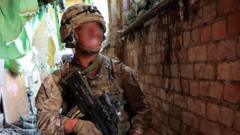
The intersection of military operational necessity and institutional accountability represents one of the most structurally complex areas of modern administrative law. Recent legal actions initiated by hundreds of current and former Royal Marines against the United Kingdom Ministry of Defence over asbestos exposure during overseas training exercises highlight a persistent friction point between statutory protection and common-law duty of care. Deconstructing this friction requires moving past sensationalized narratives to examine the exact legal mechanisms, historical precedents, and systemic cost functions governing military liability.
The Mechanics of Institutional Immunity
The foundational barrier preventing standard tort claims against the state is the doctrine of Crown Immunity. Historically, this legal shield protected the Sovereign from being sued in their own courts without consent. For decades, this principle extended heavily into military operations, preventing service personnel from pursuing the Ministry of Defence for negligence sustained during service prior to structural reforms.
While the Crown Proceedings (Armed Forces) Act 1987 lifted certain bars on civil liability for injuries sustained post-1987, legacy exceptions, practical hurdles, and the sheer latency of latent diseases like mesothelioma create an enduring protective barrier for the state. When military personnel encounter hazardous materials during operational readiness exercises—such as the documented exposure to chrysotile asbestos fibers within abandoned Soviet-era infrastructure in Latvia—the legal recourse diverges sharply from civilian employment standards.
In the civilian sector, a worker exposed to asbestos due to an employer's failure to execute a baseline risk assessment can pursue substantial civil damages through the high court, unhindered by statutory caps. By contrast, service personnel operate under a regime where the Ministry of Defence often dictates the compensation framework through specialized statutory schemes rather than standard employer liability torts.
The Asymmetric Cost Function of Military Compensation
Evaluating how financial redress is administered reveals a stark divergence between civilian tort settlements and military compensation schemes. The economic reality for a veteran diagnosed with an asbestos-related terminal illness involves strict regulatory parameters:
- Statutory Lump Sums: Modern provisions, such as those introduced via legislative updates following veterans' advocacy campaigns, allow eligible individuals diagnosed with service-acquired mesothelioma to select a fixed lump-sum payment or a traditional war pension.
- Valuation Ceilings: Fixed administrative awards often fail to match the total economic value recovered in successful civilian personal injury litigation, which routinely accounts for specialized care, lost earning capacity beyond baseline service pensions, and comprehensive family provisions.
- Exclusion of Non-Malignant Conditions: While civilian claimants with non-malignant conditions like pleural thickening or asbestosis can frequently secure compensation, military compensation structures historically concentrate resources narrowly on terminal malignancies, leaving milder or intermediate dust-related pulmonary impairments largely uncompensated under lump-sum provisions.
This creates a systemic cost containment model for the state. By capping liabilities through statutory instruments and leveraging jurisdictional defenses for legacy exposures, the Ministry of Defence absorbs significantly lower financial liabilities per affected individual than a comparable private-sector industrial enterprise facing identical health and safety failures.
Operational Hazards and the Chain of Command
The operational reality of modern expeditionary training involves occupying diverse, often aging foreign infrastructure. When units utilize disused industrial or military sites for urban combat simulation or tactical staging, the identification of environmental hazards depends on the efficacy of advance reconnaissance and engineering intelligence.
The core allegation in contemporary litigation centers on informational asymmetry: whether command elements possessed or should have possessed structural data regarding hazardous building materials, and whether operational urgency superseded safety compliance. In industrial settings, the Health and Safety Executive enforces strict abatement, encapsulation, or exclusion zones. In a military context, mission parameters frequently force personnel into suboptimal environments where operational tempo overrides environmental health protocols.
When service members are quartered in facilities containing friable asbestos—often verified through material sampling that isolates chrysotile fibers—the duty of care is ostensibly breached. Yet, litigating these breaches under human rights frameworks or allegations of intentional exposure requires plaintiffs to surmount extraordinary evidentiary hurdles to prove that command echelons acted with willful disregard rather than institutional oversight failure.
Strategic Forecast for Institutional Reform
The persistence of asbestos claims within the armed forces signals an unavoidable operational reckoning for defense authorities. As historical building stocks degrade globally and training footprints expand into aging Eastern European or domestic infrastructure, environmental monitoring must shift from reactive compensation management to proactive hazard remediation.
Future litigation will likely test the boundaries of human rights legislation in military torts, aiming to bypass traditional crown immunities by framing environmental exposure not merely as an industrial accident, but as a systemic failure of the state's absolute duty to protect life during non-combat deployments. To mitigate mounting legal exposure and reputational damage, defense procurement and infrastructure management must integrate rigorous environmental audits into every overseas deployment protocol, treating toxic building materials with the same operational gravity as active kinetic threats.