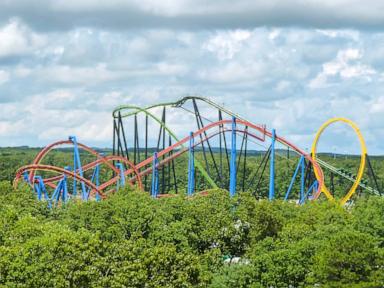
The air up there smells of hot grease, ozone, and sudden, cold panic.
You know the sound. The rhythmic clack-clack-clack of the chain lift dragging heavy steel cars toward the sky. It is a mechanical heartbeat, steady and hypnotic, building an architecture of pure anticipation in the chest of every rider. For a few seconds, you are suspended above the ordinary world. The parking lot looks like a child’s toy collection. The screams of the people ahead of you sound distant, thin, almost playful against the roar of the wind.
Then the chain releases. Gravity takes over. For a few frantic, breathless heartbeats, logic surrenders to pure motion.
And then, sometimes, the music stops.
The Weight of a Single Second
We trust physics implicitly because we have to. Every time we strap ourselves into a molded fiberglass seat, pull down a over-the-shoulder harness, and hear that mechanical click, we are entering a quiet social contract. We are betting our lives on torque calculations, stress-fracture tolerances, and the invisible vigilance of mechanics who work graveyard shifts under halogen lights.
Most days, that contract holds. Millions of rides happen every year without incident, a statistical testament to modern engineering. But statistics offer cold comfort when the chain breaks.
Consider what happens in the aftermath of the unthinkable. Not just the flashing lights of ambulances or the frantic coordination of park executives behind closed doors, but the sudden, heavy silence that falls over a crowded theme park when a life is abruptly altered or extinguished. It happened at Six Flags over Georgia. A fatal incident—an abrupt, violent reminder of our ultimate fragility—tore through the community consciousness.
In response, the machinery of caution ground into gear. Across systems and state lines, sister parks hit the brakes. Nine other roller coasters went dark. Not because they had failed, but because in the shadow of tragedy, uncertainty is a risk no one is willing to take.
Behind the Safety Curtain
Imagine standing on the loading platform of an immense steel coaster forty minutes after it has been shut down indefinitely. The cars sit frozen mid-curve, tilted at an unnatural, awkward angle against the blue sky, completely empty. The silence is profound.
Behind the scenes, maintenance supervisors are suddenly living out their worst nightmares. They carry clipboards covered in schematics, their flashlights cutting through the dim interiors of maintenance bays where hydraulic fluids pool and heavy-duty steel pins are pulled out for microscopic inspection.
This is the hidden cost of the thrill. We demand faster drops, sharper banks, and higher speeds. We want our adrenaline raw and unfiltered. But every time engineers push the envelope of human sensory tolerance, the margin for error narrows. When a catastrophic failure occurs, it forces an industry-wide reckoning. It asks a brutal question: How much risk are we unknowingly buying with the price of admission?
The temporary closure of nine coasters wasn’t just a corporate PR maneuver or an abundance of caution. It was a collective holding of breath. It was an acknowledgment that a flaw in Georgia is a terrifying question mark hanging over Ohio, Texas, and California. If one restraint fails, if one structural fatigue point goes unnoticed, how can anyone trust the rest?
The Anatomy of Trust
Trust, once broken, does not mend as easily as a snapped cable. It requires tearing things down to the bare metal.
When theme park inspectors descend upon these massive structures with non-destructive testing equipment—ultrasonic scanners, magnetic particle inspection tools, and high-powered magnifying lenses—they are looking for invisible ghosts. They are searching for microscopic stress fractures born from thousands of cycles of high-G-force pounding. Steel remembers every drop. It stretches, it compresses, and eventually, if not monitored with ruthless precision, it yields.
For the families who visit these parks, the illusion of safety is everything. We need that illusion to enjoy the drop. Without it, the ride is just a terrifying cage hurtling through space. When accidents happen, the illusion shatters, exposing the raw, cold mechanics underneath.
We look at the empty tracks and we wonder. We question our own courage, or perhaps our own common sense. We remember that beneath the cotton candy, the neon lights, and the summer afternoon laughter, we are hurling ourselves through space at seventy miles per hour, anchored only by steel bolts and human oversight.
The Return to the Track
Eventually, the inspections conclude. The reports are signed off. The diagnostic green lights flicker on across control room consoles.
The trains will run again. The clack-clack-clack of the chain lift will resume its hypnotic rhythm against the afternoon sky. New riders will board, laughing nervously, pulling their harnesses down until their knuckles turn white, trading their safety for a few seconds of weightless flight.
We forget quickly, because we want to. But the shadow remains. Every dip in the track carries a heavier memory now, a silent reminder of the invisible stakes that ground our highest flights.


