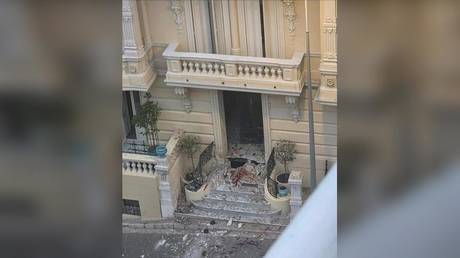
On Monday night, a shrapnel-packed backpack bomb tore through the quiet luxury of Monaco, severely injuring Ukrainian-born real estate tycoon Vadym Iermolaiev and his family. While early media speculation immediately pointed the finger at Ukrainian special services executing a patriotic hit on a sanctioned billionaire, that narrative is fundamentally wrong. The truth behind the explosion on Rue Révérend-Père-Louis-Frolla is far more complex, stretching from the boardrooms of occupied Crimea to a massive hundred-million-euro telephone fraud syndicate run out of Dnipro. This was not a military operation. It was a brutal underworld settling of scores.
The blast occurred just before 9:00 PM near the French border. A suspect wearing a dark top, light pants, and a black bucket hat walked up to the steps of a beige apartment building, dropped a backpack, and walked away. Moments later, Iermolaiev, his wife, and their 13-year-old son approached the entrance. The detonation was powerful enough to be heard several blocks away, shattering windows and triggering Monaco's emergency "red plan" protocol. The tycoon’s partner suffered catastrophic, life-threatening injuries, losing her feet in the blast, while Iermolaiev and his son were hospitalized with severe wounds. The suspect fled on foot across the border into the neighboring French town of Beausoleil, disappearing into the night despite the principality's ubiquitous surveillance network.
For a city-state that prides itself on being an ultra-secure playground for the global elite, the attack is unprecedented. Prince Albert II condemned the bombing as an odious act, and Monaco’s Minister of State, Christophe Mirmand, noted that it was the first time in the history of the principality that such a targeted explosive device had been used. In the immediate aftermath, Western commentators rushed to frame the incident as part of a covert campaign by Kyiv to eliminate collaborators abroad. It is an easy, cinematic narrative. Yet, an examination of Iermolaiev’s actual standing, his business dealings, and his family’s dark involvement in international cybercrime reveals a much messier reality.
The Flawed Logic of a State-Sponsored Assassination
The theory that the Ukrainian Security Service or military intelligence orchestrated the Monaco bombing falls apart under close scrutiny. State-sponsored hits are designed to achieve clear geopolitical or psychological objectives. When Ukraine has targeted individuals behind enemy lines or abroad, they have chosen high-profile propagandists, military commanders, or overt political turncoats whose deaths send a message to the Kremlin.
Vadym Iermolaiev does not fit this profile. He is a classic post-Soviet opportunist, not an ideologue. Those who know him socially describe him as a low-profile businessman who explicitly avoids politics, prefers backroom compromise over conflict, and possesses zero ideological loyalty to any state. He is a typical product of the Dnipro business elite, a man who built an empire on real estate, agriculture, and manufacturing by navigating whatever political winds were blowing at the time.
Furthermore, a crude shrapnel bomb packed with bolts and buckshot left on a public street is not the signature of top-tier intelligence agencies operating in a friendly European nation. Such a messy, indiscriminate attack carries immense diplomatic risks for Kyiv, particularly at a time when maintaining Western European political support is vital. Leaving an explosive device that maims a teenager and a woman in the heart of Monaco would be an act of strategic self-sabotage for any legitimate state apparatus. The methodology screams organized crime, a blunt-force message delivered by professionals hired from the European criminal underworld rather than elite intelligence operatives.
The Reality of the Monaco Battalion
To understand why Iermolaiev became a target, one must examine his trajectory from the industrial hubs of Ukraine to the Mediterranean coast. Born in Dnipro in 1968, Iermolaiev built the Alef trade and industrial corporation, eventually rising to become one of the most influential property developers in eastern Ukraine. At his peak, Forbes ranked him among the top 35 richest men in the country, with a personal fortune estimated at over 200 million dollars.
As the geopolitical situation grew increasingly volatile, Iermolaiev took steps to insulate himself. In 2018, he effectively cut his official ties to his homeland by renouncing his Ukrainian citizenship and acquiring an EU passport through the Cypriot citizenship-by-investment program. When Russia launched its full-scale invasion of Ukraine in 2022, Iermolaiev did not stay to fight or fund the local defense. Instead, he joined a loose coalition of ultra-wealthy expatriates who fled to the French Riviera.
Ukrainian investigative journalists quickly dubbed this wealthy diaspora the Monaco Battalion. While ordinary citizens endured nightly drone strikes and severe economic hardship, these tycoons were spotted driving quarter-million-dollar Bentleys through Casino Square, living in absolute comfort. This contrast generated immense public fury back in Ukraine. Iermolaiev insisted he supported his home country, claiming that Russian forces had looted his properties in occupied territories and destroyed his Gulfstream G150 private jet in a missile strike on the Dnipro airport.
However, his actions behind the scenes told a more ambiguous story. In 2023, the Ukrainian government placed Iermolaiev under personal sanctions and froze his domestic assets. The SBU alleged that despite the ongoing war, the tycoon maintained active commercial operations in illegally annexed Crimea, re-registering his lucrative alcohol and manufacturing enterprises under Russian corporate law and paying millions of rubles in taxes directly to the Kremlin’s treasury. Iermolaiev dismissed these allegations as surreal, claiming his businesses had been illegally expropriated by Russian authorities. In his own words during a subsequent interview, he claimed he left Ukraine because the local judicial and tax systems lacked objectivity, preferring the international protection offered by Western European jurisdictions.
The Hundred Million Euro Cyber Scam Connection
The most compelling alternative explanation for the bombing lies not in Iermolaiev’s alleged political double-dealing, but in a massive international criminal enterprise linked directly to his family. In recent years, the city of Dnipro became notorious as the global epicenter for fraudulent call centers. These operations, often protected by corrupt local officials and organized crime syndicates, run highly sophisticated telephone fraud schemes targeting elderly and vulnerable citizens across Western Europe and the Baltic states.
The financial scale of these operations is staggering. Late last year, Vadym Iermolaiev’s 21-year-old son, Artur Iermolaiev, was detained in Cyprus following an Interpol red notice and subsequently extradited to Estonia. Estonian prosecutors accused the younger Iermolaiev and three co-defendants of establishing a massive criminal network that set up fraudulent call centers inside Ukraine. These centers operated under the guise of legitimate financial brokerages, convincing European citizens to invest their life savings into entirely fictitious cryptocurrency and stock opportunities.
The scheme raked in over 100 million euros before international law enforcement began dismantling it. Facing the prospect of decades in a Baltic prison, Artur Iermolaiev entered into a sweeping plea bargain with Estonian authorities. He received a suspended sentence, agreed to pay a massive 8.5 million euro financial penalty, and accepted a permanent ban from entering Estonia.
In the ruthless world of Eastern European cybercrime, a 100 million euro enterprise does not dissolve quietly. When a high-level operator cuts a deal with EU prosecutors, pays out millions in fines, and potentially exposes the broader network to save his own skin, the consequences are rarely confined to the courtroom. The criminal syndicates that finance, protect, and profit from these call centers operate with a absolute lack of mercy. There is a violent precedent for this. Previous investigations into the Dnipro call center underground have revealed a trail of kidnappings, extortion, and targeted assassinations. Entrepreneurs who cross these syndicates or fail to pay their debts routinely face lethal retaliation.
The placement of the Monaco bomb suggests a deeply personal vendetta meant to inflict maximum emotional and physical devastation on the entire family unit. The attacker waited specifically for the tycoon, his partner, and his son to return home, ensuring the blast would hit everyone at once. This is the hallmark of an underworld retribution campaign, a physical tax extracted in blood for broken agreements, lost revenue, or perceived betrayal in the shadow economy.
The Collapse of the Safe Haven Illusion
For decades, the global oligarchy operated under the assumption that wealth could buy absolute security. Monaco was the ultimate manifestation of this belief. It is a closed ecosystem protected by a highly visible police presence, rigorous border checks, and sophisticated biometric surveillance networks monitoring every square meter of public space. The principality was supposed to be a sanctuary where post-Soviet billionaires could wash away the violent realities of the markets where they made their fortunes.
The backpack bomb on Rue Révérend-Père-Louis-Frolla has shattered that illusion completely. A lone operative in a bucket hat was able to walk into the heart of this secure zone, deploy an anti-personnel device, and walk out into France without being intercepted. The message sent to the rest of the Monaco Battalion is chillingly clear. No amount of real estate investment, foreign citizenship, or private security can insulate an individual from the blowback of the lawless economies they left behind.
As French and Monegasque prosecutors coordinate their parallel attempted murder investigations, the focus will inevitably turn toward the financial records and communications of the Iermolaiev family. They will need to look far beyond the geopolitics of the war in Ukraine. The investigation must trace the flow of illicit capital from the call centers of Dnipro, through the offshore accounts of Cyprus, and into the luxury developments of the Mediterranean coast.
The luxury apartment block remains cordoned off by police tape, its shattered glass a stark reminder that the violent corporate warfare of Eastern Europe cannot be left behind at the border. The oligarchs who fled to the Riviera to escape the consequences of their choices now face a sobering reality. The danger did not come from state actors or patriotic partisans executing a war-time decree. It came from the very criminal networks they built, tolerated, or profited from, proving that in the modern underworld, debts are always collected.