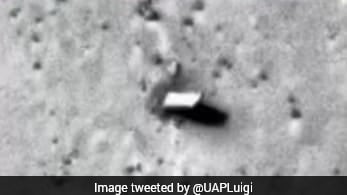
The internet is buzzing because a former defense official hinted that Uncle Sam is hoarding classified snapshots of "monoliths" on the lunar surface. It is the classic UFO news cycle playing its greatest hits: a vague whistle, hints of a cover-up, and an immediate descent into sci-fi fantasy.
Everyone is asking the wrong question. People want to know what the government is hiding. They want to know if Stanley Kubrick was right.
They should be asking why our collective understanding of planetary geology and imaging technology has rotted to the point where we mistake a basic pile of rocks for an alien beacon.
The lazy consensus loves a mystery. It sells ads. But as someone who has spent years analyzing satellite imagery and tracking the intersection of defense tech and aerospace, I can tell you the real story here isn't an extraterrestrial cover-up. It is a masterclass in human pareidolia and a profound misunderstanding of how space surveillance actually works.
The Optical Illusion of the Monolith
Let us establish some basic physics. The lunar surface is a hostile, high-energy environment. It has been battered by micrometeorites for billions of years. When a large impact occurs, it shatters bedrock, ejecting massive, blocky fragments across the landscape.
Over time, thermal cycling—the extreme swinging between boiling days and freezing nights—cracks these boulders along natural stress lines. The result? Clean, angular edges. Sharp, vertical faces.
To a human eye primed on Hollywood movies, a rectangular block on a desolate plain looks intentional. To a geologist, it looks like a standard piece of basaltic ejecta. We saw this exact same panic with the "Moon Cube" spotted by China’s Yutu-2 rover, which turned out to be a tiny, jagged rock once the rover got closer. We saw it decades ago with the "Face on Mars."
The logic of the conspiracy theorist relies on a flaw in perspective. They assume that because a shape is geometric, it must be artificial. Nature loves a straight line if the crystalline structure of the mineral demands it.
The Classified Photo Trap
The core argument of the current rumor mill hinges on authority. A former Pentagon official says the photos exist, so they must be real.
I have watched organizations throw millions of dollars down the drain chasing rumors based entirely on the credentials of a single source. In the intelligence community, classification does not automatically equal importance or truth.
Why would the US government classify photos of regular lunar rocks?
- Resolution capabilities: The military does not hide the moon rock; it hides the camera that took the picture. If a defense satellite captures a high-resolution image of the lunar surface while testing its optics, publishing that image tells foreign adversaries exactly what our orbital sensors can see.
- Sensor calibration: Advanced reconnaissance satellites use deep space and the lunar surface to calibrate their instruments. The data is classified by default because the calibration metrics reveal the operational limits of our national security hardware.
- Administrative inertia: Once a file is marked secret in a bureaucracy, it takes an act of Congress to unmark it. It is safer for a bureaucrat to keep a photo of a boring trench classified than to risk their career releasing it.
The conspiracy crowd looks at a closed door and assumes a treasure chest is inside. Usually, it is just an empty broom closet.
Why Your Trust in Whistleblowers is Misplaced
We live in an era where anyone with a former security clearance can get a book deal or a podcast spot by hinting at cosmic secrets.
Let us look at this brutally. If you possess genuine, hard evidence of an anomalous structure on the moon that alters our understanding of physics or history, you do not drop vague hints at a conference. You leak the raw telemetry. You provide the coordinate data.
The downside of my pragmatic approach is obvious: it is boring. It does not spark joy or trigger late-night internet rabbit holes. It forces us to accept that space exploration is a slow, grueling process of analyzing chemical compositions and orbital mechanics, not a real-life episode of The X-Files.
But clinging to the fantasy of hidden lunar monoliths actively harms scientific literacy. It diverts funding, attention, and intellectual capital away from legitimate, fascinating space tech developments—like autonomous lunar manufacturing or water-ice extraction—and channels it into a circus of speculation.
Stop looking for shadows on the lunar surface that match your favorite sci-fi tropes. The moon is a graveyard of impact craters and volcanic plains, not a gallery of alien architecture. If you want to find something truly anomalous in space, look at the engineering required to get us back there, not the rocks we left behind.