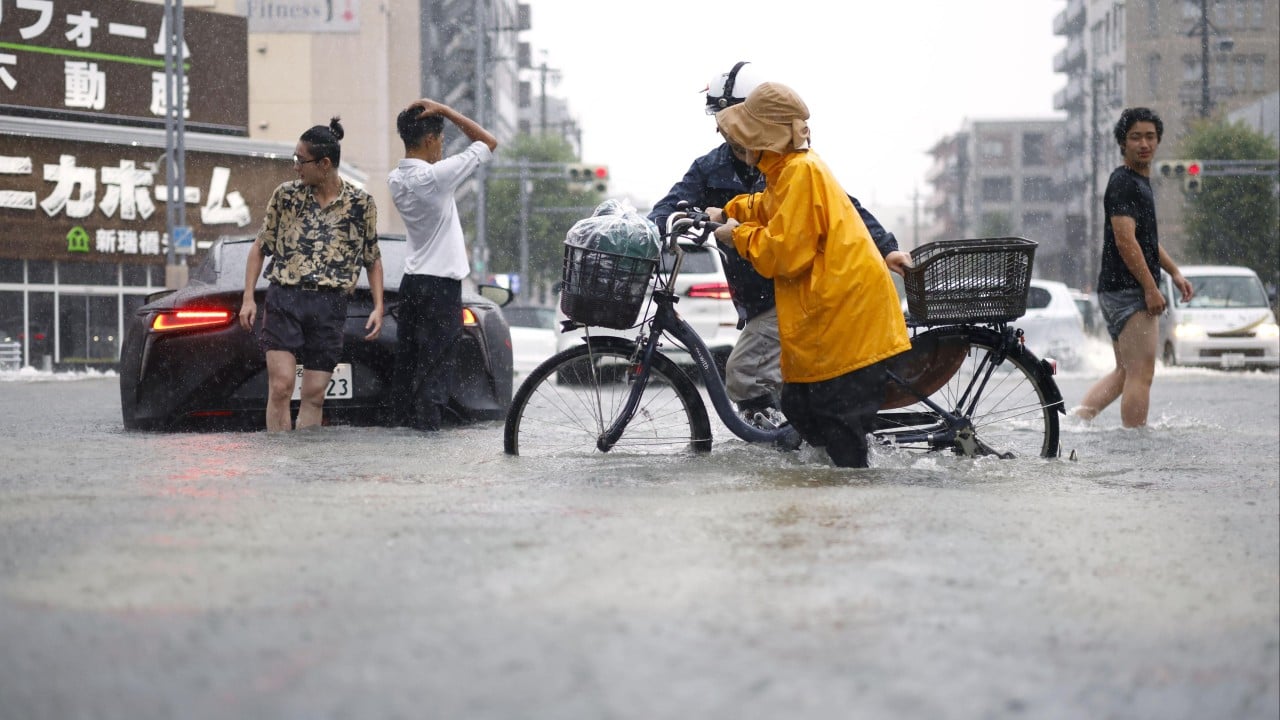
The rain did not fall. It arrived with the weight of a physical ceiling collapsing.
Around five in the morning, long before the city’s millions of commuters began checking train schedules or pulling zippers on briefcases, the sky over Nagoya tore open. By seven, the storm had rewritten the geography of central Japan. Streets ceased to be asphalt and became rushing, gray canals. Sidewalks vanished under brown froth.
I remember the smell of it first. A sharp, metallic tang of wet concrete mixed with the deep, earthy stench of overwhelmed municipal drainage systems. It is a terrifying smell because it signals an old truth: water always wins in the end.
The Weight of Water
To understand what happened in Nagoya, you have to look past the dry meteorological reports of record-breaking precipitation. Numbers on a weather map fail to capture the sensory reality of a modern metropolis grinding to an abrupt, terrifying halt.
Take Kenji, a hypothetical station attendant at Nagoya Station, though his experience mirrors dozens of real workers that morning. He stepped onto the platform just as the automatic doors sealed shut against the howling wind. Within minutes, the cavernous underground concourses—usually a humming labyrinth of businessmen with briefcases, students with umbrellas, and vendors selling steaming bowls of noodles—began to sweat. Water seeped through expansion joints. It pooled around ticket turnstiles. The rhythmic, reassuring click-clack of the commuter trains fell silent, replaced by the rising, metallic echo of emergency sirens bouncing off concrete walls.
Record rainfalls are rarely polite. They do not give you time to adjust your schedule. They transform the ordinary routines of life into an obstacle course of survival.
Consider what happens next: the trains stop. Millions of people, caught midway between the quiet safety of home and the fluorescent prison of the office, find themselves stranded in a gray twilight. Subway lines flooded faster than pumps could clear them. Commuters huddled under station eaves, watching the asphalt disappear beneath tires that threw up great, dirty wings of spray.
A City Built on Vulnerability
Nagoya is an engine room of Japanese industry. It is a place of precision manufacturing, sprawling ports, and tightly timed logistics. When the heart of this industrial hub is submerged, the shockwaves ripple far beyond local train delays.
The core issue is not merely that it rained hard. Meteorologists noted that stationary rainbands—linear clusters of intense thunderstorms—parked themselves directly over Aichi Prefecture, dumping months of water in a matter of hours. The drainage infrastructure, modern and sophisticated as it is, simply hit a mathematical wall. You cannot pour an ocean through a straw.
When you stand knee-deep in water outside a shuttered department store, surrounded by thousands of stranded strangers, human nature splits into two distinct camps. There is panic, yes—the frantic checking of dead cell phones, the sharp arguments over blocked stairwells. But there is also a strange, quiet solidarity. Convenience store shelves emptied of hot tea and rice balls within twenty minutes. Total strangers shared dry patches of concrete under blue plastic convenience store umbrellas. People swapped rumors translated from local emergency broadcasts, piecing together the scope of the disaster like a puzzle made of wet paper.
The Aftermath of the Deluge
As the afternoon wore on, the sky finally exhausted itself. The rain slowed to a sullen mist, and the brown water began its slow, sluggish retreat back toward the rivers and the bay.
What remains in the wake of such a storm is never just mud. It is the sobering realization of how fragile our engineered landscapes truly are. We spend decades pouring concrete, laying steel tracks, and stringing high-voltage cables, convincing ourselves that we have tamed the elements. We build monuments to efficiency. Yet, all it takes is a few hours of relentless, unyielding sky to remind us that we are merely camping on nature's floodplain.
In Nagoya, the trains are running again now. The platforms have been scrubbed clean. The digital boards flash crisp, punctual times once more, erasing the memory of the chaos as efficiently as a computer keystroke.
But out on the streets, long after the puddles have evaporated, the stain remains on the lower bricks of buildings. It is a quiet, persistent reminder of the morning the sky fell, and the day the city held its breath.