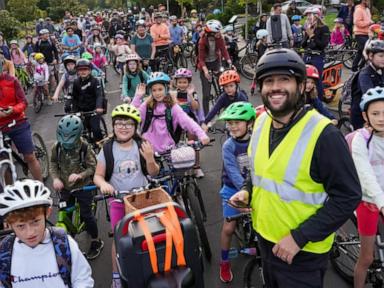
The air at 7:30 AM is usually a cocktail of nitrogen, oxygen, and the acrid, metallic tang of idling engines. If you live in a city, you know this sound. It is a low-frequency hum, a collective groan of thousands of commuters trapped in steel boxes, inching toward offices and schools in a state of suspended animation. It is the sound of patience eroding.
But in Portland, Barcelona, and London, a new sound is cutting through the smog. It isn't the roar of a motor or the impatient blare of a horn. It is the rhythmic clicking of bicycle chains and the high-pitched, unfiltered laughter of children who aren't being chauffeured to school—they are riding to it. If you liked this piece, you should check out: this related article.
This is the bike bus. It isn't a vehicle. It is a movement.
The Tyranny of the Back Seat
Consider for a moment the life of a typical eight-year-old in the modern world. We have, with the best of intentions, engineered the independence out of their childhood. We buckle them into rear-facing seats, then forward-facing boosters, and eventually standard bench seats behind child-locked doors. They view the world through tempered glass, a blurred gallery of strip malls and traffic lights. For another look on this story, see the latest coverage from The Spruce.
The walk to school, once a rite of passage, has become a logistical nightmare or a safety hazard. We tell ourselves it’s too dangerous to let them go alone. There are too many cars. Ironically, most of those cars are driven by other parents who are also terrified of the traffic they are currently creating. This is a circular trap of our own making.
Sam Balto, a physical education teacher in Portland, saw this trap and decided to walk—or rather, pedal—away from it. What started as a modest organized ride has blossomed into a viral phenomenon. When you see a video of a bike bus, it feels like a glitch in the simulation. Hundreds of kids, flanked by parents and volunteers, occupy the entire width of a city street. They are a swarm of neon vests and spinning spokes.
It looks like a protest, but it feels like a party.
Safety in the Swarm
The "bus" functions on a simple, ancient principle: strength in numbers. A lone child on a bicycle is a vulnerable target, a flicker of movement that a distracted driver might miss. But a hundred children? That is a topographical shift. You cannot ignore a hundred children.
The mechanics are surprisingly sophisticated. "Drivers" (usually parents or teachers) lead the pack, maintaining a steady pace. "Marshals" ride on the flanks, acting as human shields at intersections, holding back the tide of SUVs until the last straggler has crossed the line. It is a rolling bubble of safety created by nothing more than collective will.
But the real magic isn't in the logistics. It's in the neurochemistry.
We often wonder why childhood anxiety is spiking, why kids seem more restless in the classroom, why the "fidget spinner" became a cultural icon. The answer might be as simple as the fact that we have stopped moving. A child who arrives at school in a bike bus has already navigated a mile of city streets. They have felt the wind on their face, adjusted their balance a thousand times, and shouted greetings to their friends.
Their brains are lit up like Christmas trees before the first bell even rings. They aren't "settling down" for class; they are arriving prepared. They have burned off the jittery energy of the morning and replaced it with the quiet confidence of someone who has mastered their environment.
The Celebrity Catalyst and the Tipping Point
Societal change usually happens in one of two ways: through grueling policy shifts or through a sudden, infectious change in what we consider "cool." The bike bus is currently enjoying the latter. When celebrities like NBA star Jrue Holiday or professional cyclists join these rides, they aren't just providing a photo op. They are lending cultural capital to a mode of transport that was previously dismissed as a hobby for the eccentric or the impoverished.
This visibility matters because it forces a conversation about land use. For decades, our cities have been designed around the movement of machines rather than the flourishing of humans. We prioritize "throughput"—the speed at which cars can exit a neighborhood—over the safety of the people who actually live there.
The bike bus is a weekly reclamation of that space. It is a temporary, joyous occupation that asks a pointed question: Who is this street for?
When a city council sees five hundred voters' children taking over a major artery every Wednesday, the demand for permanent bike lanes stops being a niche request from "cyclist lobbyists." it becomes a demand for basic safety for the next generation. It shifts the "invisible stakes" of urban planning from abstract data points to the very real, very breakable bodies of our children.
The Invisible Stakes of Autonomy
There is a psychological cost to our car-centric lifestyle that we rarely discuss. It is the loss of "scouting." In previous generations, children explored their neighborhoods. They knew which houses had the mean dogs and where the best climbing trees were. They mapped their world with their own feet.
When we drive children everywhere, we strip them of this mental mapping. They become passive passengers in their own lives. They learn that the world is something to be endured until they reach a destination, rather than something to be experienced.
The bike bus returns that autonomy. Hypothetically, imagine a girl named Maya. In a car, Maya is a passenger, staring at a screen or a seatback. On the bike bus, Maya is an operator. She has to judge distances. She has to communicate with the rider next to her. She has to understand the physics of her own momentum. She is learning, in a very literal sense, how to steer her own life.
This isn't a metaphor. It is a developmental necessity.
The Logistics of Joy
Critics often point to the weather or the hills as insurmountable barriers. "It's too cold in the winter," they say. "My city is too hilly."
But look at the bike bus movements in Glasgow or Copenhagen. These aren't tropical paradises. These are places where people have decided that a little rain is a fair price to pay for a sense of community. The "bus" creates its own climate. When you are riding in a pack of a hundred people, you stay warm. You stay motivated. You stay visible.
The barriers aren't physical; they are imaginative. We have been conditioned to believe that the car is the only viable tool for the "school run." We have accepted the stress of the drop-off line—the shouting, the idling, the frantic checking of watches—as an inevitable part of being a parent.
It isn't.
The bike bus proves that the school run can be the best part of the day. It turns a chore into a ritual. It turns neighbors into a village.
The Ripple Effect
The impact of this movement extends far beyond the morning commute. It changes the way we see our neighbors. In a car, other drivers are obstacles. They are "the guy in the silver sedan" who cut you off. They are anonymous and, therefore, easy to resent.
On a bike, people have faces. You see the father struggling with a trailer. You see the teacher high-fiving a student. You see the elderly neighbor waving from the porch. The bike bus re-humanizes the streetscape. It lowers the temperature of our public discourse by simply putting us in the same air, breathing the same oxygen, and moving toward the same goal.
There is also the matter of the "green" argument, which is often framed as a burden—something we must do to save the planet. The bike bus frames it as something we get to do. It’s not about carbon credits or emissions standards, though those are vital. It’s about the fact that a bicycle is the most efficient machine ever invented for turning food into travel. It is about the quiet thrill of moving under your own power.
Why This Matters Now
We are living through a period of profound disconnection. We are more "connected" than ever through our devices, yet more isolated in our daily lives. The bike bus is a low-tech solution to a high-tech problem. It requires no apps, no subscriptions, and no proprietary hardware. It only requires a bike and a willingness to show up at the corner of 4th and Main at 7:45 AM.
It is a grassroots rebellion against the sedentary life. It is a middle finger to the idea that our children should be "contained" for their own safety.
The momentum is building. What started as a few scattered groups has become a global network of "bus drivers" sharing tips on how to negotiate with local police or how to keep a pack of first-graders in a straight line. They are building a new infrastructure out of nothing but enthusiasm.
The next time you find yourself sitting in traffic, gripped by that familiar, low-level irritation as the light turns red for the third time, listen. Look past the hood of your car. You might hear a bell ringing. You might see a flash of a neon vest.
You might see a group of children who aren't waiting for the future to happen to them. They are pedaling toward it, together, laughing all the way.
The street is theirs again. And for a brief, glorious window every morning, the world feels a little bit smaller, a little bit safer, and a whole lot more alive.
The car in front of you isn't moving. But the children are.


