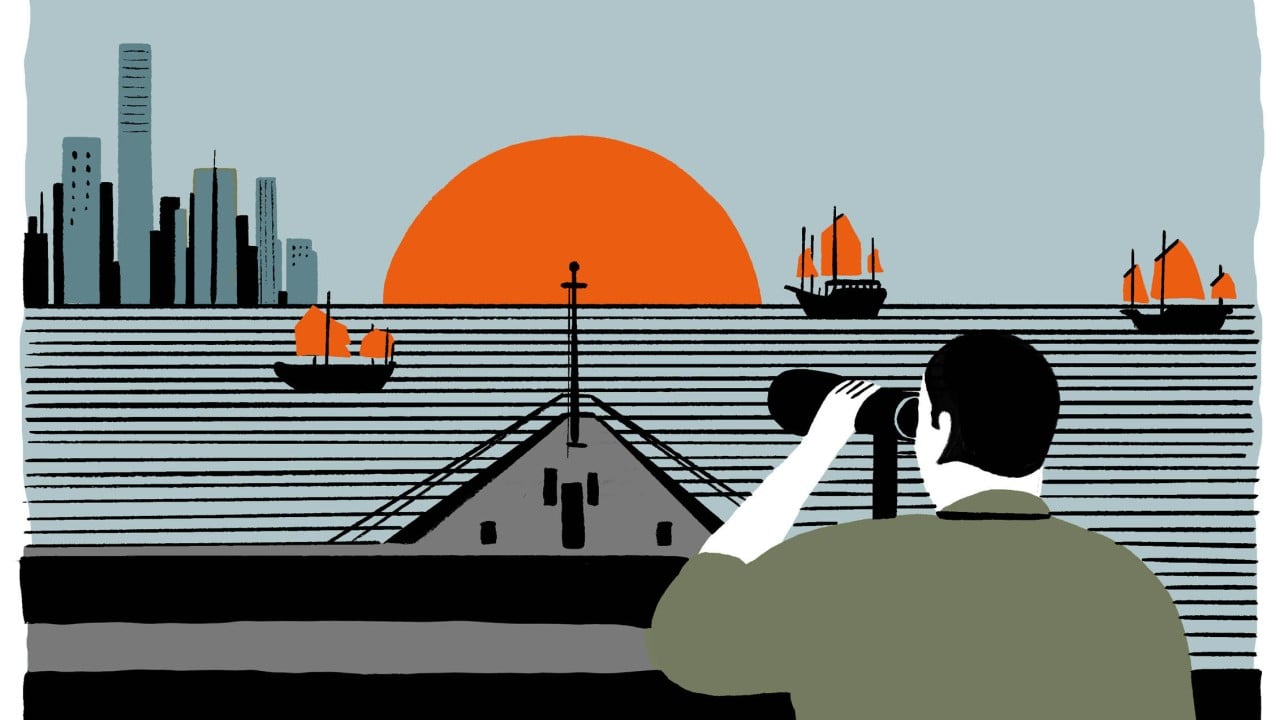
The wood of the Star Ferry still smells of diesel, salt water, and sixty years of wet paint. If you sit on the lower deck, right by the vibrating engine room, you can hear the identical heavy thud that passengers heard in 1972, 1997, and yesterday. It is a comforting sound. For a few cents, it offers the illusion that nothing changes, that the city rising on either side of Victoria Harbour is an eternal monument to perpetual success.
But if you look closely at the green-and-white vessel as it bumps against the Tsim Sha Tsui pier, you notice the ropes are frayed. The passengers are fewer. The tourists are taking photos of a skyline that looks magnificent from a distance, but up close, tells a far more complicated story.
My uncle, Wah, worked in the shipping offices near Connaught Road for forty-two years. He still carries a physical leather-bound ledger in his breast pocket. He refuses to use a digital calendar. To Wah, the golden age of Hong Kong is not a memory; it is a permanent template of how the world should work. He speaks of the 1980s as if they occurred last Tuesday. He remembers when the colony was the undisputed middleman of Asia, the gatekeeper to a closed continent, and the manufacturing engine of cheap toys and high-grade textiles.
"We were the only game in town," he tells me over dim sum in a noisy hall where the waiters still yell out the names of steamed dumplings. "Everyone had to pass through our gates. We had the deep harbor. We had the English common law. We had the drive."
He is right. They did.
But the gates have been wide open for a very long time now, and the world has learned to walk right past the gatekeeper.
The Mirage of the Middleman
The tragedy of modern Hong Kong is not that it lost its talent, its work ethic, or its beauty. Its tragedy is that it became hopelessly, fatally enamored with its own history.
For decades, the city operated on a beautifully simple formula. It was a friction-free transition zone. If you were a Western firm wanting to sell to China, or a Chinese factory wanting to sell to Europe, you stopped in Hong Kong. You hired a local agent, opened an account at a bank with colonial sandstone pillars, and let the city take its cut. This middleman economy made Hong Kong incredibly wealthy. It created a class of tycoons who built empires on property, shipping, and utility monopolies.
But being a middleman is a temporary gig. Eventually, the buyer and the seller find a way to talk directly.
Consider the container port. In the 1990s, Kwai Tsing Container Terminals was the busiest port on the planet. Giant cranes swung twenty-four hours a day, stacking metal boxes like colorful Lego bricks. Today, Kwai Tsing is quiet. It has slid down the global rankings, overtaken not just by Singapore, but by the neighboring ports of Shenzhen, Ningbo, and Guangzhou.
Why pay Hong Kong’s high handling fees and trucking costs when a factory in Dongguan can truck its goods straight to Shenzhen’s Yantian port for a fraction of the price?
Wah looks at these declining numbers and blames politics. He blames the pandemic. He blames the rising costs of labor. He blames everything except the one uncomfortable truth: the world simply does not need a middleman the way it used to. The direct shipping routes, the digitization of customs, and the modernization of mainland ports have bypassed the harbor entirely.
To survive, a city cannot merely be a transit lounge. It has to create something of its own.
The Concrete Ceiling
Let us look at another part of the myth: the real estate gold rush.
Every resident of this city knows the property ladder is not just an investment; it is a religion. For fifty years, the recipe for wealth was simple: buy four walls, wait five years, sell them to someone more desperate than you, and buy eight walls. The government funded its low-tax regime by selling land to a handful of massive conglomerates. These developers built towers of micro-flats—tiny apartments the size of a parking space—and sold them at prices that required young couples to sign away thirty years of their lives.
My cousin, Cherry, represents the generation that inherited this system. She is thirty-four, sharp, and holds a master’s degree in artificial intelligence. She does not want to buy a micro-flat.
"Why would I spend eighty percent of my salary to live in a concrete box where I can touch both walls at the same time?" she asks. "My friends in Shenzhen are renting modern lofts for a third of the price and spending the rest of their money on building their companies."
Cherry tried to launch a logistics startup four years ago. She designed an algorithmic system to optimize regional supply chains, hoping to modernize the very industry her uncle Wah worked in. She went to local venture funds, most of which are run by the sons and grandsons of the old real estate tycoons.
The meetings were polite, but useless.
"They didn't understand the software," Cherry says, stirring her cold milk tea. "They kept asking me what my physical assets were. They wanted to know if I owned any warehouses or office space that could be used as collateral. They are still thinking like landlords in 1974. They don't want to invest in ideas. They want to invest in brick, mortar, and rent."
Stymied by the lack of local support, Cherry eventually moved her primary operations across the border to Nanshan, a high-tech district in Shenzhen. There, she found an ecosystem where capital was willing to take risks on intangible intellectual property. She is still a Hong Konger at heart, but her economic reality is now tied to a city that barely existed when her uncle was her age.
This is the quiet brain drain that does not show up in the migration statistics. It is the departure of ambition.
The Trap of Yesterday's Playbook
There is a psychological comfort in looking backward. When a society faces a highly uncertain future, its natural instinct is to retreat into the stories that once made it feel safe.
In Hong Kong, this manifests as an obsession with preserving the aesthetics of the past. We mourn the loss of the giant neon signs that once hung over Nathan Road like glowing electric dragons. We romanticize the dark, smoky noodle stalls in Mong Kok. We write endless essays about the cinematic glory of Wong Kar-wai films and the golden age of Cantopop.
These cultural artifacts are beautiful, and they deserve to be remembered. But a living city cannot survive as a museum of its own youth.
While Hong Kong was busy reminiscing, the cities around it were busy building the future.
- Shenzhen transformed from a fishing village of 30,000 people into a global hardware capital of 17 million, housing giants like Tencent, DJI, and BYD.
- Singapore diversified its economy, aggressively courting biotechnology, green finance, and regional corporate headquarters by offering long-term stability and forward-looking regulations.
- Shanghai rebuilt its financial district from marshland into a towering center of gravity for global capital.
Hong Kong looked at these developments and assumed its historical advantages—its low taxes, its free flow of capital, its strategic location—would protect it forever. They were wrong. Those advantages are no longer unique selling points; they are the baseline requirements for entering the game.
The city’s economic foundation remains heavily reliant on four traditional pillars: financial services, tourism, trading and logistics, and professional services. Together, they represent a structure designed for a world that has already disappeared.
The Real Risk of Playing It Safe
It is easy to blame external forces for this stagnation. We can point to geopolitical tensions, changing global trade alignments, or shifting regulatory frameworks. But the deepest threat to Hong Kong is internal. It is a profound, systemic risk aversion.
When the old tycoons made their fortunes in the mid-twentieth century, they were gamblers. They came to this barren rock with nothing but the clothes on their backs, took immense risks, and built something out of nothing. But wealth has a way of turning pioneers into preservationists. The descendants of those pioneers are now focused entirely on risk mitigation and wealth preservation.
They have created a corporate culture where making a mistake is far more dangerous than doing nothing at all.
If you walk through the office towers of Central, you will find thousands of brilliant young minds spending their days drafting compliance reports, preparing slides for risk-assessment committees, and ensuring they do not violate any internal guidelines. They are incredibly smart, highly educated, and entirely unproductive in terms of genuine innovation. They are paid handsomely to keep the machine running, even as the tracks ahead of the machine are running out.
We have built a system that punishes the very trait that made us great in the first place: audacity.
The View from the Peak
Last week, I took the Peak Tram up the steep slope of Mount Austin. Like the Star Ferry, the tram is an icon, recently upgraded with sleek new cars that glide smoothly along the metal tracks.
From the top, the view of the city remains spectacular. At night, the buildings light up like a thousand circuit boards planted in the dark water of the harbor. It is easy to stand up there, looking down at the glittering towers, and believe that everything is fine. The sheer density of concrete and glass suggests an unshakeable permanence.
But the light from those towers is a reflection of the sun that has already set.
If Hong Kong is to have a future that matches its past, it must stop trying to rebuild the world of 1997. It must accept that the old middleman model is dead and buried. The city cannot rely on its traditional role as a simple bridge between East and West, because both sides have built their own roads.
Instead, Hong Kong must become a place that invents. It must use its unique position—its common law system, its world-class universities, and its financial depth—to fund and develop the technologies that will define the next fifty years. It must become the place where green technology is financed, where medical breakthroughs are patented, and where new models of urban sustainability are created.
This requires more than just government funding or policy blue papers. It requires a shift in the collective imagination of the city.
It means Uncle Wah must stop looking at his old ledgers as a guide for his niece's career. It means the property tycoons must accept lower profit margins on residential blocks to allow space for research labs and creative studios. It means young people must be encouraged to fail, to build, and to try things that have no precedent in the family history books.
As I rode the tram back down the mountain, the city rushed up to meet me. The historic brick buildings of Central stood alongside the glass facades of the global banks. It is a beautiful mixture of what was and what is.
But the tram only moves forward because it is pulled by a heavy steel cable that is anchored to the top of the hill. If we keep looking back at where we started, we will eventually lose the momentum needed to reach the summit.
The past is a lovely place to visit. But you cannot live there.