The maritime choke point that feeds a massive share of the planet's daily petroleum consumption is broken. For months, the waterway separating the Persian Gulf from the Gulf of Oman has functioned as a floating shooting gallery, turning standard crude transport into a high-stakes gamble. Amid this persistent friction, a narrative has taken root in Washington and across various regional capitals that the predicament can simply be engineered away.
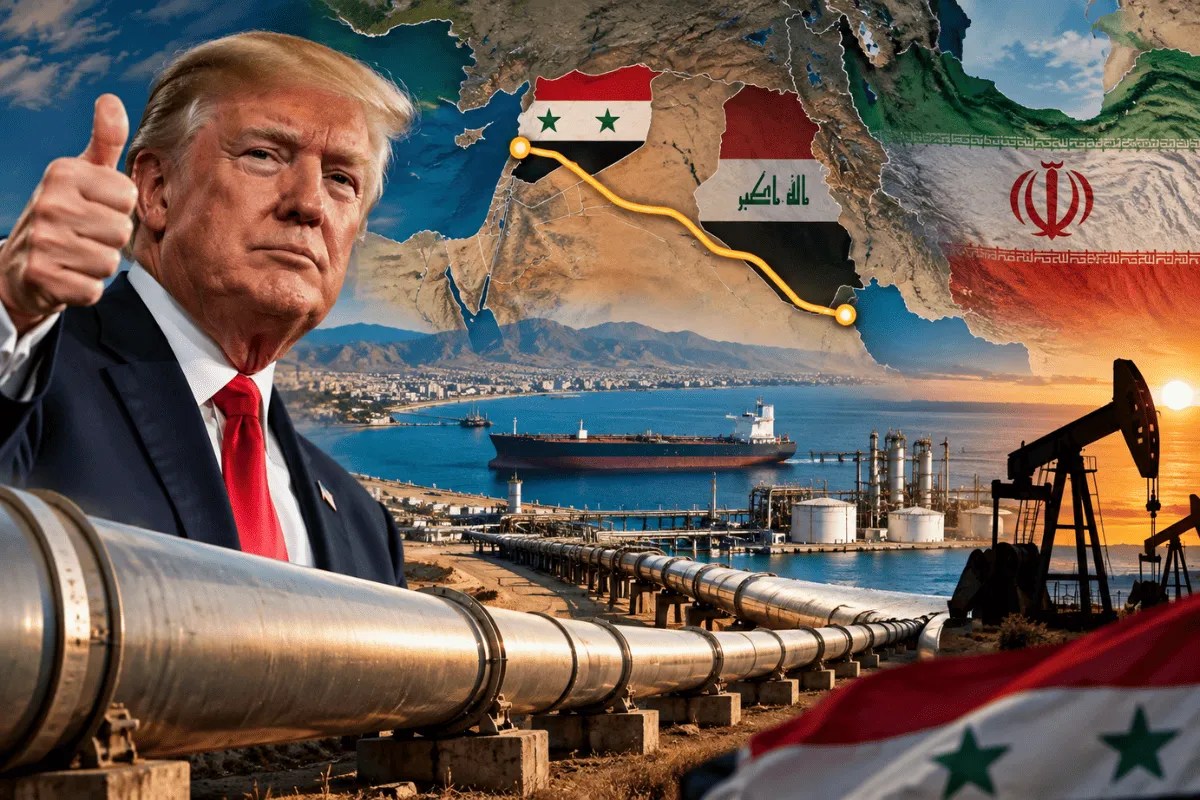
Donald Trump recently took to social media to declare it "great" that Syria is positioning itself as an overland transit corridor and a viable alternative to the Strait of Hormuz. International media quickly picked up on plans involving oil trucks rumbling across barren deserts toward the Mediterranean port of Baniyas, alongside multi-billion-dollar proposals for pipelines designed to pump millions of barrels of crude straight to Europe.
The political appeal of such a workaround is obvious. Yet, the physical, financial, and geopolitical reality of turning Syria into an energy superhighway reveals a staggering chasm between executive optimism and on-the-ground engineering.
To understand why this proposed workaround faces insurmountable odds, one must look closely at the sheer volume of material moving through the contested maritime bottleneck during normal periods. Roughly a fifth of the world's liquefied natural gas and a quarter of seaborne oil trade historically traverse this narrow marine trench daily. Replacing that massive flow via overland trucking or unbuilt pipeline networks is an administrative and logistical fantasy in the near term.
Consider the trucking operations currently touted as a primary proof-of-concept. Thousands of heavy-duty vehicles snake day and night across harsh desert terrain from southern Iraqi refineries toward the Syrian coast. It is a slow, expensive, and thermodynamically inefficient substitute for supertankers. A single modern crude carrier can haul more petroleum than thousands of individual highway trucks could manage over weeks of continuous driving, exposing the stark inadequacy of road transport to handle macro-level market demands.
Proponents of the alternative corridor point eagerly toward grand pipeline blueprints. Talks are underway involving major multinational energy firms to resurrect and expand transit lines linking the oilfields of northern and southern Iraq to Mediterranean export terminals. A revived pipeline corridor could theoretically shift vast quantities of crude away from the volatile Persian Gulf waters.
However, building or restoring these arteries requires years of intensive construction, immense capital outlays stretching past fifteen billion dollars, and absolute regional stability. In a war-scarred landscape where state control remains fractured and insurgent sleeper cells routinely target infrastructure, laying thousands of miles of steel pipe across disputed territory is an invitation to continuous sabotage. No major energy corporation will commit permanent billions to a transit corridor without airtight security guarantees that local militias cannot easily provide.
Even if the engineering hurdles were miraculously cleared overnight, the geopolitical geography remains hostile. Syria under its current transitional administration is attempting a desperate rehabilitation on the global stage, seeking foreign investment and normalization by offering its geographic positioning as a strategic asset. Leveraging Mediterranean access looks good on paper, but internal security is fragile, and regional rivalries run deep. Neighboring states that once channeled their exports through different paths view these sudden transit ambitions with deep suspicion.
The rush to find a silver bullet exposes a fundamental misunderstanding of energy markets. Choke points like the Strait of Hormuz are not structural design flaws that can simply be bypassed with a stroke of a pen or an enthusiastic social media post. They are the organic result of geography, where centuries of infrastructure investment concentrated extraction points directly adjacent to the cheapest available maritime exits.
Efforts to circumvent these realities usually substitute one vulnerability for another. Shifting crude overland places reliance entirely on the goodwill and internal stability of unstable transit nations, trading maritime exposure for land-based sabotage risks. As long as global consumption depends on Persian Gulf fields, no amount of desert trucking or distant pipeline promises will dissolve the strategic weight of the world's most contested passage.