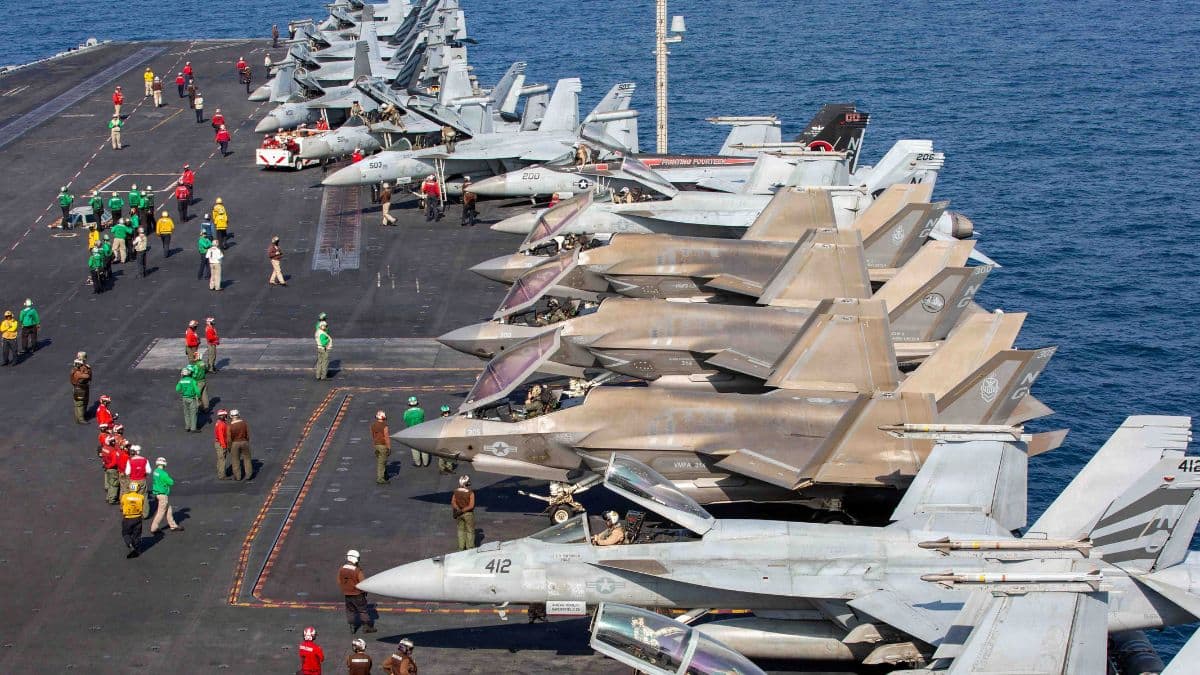
The media is currently hyperventilating over a spreadsheet that doesn't exist. You’ve seen the headlines: "The Trillion Dollar Mistake," "The Economic Collapse of the West," and "Trump’s Expensive Gamble." They point to the $2,000,000,000,000 spent in Iraq and Afghanistan as a crystal ball for the current kinetic operations in Tehran.
They are wrong. Dead wrong.
The "lazy consensus" assumes that every Middle Eastern conflict is a quagmire designed to drain the American treasury. This view fails to account for the fundamental shift in how war is prosecuted in 2026. We are no longer in the business of nation-building, "hearts and minds," or boots-on-the-ground occupation. This is a surgical decapitation of a regime that has spent decades acting as a tax on global trade.
If you want to know the real cost of a war with Iran, you have to stop looking at the Pentagon’s outflow and start looking at the global economy’s bottleneck.
The Sunk Cost Fallacy of "Maximum Pressure"
Critics argue that the $779 million spent in the first 24 hours of the February 28 strikes is a sign of fiscal ruin. This is amateur-hour accounting. That money was already spent. The Tomahawk missiles (roughly $2 million apiece) and the flight hours for the F-35s were budgeted years ago. The personnel are on salary regardless of whether they are sitting in a barracks in Norfolk or launching sorties from the Persian Gulf.
The real fiscal story isn't the cost of the bombs; it’s the removal of the "Iran Discount." For forty years, the global market has paid a hidden tax on every barrel of oil and every shipping container passing through the region due to the threat of Iranian proxy interference.
Imagine a scenario where the Strait of Hormuz is no longer a hostage-taking theater for the IRGC.
By neutralizing the clerical regime’s ability to harass the 20% of the world’s oil supply that flows through that 21-mile-wide neck of water, the U.S. isn't "spending" money—it is performing a massive, one-time maintenance fee on the global supply chain.
The Oil Price Hysteria is Mathematically Flawed
The "experts" at the big banks are warning of $120 oil. They cite the 6.3% jump to $71.23 as the beginning of the end. Let’s look at the actual data.
In 2025, the global oil market was already oversupplied by nearly 1.5 million barrels per day. The U.S. is now the world’s largest producer, pumping out over 13 million barrels per day. Unlike the 1970s, the West is no longer at the mercy of a single regional hegemon.
- Strategic Pipeline Redundancy: Saudi Arabia and the UAE have already built the East-West and ADCOP pipelines. These can bypass the Strait of Hormuz and move over 6 million barrels per day directly to the Red Sea and the Gulf of Oman.
- The "Rocket and Feather" Effect: Gas prices spike on fear (the rocket) and drift down on reality (the feather). If the conflict stays kinetic for less than 60 days—as most projections for a decapitation strike suggest—the "war premium" on gas will evaporate before the next quarterly earnings reports.
- The China Factor: Iran’s biggest customer is Beijing. By disrupting Iranian exports, the U.S. isn't hurting its own economy; it is forcing its primary geopolitical rival to pay $15 more per barrel on the spot market.
War is expensive, but uncertainty is pricier. A resolved conflict, even a violent one, provides the market with a "floor." An indefinite "Cold War" with a nuclear-threshold Iran provides only a "ceiling."
Why the "Trillion Dollar" Comparison Fails
The competitor article you read probably compared this to Iraq. It’s a false equivalence.
Iraq was an exercise in occupational friction. We tried to build a democracy in the sand using 150,000 soldiers and a mountain of cash. The 2026 model of conflict is structural demolition.
The U.S. and Israel have already eliminated the Supreme Leader and forty top officials in a single week. There is no plan for a "Green Zone" in Tehran. There are no plans to pave roads in Isfahan. The "cost" of this war is being borne by the Iranian regime’s infrastructure, while the U.S. military-industrial complex is essentially conducting a live-fire audit of its inventory.
The Hidden ROI: Defense Tech Validation
From a business perspective, this conflict is the ultimate showroom. Every time a $4 million Patriot interceptor knocks down an Iranian drone, the stock value of the manufacturer isn't just rising—the global demand for that tech is solidified.
- Poland, Germany, and Taiwan are watching.
- The "Battle-Proven" Label adds a 20% premium to defense exports.
- Data Acquisition: The U.S. is currently collecting more electronic intelligence (ELINT) on Russian and Chinese-made radar systems used by Iran than ten years of simulation could provide.
This isn't "spending." It’s R&D in a live environment.
The Brutal Reality of the "Groceries" Argument
Pundits love to say, "The President should be worried about the price of groceries, not a war." This is the peak of economic illiteracy.
Groceries are expensive because of energy and shipping costs. Shipping costs are high because of insurance premiums. Insurance premiums are high because of... (wait for it)... regional instability in the Middle East.
If this operation results in the permanent degradation of the Houthi supply lines and the IRGC's naval harassment capabilities, the long-term cost of shipping a container from Shanghai to Rotterdam will drop. You don't fix inflation by ignoring the pirates; you fix it by sinking their fleet.
The Risk Nobody Admits
Is there a downside? Of course. The risk isn't the fiscal cost to the U.S. Treasury. The risk is the Fragility of the Global Interdependence.
If Qatar suspends LNG production for more than 90 days, Europe freezes. But notice the actor there: Qatar. The cost is externalized. The U.S. is energy independent. The U.S. is geographically isolated. The U.S. is the only player in this game that can afford to break the board and still have a seat at the next table.
Stop asking how much the war will cost. Start asking how much the status quo was costing you every time you filled up your tank over the last decade. The bill for forty years of "strategic patience" has finally come due. Paying it now, in a lump sum of high-explosives, is actually the fiscally responsible move.
Would you like me to analyze the specific impact on the S&P 500's energy sector versus the defense sector following the February 28 strikes?