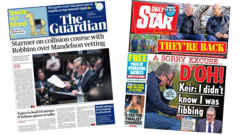
The British press is currently obsessed with the narrative of "collision courses." They look at Keir Starmer, look at the protesting unions or the restless backbenchers, and see a disaster in slow motion. They see a Prime Minister "accidentally" stumbling into fibs or losing control of the room.
They are wrong. They are misreading the basic physics of power.
In Westminster, a "collision" isn't a sign of failure; it’s a tool of branding. If you aren't colliding with someone, you aren't moving. The media’s lazy consensus—that a harmonious party is a strong party—is a relic of an era that died decades ago. Stability is the mask; calculated conflict is the engine.
The False Premise of the "Accidental" Fib
The headlines are screaming about Starmer’s shifting positions, framing them as a lack of integrity or a series of "I didn't know" moments. This is the first great misconception. In high-level politics, nobody "stumbles" into a contradiction.
Strategic ambiguity is a feature, not a bug.
When a leader says they "didn't know" they were "fibbing," the press treats it as a character flaw. It isn't. It’s a clearance operation. By feigning ignorance or framing a pivot as a discovery of "new economic realities," a leader kills off old baggage without having to apologize for it. Apologies create blood in the water. Ignorance creates a shield.
The media focuses on the morality of the flip-flop. The strategist focuses on the utility. If Starmer had stuck to every 2020 pledge, he would be unelectable today. The "collision" with his former self is a deliberate signal to the center-right that the old version of the party is dead.
Why the Collision Course is the Goal
Every time you see a headline about Starmer being on a "collision course" with the left wing of his party, understand that his team is likely popping champagne.
In the eyes of the swing voter, the best thing a Labour leader can do is be hated by the "wrong" people. Tony Blair understood this deeply. You don't gain credibility by convincing your base; you gain it by defying them.
The current friction over fiscal rules and spending isn't a crisis of management. It’s a staged demonstration of "Iron Discipline." If the Chancellor doesn't make someone cry, the markets don't believe the budget is real.
The Geometry of Political Power
Imagine a triangle of power:
- The Core Base (The activists)
- The Swing Voter (The undecideds)
- The Institutional Power (Markets and Civil Service)
The media spends 90% of its time interviewing the Core Base to see if they are happy. They never are. But the Swing Voter only cares about whether the leader looks like they can control the Core Base. Therefore, the collision is the proof of leadership. If Starmer isn't fighting his own party, he looks weak to the only people who actually decide elections.
The Financial Reality the Press Ignores
The "collision" over the economy is often framed as a choice between "cruelty" and "compassion." This is a primary school level of analysis.
The UK is currently operating within a fiscal straitjacket that the press refuses to explain properly. We are dealing with a debt-to-GDP ratio that makes the 2008 era look like a period of wild surplus.
| Metric | 2008 Context | Current Reality |
|---|---|---|
| Debt-to-GDP | ~35-40% | ~90-100% |
| Interest Payments | Manageable | Third largest government department |
| Demographics | Younger workforce | Aging, high-cost population |
When the papers talk about Starmer "colliding" with his promises to invest, they ignore the fact that the cost of borrowing is no longer near zero. You cannot "spend your way to growth" when your interest payments are eating the schools and hospitals you're trying to build.
The "collision" isn't with an ideology; it’s with a spreadsheet. But "Prime Minister Follows Basic Math" doesn't sell papers. "Starmer on Collision Course with Unions" does.
The Performance of the "Clueless" Leader
The "I didn't know I was fibbing" narrative serves a second, more cynical purpose. It lowers the bar.
If the public believes a leader is slightly incompetent or prone to "misspeaking," they stop looking for malice. It is the Boris Johnson maneuver, repurposed for a man in a better suit. If you are "boring and slightly confused," people stop fearing you have a secret radical agenda.
It is a sedative.
While the press is busy fact-checking a trivial comment from three years ago, the real work of shifting the state’s architecture happens in the background. The media is looking at the magician’s waving hand (the "fib") while the other hand is rearranging the deck.
Stop Asking if They Are Lying
The most common question in the "People Also Ask" section of any political search is some variation of "Is [Leader] lying about [Policy]?"
This is the wrong question. It assumes that a political policy is a static truth. It isn't. A policy is a temporary agreement between competing interests that lasts until the environment changes.
Instead of asking if they are lying, ask: "Who benefits from this specific change in direction?"
If Starmer pivots on green energy spending, don't look for the lie. Look at the bond yields. Look at the institutional investors who signaled they wouldn't back the debt. The "collision" with the green wing of the party is just the price of admission to the global financial markets.
The High Cost of Harmony
I’ve seen organizations—both in the public and private sector—die because they feared "collision." They prioritized consensus over clarity.
When a leader tries to keep everyone happy, they end up with a diluted, grey-sludge strategy that satisfies no one and solves nothing. A leader who isn't on a collision course is a leader who is standing still.
The friction you see in the headlines is the sound of the gears finally grinding. It’s uncomfortable. It’s noisy. It looks messy on a front page. But it’s the only way a massive, rusted machine like the UK government actually changes direction.
The Journalism of Distraction
The papers focus on the "spat" because it’s easy to write. It has characters, conflict, and a clear "winner" and "loser."
What they miss is the structural reality. The UK is currently a country where the state is too small to provide the services people expect, but the tax burden is too high for the economy to grow. That is the real collision. It’s a collision between public expectation and physical reality.
Everything else—the "fibs," the backbench grumbling, the "collision courses"—is just theater designed to distract us from the fact that no one has a painless way out of that trap.
Starmer isn't "colliding" with his party; he’s using the party as a crumple zone to protect himself from the impact of the economic reality he’s about to hit.
The next time you see a headline about a "government in crisis" because of internal friction, remember: the friction is the only thing proving the wheels are turning.
The collision is the strategy.
Stop reading the play-by-play and start looking at the scoreboard. The game isn't about being "honest" or "unified." It's about surviving the contact.
If you want a leader who never changes their mind, never "fibs," and never clashes with their base, you’re looking for a statue, not a Prime Minister. Statues are great for pigeons, but they’re terrible at running a country.
The mess is the point. The conflict is the proof of life.
Stop looking for a clean narrative in a dirty business.