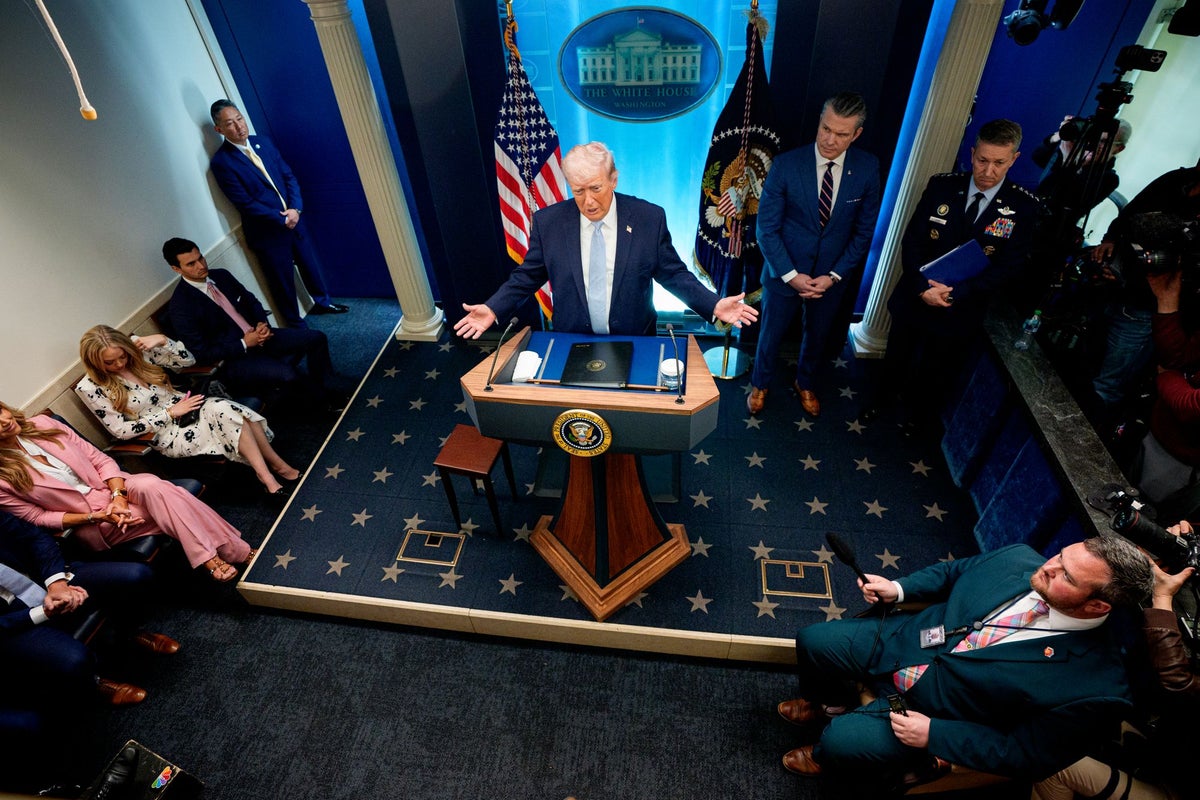
The pundits are wringing their hands over whether we are "winding down" or "ratcheting up" conflict with Iran. They point to the White House’s apparent indecision as a sign of weakness or a lack of coherent strategy. They are looking at the chessboard upside down.
This isn’t a failure of policy. It is the policy.
The media loves a binary. They want a "Big Bang"—either a grand diplomatic reset or a total kinetic war. They treat the current state of "managed chaos" as a bug in the system. In reality, the state of perpetual, low-boil tension is the most profitable and stable outcome for the military-industrial complex and the global energy markets. If you think the goal is a resolution, you don’t understand how power functions in the 21st century.
The Illusion of the Unpredictable Leader
The prevailing narrative suggests that because Trump—or any sitting president—claims not to know where the conflict is headed, the situation is spinning out of control. This is a fundamental misunderstanding of Strategic Ambiguity.
In game theory, specifically within the framework of a Nash Equilibrium, if your opponent knows exactly what your red lines are, they will push right up to the millimeter before that line. By maintaining a public persona of "I don’t even know what I’m doing," a leader forces the adversary to calculate for the worst-case scenario. This isn't confusion; it’s a tax on the enemy's decision-making process.
I’ve sat in rooms where "uncertainty" was the most effective tool on the table. When the market doesn't know if a strike is coming, risk premiums stay high. When Tehran doesn't know if a tweet will turn into a Tomahawk missile, they hesitate. The "not knowing" is the leverage.
The False Premise of the "Total War" Threat
Let’s dismantle the biggest lie in the competitor’s piece: the idea that we are on the "brink" of a war that neither side wants.
The United States and Iran have been in a "Cold War" since 1979. We aren't on a path to a new war; we are simply in the 47th year of the current one. The "escalation" everyone fears is actually a series of calibrated, symmetrical strikes designed to maintain the status quo.
Consider the mechanics of the 2020 Soleimani strike and the subsequent Iranian response. It was a choreographed dance. Iran gave plenty of warning before its missile counter-strike on Al-Asad Airbase, ensuring minimal American casualties while allowing the regime to save face domestically. Both sides used the "threat of war" to solidify internal power without ever intending to cross the threshold of a full-scale invasion.
A full-scale war is bad for business. It destroys the very infrastructure—the oil refineries, the shipping lanes, the regional hubs—that makes the Middle East valuable. The goal is never to own the rubble; the goal is to control the flow.
Why the "Maximum Pressure" Narrative Is Flawed
Mainstream analysis suggests that sanctions are a means to bring Iran to the negotiating table for a "better deal." That’s a fairy tale for the voters.
Sanctions are not a bridge to a deal; they are a permanent containment wall. They serve a dual purpose:
- They decouple Iran from the global financial system, preventing a regional power from becoming a global economic competitor.
- They create a "shadow economy" that benefits specific players who specialize in sanctions-busting, often with the tacit knowledge of Western intelligence agencies.
If you think the goal is to fix Iran’s behavior, you’re missing the point. The goal is to make Iran’s behavior irrelevant to the global bottom line. By keeping them "in a box," the U.S. ensures that regional allies like Saudi Arabia and the UAE remain dependent on American hardware and security guarantees.
The Energy Racket
The "war scare" is the greatest subsidy the oil industry ever received. Every time a tanker is harassed in the Strait of Hormuz, the price of Brent Crude spikes.
Look at the data. The correlation between "Iranian tension" and domestic shale profitability is undeniable. We don’t need Iranian oil; we need the fear of losing Middle Eastern oil to keep prices high enough to make expensive American extraction methods viable.
If peace actually broke out tomorrow—if Iran was fully integrated into the world market and started pumping 4 million barrels a day without restriction—the global price of oil would crater. The Texas oil patch would go dark. The "instability" that journalists bemoan is actually the heartbeat of the energy sector.
The "People Also Ask" Delusions
Q: Is Iran a nuclear threat?
Brutally honest answer: A nuclear-capable Iran is more useful to the West than a disarmed Iran. As long as the "threat" exists, the U.S. has a permanent justification for its military footprint in the region. The moment Iran actually builds a bomb, the game changes. The moment they give it up entirely, the game ends. The sweet spot is the "threshold"—always five minutes away from a breakout.
Q: Why doesn't the U.S. just invade?
Because we learned our lesson in Iraq. You don't need to occupy a country to neutralize it. You just need to keep its currency in the trash and its leaders looking over their shoulders. Occupation is expensive and politically toxic. Containment is cheap and sustainable.
The Strategy of Permanent Friction
We have entered the era of "Gray Zone" warfare. This isn't about winning or losing. It's about maintaining a level of friction that justifies budgets, stabilizes prices, and keeps the domestic populace focused on a foreign "other."
The competitor’s article asks if we are winding down or ratcheting up. The answer is neither. We are idling. We are keeping the engine running in neutral, occasionally revving it to see the smoke, but never putting it into gear.
Stop looking for a resolution. There is no "endgame" because the game itself is the prize. The uncertainty that Trump admits to, or that any future president will mimic, is the armor that protects the underlying interests.
The next time you see a headline about "imminent conflict" in the Persian Gulf, don't look at the troop movements. Look at the defense stock tickers and the price of a barrel of oil. The tension isn't a sign that the system is breaking; it's proof that the system is working exactly as intended.
You aren't watching a war film. You're watching a balance sheet.
Accept the friction. Stop waiting for the fire. The smoke is all they need.


